The big drones are moving. While small FPV quadcopters dominate the headlines out of Ukraine, 2026 is shaping up as one of the busiest delivery years on record for the aircraft at the opposite end of the size spectrum: medium-altitude long-endurance (MALE) and high-altitude long-endurance (HALE) unmanned aircraft, the large, long-legged platforms that do the unglamorous work of watching oceans, borders, and battlefields for 24 hours at a stretch.
Four industrial ecosystems are shipping aircraft this year — American, Turkish, Chinese, and Israeli — while Europe's homegrown alternative continues to slip further into the next decade. This roundup tracks who is actually delivering what, to whom, and in what quantities, based on manufacturer announcements, government statements, and defense-press reporting through mid-2026.
Where the Lines Sit
MALE platforms — think MQ-9 Reaper, Bayraktar Akinci, Wing Loong II, Heron Mk II — typically operate between roughly 10,000 and 50,000 feet with endurance measured in tens of hours. HALE aircraft such as the RQ-4 Global Hawk and MQ-4C Triton cruise above 50,000 feet on missions that can exceed a full day. Both fall into Group 5 of the Pentagon's UAS classification system — over 1,320 pounds, above 18,000 feet. What follows is organized by who builds them.
General Atomics: The MQ-9B Wave Crests
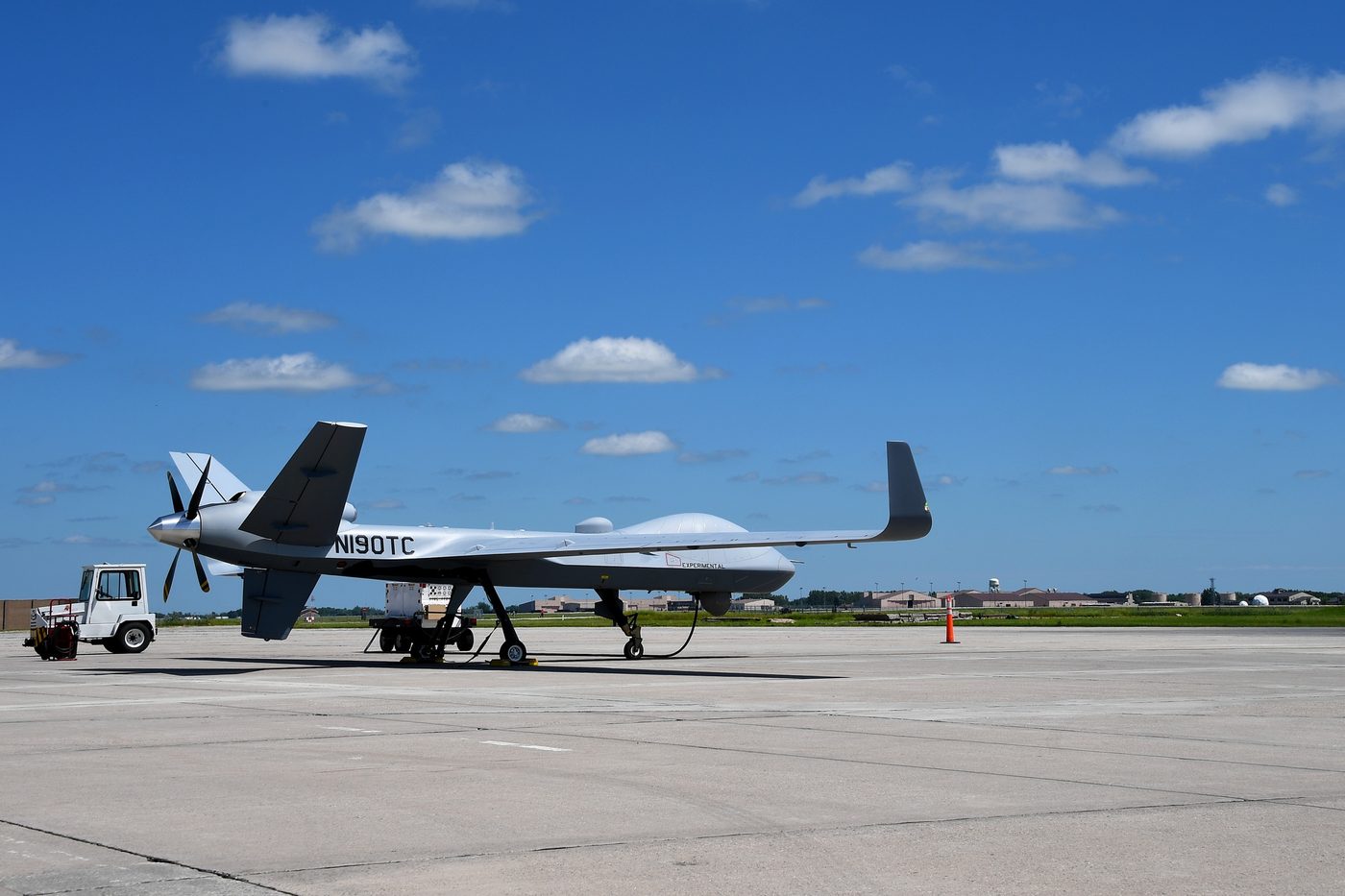
General Atomics Aeronautical Systems' MQ-9B — sold as the SkyGuardian and its maritime SeaGuardian sibling — is in the middle of its largest delivery push since the type was introduced. Per GA-ASI's January 2026 announcement of the German order, the customer list now spans Belgium, Canada, Denmark, Germany, India, Japan, Poland, Taiwan, and the U.S. Air Force — plus the United Kingdom, whose Protector fleet is a certified MQ-9B variant.
Belgium became the newest operating nation in 2025. The first of four MQ-9B SkyGuardians ordered by Belgian Defence arrived at Florennes Air Base in August 2025 and made its first flight in Belgian airspace on September 23, 2025, according to GA-ASI. "This event ushers in a new era of information dominance for Belgium," GA-ASI CEO Linden Blue said at the time.
The United Kingdom is flying its aircraft but still chasing a milestone. The RAF's Protector RG Mk1 — the certified British MQ-9B variant based at RAF Waddington — has already deployed operationally and is providing intelligence, surveillance, and reconnaissance support. Yet as of late January 2026, defence minister Luke Pollard confirmed the fleet had still not formally reached Initial Operating Capability, a milestone originally expected in 2025, and no Full Operating Capability date had been set, per UK Defence Journal.
Japan is quietly building one of the largest civil-agency MALE fleets in the world. The Japan Coast Guard operates three MQ-9B SeaGuardians — initially leased, since purchased outright — from Kitakyushu Airport, flying missions that include monitoring around the Senkaku Islands. Two more aircraft were scheduled for deployment by March 2026, four additional airframes were requested in the fiscal 2026 budget, and the service plans to reach nine MQ-9Bs by fiscal 2028, all owned rather than leased, according to Naval News.
India signed the largest single MQ-9B order on the books in October 2024: 31 aircraft worth roughly Rs 32,000 crore (about $3.5 billion), split as 15 SeaGuardians for the Indian Navy and eight SkyGuardians each for the Air Force and Army, with a maintenance, repair, and overhaul facility to be established in-country, per India's state-run DD News. General Atomics chief executive Vivek Lall told Bharat Shakti in 2025 that ten aircraft will be delivered in flyaway condition and the remaining 21 assembled in India, with a three-year delivery deadline — though, as Lall noted, the government-to-government agreement governs exactly when deliveries happen.
Poland signed for three MQ-9B SkyGuardians plus two Certifiable Ground Control Stations in December 2024, graduating from the MQ-9A Reapers it has leased since 2022. Germany became the newest customer on January 12, 2026, ordering eight SeaGuardians with four ground control stations through the NATO Support and Procurement Agency — though first delivery is not expected until 2028, per GA-ASI.
HALE: Triton Goes NATO
At the high-altitude end, the story of 2026 is Northrop Grumman's MQ-4C Triton breaking out of its two-nation club. On July 7, 2026, at the NATO Summit's Defence Industry Forum in Ankara, Denmark, Finland, Germany, and Norway signed a letter of intent to procure up to five Tritons for maritime surveillance, as UASFeed reported and Naval News and The Defense Post detailed. "These aircraft can fly for long periods at high altitude and cover large areas, including over open water, more efficiently than most other aircraft can," NATO Secretary-General Mark Rutte said, per C4ISRNET.
This is intent rather than delivery — Northrop Grumman says it will now work with NATO and the U.S. Navy to build and deliver the aircraft, per The Defense Post. But the buyers are joining a type already flying with the U.S. Navy and the Royal Australian Air Force, which is procuring four of its own, and the new aircraft will complement NATO's existing five-unit RQ-4D Phoenix surveillance fleet, operated from Sigonella airbase in Italy, per Naval News. C4ISRNET's reporting on the announcement puts the Triton's operating profile above 50,000 feet with more than 24 hours of endurance and roughly 7,400 nautical miles of range.
Turkey: Akinci by the Hundred
No manufacturer is delivering large combat drones in greater numbers than Baykar. The company posted a record $2.2 billion in exports in 2025 — 88 percent of its $2.5 billion revenue — and held the title of world's largest armed drone exporter for a third consecutive year, per Türkiye Today. Its export agreements now cover 37 countries: 36 for the Bayraktar TB2 and 16 for the heavier Akinci.
The Akinci numbers illustrate the production tempo. As of early January 2026, Baykar had delivered 110 Akinci aircraft and stated a target of reaching 120 by the end of the year, with the type in use by 13 countries beyond the Turkish Armed Forces, according to Army Recognition, citing Turkish media reporting from Baykar's Çorlu flight training and test center. More than 2,000 pilots and technicians have been trained on the aircraft since 2021.
The TB2 pipeline keeps adding NATO members: Croatia formally inducted its six TB2s — a roughly $95 million package signed in November 2024 — into service on September 3, 2025, at a ceremony at Colonel Marko Živković Barracks in Pleso, assigning them to the 125th Fighter Reconnaissance Squadron, per The Defense Post. Baykar's jet-powered Kizilelma, meanwhile, is slated to enter Turkish inventory and begin operations in 2026.
Turkish Aerospace (TAI), Turkey's other MALE house, continued selling its Anka and Aksungur lines through 2025, and its CEO says the redesigned stealth Anka-3 will enter mass production in 2026, per Daily Sabah. The Aksungur, meanwhile, logged a 40,000-foot altitude milestone flying on the domestic TEI PD-170 engine, one of the platform achievements C4Defence highlighted in its review of Turkey's 2025 defense year.
China: From Bespoke Builds to Assembly Lines
China's delivery numbers are the hardest to pin down — Beijing does not announce export handovers — but its production posture became dramatically more visible in October 2025, when state broadcaster CCTV aired footage of Wing Loong reconnaissance-strike drones being assembled on automotive-style moving lines at a complex in Zigong, Sichuan, with reported capacity in the range of 200 aircraft per year, per Army Recognition. That industrialization sits atop an export base that, as UASFeed has detailed, saw Chinese manufacturers deliver 282 combat drones to 17 countries over the preceding decade per SIPRI data — spanning the AVIC Wing Loong family and CASC's CH (Rainbow) series. The through-line for 2026: whatever China's order book holds, the factory floor is no longer the constraint.
Israel: Heron Mk II Comes Home
Israel Aerospace Industries' Heron family has spent decades as an export mainstay, but 2026's most concrete Heron deliveries are going to its home customer. The Israeli Air Force is standing up a new squadron of roughly 20 Heron Mk II aircraft at Hatzor Airbase, with the first airframes expected from May 2026 and the squadron slated to be operational by summer, Calcalist reported in April. The outlet put the base price near $10 million per aircraft before payloads, and quoted an air force official saying UAV flight activity has increased fivefold since the October 2023 war began.
Eurodrone: The One That Isn't Shipping
Europe's answer to all of the above remains on paper. The Airbus-led, OCCAR-managed Eurodrone — contracted in February 2022 at roughly €7.1 billion for 20 systems totaling 60 aircraft and 40 control stations — was originally planned to enter service in 2025. As of July 2026, entry into service has slid beyond 2030, France has reduced its planned procurement funding, and Dassault Aviation is seeking financial compensation from Airbus amid a workshare dispute that echoes the partners' fighter-program feud, per Meta-Defense. Every year the program slips, the MQ-9B and Akinci order books above absorb more of the European demand it was designed to serve.
Why It Matters
Delivery schedules are strategy made visible. The MALE/HALE market of 2026 shows a clear four-way split: American platforms winning the allied maritime-surveillance tier, Turkey dominating the armed-drone volume market with prices and delivery speed Western primes cannot match, China converting its export niche into industrial mass, and Israel feeding a wartime home market. European governments, meanwhile, are buying from the first two because their own program cannot ship. For air arms planning procurement — and for the counter-UAS planners watching the other side of the ledger — the pattern of who takes delivery in 2026 will define who has persistent eyes over contested waters and borders well into the 2030s.
Sources
- MQ-9B SkyGuardian Flies for First Time in Belgium — GA-ASI
- Germany Buys Eight MQ-9B SeaGuardian RPA Through NSPA — General Atomics
- Poland To Acquire Three MQ-9B SkyGuardians From GA-ASI — GA-ASI
- Protector drone still short of IOC despite deployment — UK Defence Journal
- Japan Coast Guard to acquire four additional unmanned aircraft — Naval News
- India, US sign deal worth Rs 32,000 crore for buying 31 MQ-9B drones — DD News
- India To Assemble 21 MQ-9B Predator Drones: Vivek Lall — Bharat Shakti
- NATO to add up to five Northrop Grumman Triton drones for maritime surveillance — C4ISRNET
- Four NATO Allies to Procure Up to Five MQ-4C Triton HALE UAVs — Naval News
- NATO Eyes Northrop Grumman's MQ-4C Triton Drone for Maritime ISR — The Defense Post
- Baykar sets $2.2B export record; Kizilelma to enter inventory in 2026 — Türkiye Today
- Türkiye's Baykar Ramps Up Akinci Combat Drone Production Toward 120 Units by 2026 — Army Recognition
- Turkish-Made Bayraktar TB2 Military Drones Enter Service in Croatia — The Defense Post
- Türkiye's top homegrown air platforms gear up for duty — Daily Sabah
- Türkiye Defense: 2026 Vision & 2025 Analysis — C4Defence
- China Moves Wing Loong Drones Into Mass Production — Army Recognition
- Eyes on Iran: Israel expands drone fleet for the next war — Calcalist
- The Eurodrone suffers a fresh delay after industrial tensions between Airbus and Dassault Aviation — Meta-Defense