
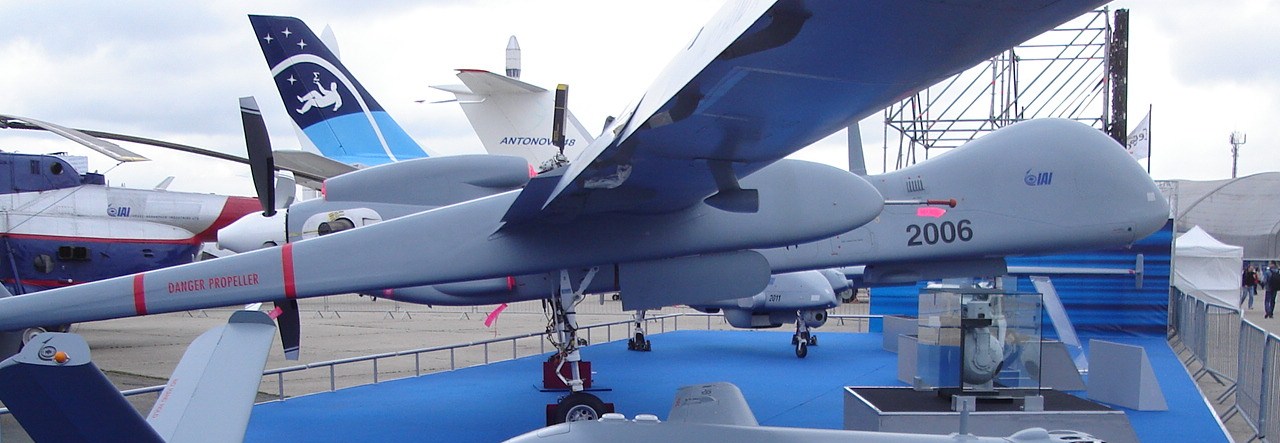
At 07:15 on October 7, 2023, as Hamas fighters tore through breached border barriers and overwhelmed divisional command posts, the first aircraft on station over Gaza wasn't a fighter jet. It was a Heron MALE drone, feeding real-time imagery to commanders who had lost situational awareness in the opening minutes. Over the weeks that followed, Herons flew continuous 24-hour orbits across Gaza, Lebanon, and maritime approaches — sustaining coverage through clouds and storms that grounded earlier-generation systems.
That performance reflects nearly five decades of continuous investment by Israel Aerospace Industries' Malat division, an arc running from a four-meter fiberglass Scout to a 26-meter turboprop that cruises at 45,000 feet for up to 70 hours at a stretch.
The Scout and the Lineage Behind It
The 1973 Yom Kippur War exposed Israeli intelligence blind spots that cost lives. Malat's response was the Scout UAV, first prototype in 1979: a 4-meter, fiberglass-and-aluminum airframe with a central EO/IR turret capable of real-time 360-degree surveillance and a radar cross-section small enough to be effectively invisible to the SAM batteries it was designed to locate.
The Scout's 1982 Lebanon War debut established the template. Israeli forces used Scouts to locate Syrian SAM installations in the Bekaa Valley and provoke active radar emissions, then fed targeting data to strike aircraft. Multiple Syrian SAM sites were destroyed in hours.
The deeper export of this expertise ran through Abraham Karem, an Iraqi-born engineer who, drawing on experience as an Israeli Air Force designer, developed the Amber drone in the United States. Amber's lineage — through acquisition and further development — produced the General Atomics MQ-1 Predator. The Economist said Karem "created the robotic plane that transformed the way modern warfare is waged." Israel held 61% of global drone exports from 1985 to 2014. By 2021, drone sales represented roughly $1 billion — 9% of Israel's $11.3 billion in total arms exports.
The Heron Family Architecture
IAI introduced the first Heron in 1994, designed for longer missions and higher altitudes than Scout-class systems. The baseline Mk I carries 1,150 kg maximum takeoff weight, an Austrian Rotax 914 turbo at 115 hp, and a 16.6-meter wingspan. Service ceiling is 10,000 meters (32,800 ft); endurance reaches up to 45 hours. Payload capacity started at 250 kg, later upgraded to 470 kg. Navigation is GPS-based with automated takeoff and landing, and communications support both line-of-sight and SATCOM data links.
The sensor suite that can be mounted treats the airframe as a modular payload bus: Northrop Grumman EO/IR, IAI Tamam Division thermal surveillance, Maritime Patrol Radar, Synthetic Aperture Radar, Ground Moving Target Indicator, Electronic Support Measures, laser designator, and an Automatic Identification System for vessel tracking. The Mk II variant upgrades to a Rotax 915 iS, raises the ceiling to 35,000 ft, extends endurance to 45 hours, and standardizes payload at 470 kg. The family also includes a Maritime Heron, the Super Heron with a heavy-fuel diesel engine, and the T-Heron for short-range tactical ground support. Collective flight hours across 50-plus global customers now exceed 2.1 million.
Heron TP (Eitan): The Turboprop Step-Change
Eitan — Hebrew for "steadfast" — first flew in 2006 (exact date disputed) and was publicly unveiled in late 2007. The Israeli Air Force inducted it with the White Eagle Squadron in February 2010. Israel operates approximately 15 aircraft.
The numbers tell the scale story: 26-meter wingspan (comparable to a regional airliner), 14-meter fuselage, 5,300–5,400 kg maximum takeoff weight. Power comes from a Pratt & Whitney Canada PT6A-67A producing 1,200 horsepower, driving a pusher-mounted four-blade propeller. Service ceiling is 45,000 feet — above most commercial air traffic. Endurance reaches 36 hours operationally; IAI has cited endurance capabilities exceeding 70 hours in lighter payload configurations. Payload capacity is 1,000 kg in most operational sourcing.
Avionics are triplex redundant, with dual automatic takeoff and landing systems for degraded airfield operations. SATCOM enables beyond-line-of-sight tasking from remote ground stations. Mission systems span EO/IR with laser range finder, SAR, ELINT/COMINT, ESM, Maritime Patrol Radar, and the M-19HD multi-sensor EO payload.
"The experience we gained in four decades of operations with more than 50 customers worldwide has shaped the ongoing evolution." — Avi Bleser, VP of Marketing and Sales, IAI
Export Footprint and Combat Record
India is the largest single customer. A $220 million contract in November 2005 covered approximately 50 Heron MALEs for border ISR with Pakistan and China. Follow-on agreements added 15 Herons (~$300 million, 2013) and 10 Heron TPs ($400 million, 2015); four additional Heron TPs were procured under emergency acquisition in February 2021. By November 2021 they were deployed in eastern Ladakh. Indian government sources confirmed to ANI: "The advanced Heron drones have arrived in the country and are being deployed for surveillance operations in the eastern Ladakh sector." India's armament integration effort — Project Cheetah — was subsequently cancelled.
Germany's 2018 deal, brokered through Airbus, covered five Heron TP systems under a nine-year lease valued at $1.17–1.2 billion total including training and support. German crews trained in Israel; first flight of a German-operated aircraft occurred in July 2020. Defense Minister Ursula von der Leyen stated the platform would "provide better protection for the soldiers on the ground" in Afghanistan and Mali. Greece operates three Heron TPs. Turkey signed a $180 million contract in 2004 for 10 Herons, integrating ASELSAN ASELFLIR-300T electro-optical systems onto their variants. Australia leased Herons for C$95 million (~$88 million USD) from 2010 to 2012, logging over 27,000 flight hours. The EU's Frontex began deploying Herons from Malta in 2021 for Mediterranean maritime patrol.
Operationally, the family has accumulated a consistent record across Gaza (Operation Cast Lead 2008–2009; Iron Swords 2023–ongoing), NATO ISR missions in Afghanistan and Mali, and Indian high-altitude surveillance. During Iron Swords, European Security & Defence noted the platform's sustained performance: "The steadfast stance of the IAF's Herons has demonstrated the agility and operational capability of the Heron family, which has been proven in decades of combat operations." All-weather day-and-night continuity — the specific capability that matters at operational command posts — was validated across a prolonged, high-intensity campaign.
The Heron that arrived over Gaza at 07:15 on October 7 was executing the same persistent surveillance role the Scout proved over the Bekaa Valley in 1982 — scaled across four decades of incremental development into a platform that does it for 70 hours at a time, from 45,000 feet, via satellite to a ground station anywhere on earth. It is one of the most widely exported MALE-class UAS platforms outside the United States.
Sources
- Airforce Technology — Heron TP (Eitan) MALE UAV
- Airforce Technology — Heron UAV
- Defense Industry Daily — Israel Sells Heron UAVs to India
- Fox News / AP — Netanyahu Hails German Approval of $1B Israel Drone Deal
- Bolt Flight — The IAI Heron: Israel's Game-Changing Eye in the Sky
- European Security & Defence — Heron UAV Impact in Iron Swords War
- Shephard Media — IAI's Heron Family in Spotlight
- Israel Defense — IAI Heron Family (IAI)
- War Wings Daily — IAI Scout UAV
- PBS NOVA — UAVs: Spies That Fly
- World Peace Foundation — Drones in the Formation and Militarization of Israel
- Middle East Forum — How Israel Became a Leader in Drone Technology
- Armed Forces EU — IAI Eitan (Heron TP)
- Eurasian Times — India Deploys Advanced Israeli-Origin Heron TP Drones Near China
- Israel Aerospace Industries — Heron MALE UAS (official product page)