
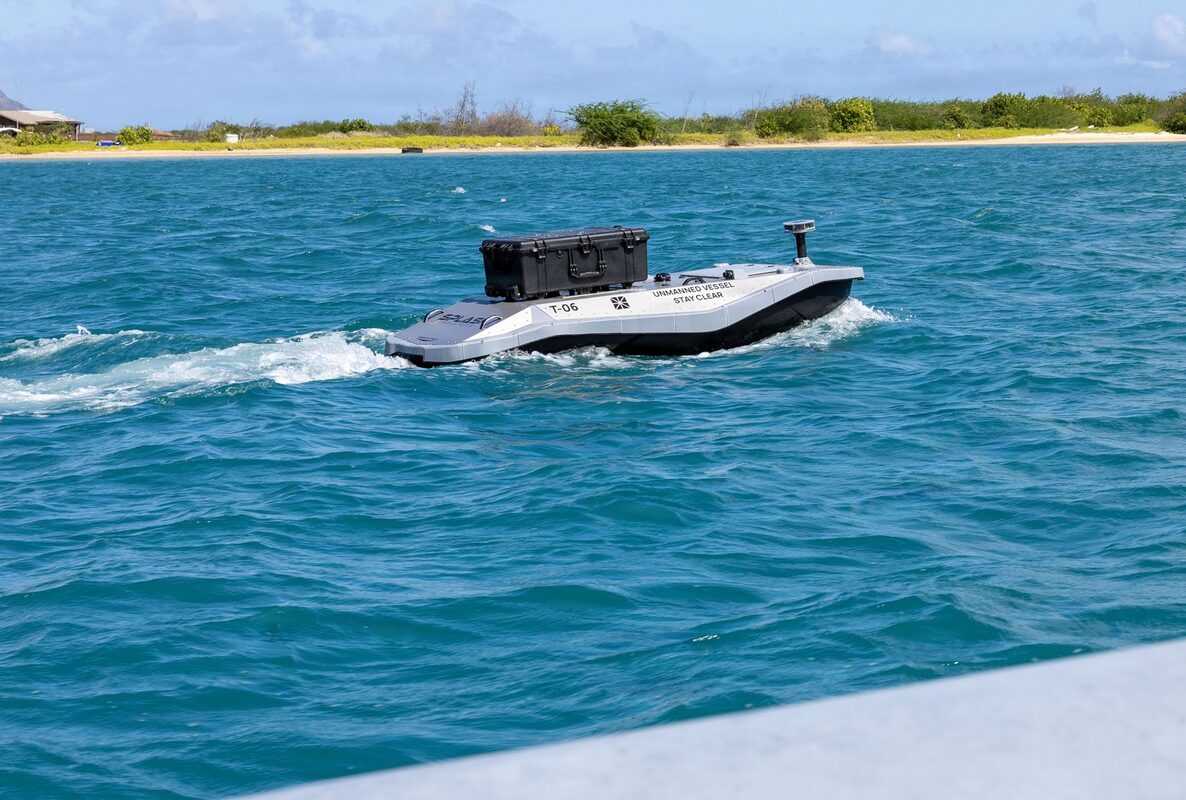
Somewhere in the deep water off Hawaii on July 17, 2026, the decommissioned amphibious assault ship ex-USS Peleliu absorbed a barrage that reads like a catalog of modern naval strike — Penguin anti-ship missiles, Hellfires, Spike NLOS, and air-launched cruise missiles. But buried in the official imagery of the sinking was something new: two U.S. Navy one-way attack unmanned surface vessels closing on the hull and detonating at the waterline. It was, by the accounts published this week, the first time kamikaze sea drones took part in a Rim of the Pacific (RIMPAC) sinking exercise.
The detail was reported by Naval News, which characterized the drones as "Ukraine-style" explosive surface craft and framed their use within the Navy's push toward attritable, autonomous surface strike. Official Department of Defense media from Commander, U.S. 3rd Fleet — distributed through DVIDS — corroborates the participation, including a b-roll clip explicitly labeled "USVs participate in RIMPAC 2026 sinking exercise." The Peleliu SINKEX, in other words, was not just a demolition drill for legacy weapons. It was a proving ground for where the Navy says it wants unmanned surface warfare to go.
What actually happened at the SINKEX
RIMPAC 2026 ran from June 24 to July 31 and, per The War Zone, drew 30 nations, more than 30 ships, five submarines, more than 200 aircraft and approximately 30,000 personnel — the largest recurring international maritime exercise in the world. Sinking exercises, or SINKEXs, are a familiar centerpiece: retired hulls are towed into deep water and used as live targets so allied forces can rehearse the full kill chain against a full-size ship.
Two decommissioned vessels went down this year. The Ticonderoga-class guided-missile cruiser ex-USS Mobile Bay (CG-53) was sunk on July 12. The Tarawa-class amphibious assault ship ex-USS Peleliu (LHA-5) followed on July 17. Against Peleliu, the weapons list was deliberately broad and multinational: a Royal New Zealand Navy Seasprite put an AGM-119 Penguin into the hull, a U.S. Army AH-64 fired Spike NLOS, a Royal Australian Navy MH-60R launched an AGM-114N Hellfire, and an Italian SH-101 employed the Marte anti-ship missile. F/A-18F Super Hornets contributed AGM-158C LRASM shots, and land-based fires including HIMARS and Japan's Type 12 surface-to-ship missile were folded into the event.
The two one-way attack USVs slot into that sequence as an addition, not a replacement. Naval News reports they ran in on the target and detonated at the waterline — the part of a ship's structure where an explosive charge does the most to flood and destabilize a hull. That is the same principle behind the small explosive drone boats that have dominated headlines from the Black Sea.
The 'Golden Fleet' framing
Naval News situated the demonstration inside two Navy branding efforts: the "Golden Fleet" unmanned initiative and the "Air Wing of the Future." Both are shorthand for the service's stated goal of fielding large numbers of cheaper, expendable autonomous systems alongside crewed platforms. A one-way attack USV — a boat built to be spent, carrying a warhead to a target and not coming home — is close to the purest expression of that concept on the water.
The same report placed the Peleliu drones in a wider ecosystem of surface autonomy the Navy has been experimenting with, name-checking a Saildrone counter-UAS vessel and the Saronic Corsair, a USV the service has operated in the Middle East. Those are different vehicles doing different jobs — sensing and patrol versus explosive strike — but together they sketch the mixed unmanned surface force the Navy is trying to assemble.
Why It Matters
For three years, the reference case for cheap explosive sea drones has been Ukraine, where inexpensive uncrewed boats have damaged and sunk far more expensive Russian warships in the Black Sea. That asymmetric playbook has been studied closely by every major navy. Seeing U.S. Navy one-way attack USVs used against a real, full-size hull at RIMPAC — in front of 30 partner nations — is a signal that the concept has moved from adversary tactic and lab demonstration toward something the Navy is willing to exercise in the open.
A SINKEX is also uniquely honest ground for this. Unlike a range test against an inflatable target or a shore mock-up, the Peleliu event put the drones against genuine ship steel and let observers watch what a waterline detonation does as part of a larger, layered attack. That it happened alongside Penguin, Hellfire, LRASM and Type 12 shots is the point: the Navy is not pitching attritable USVs as a silver bullet, but as one more magazine in a strike package that still leans heavily on crewed aircraft and conventional missiles.
The open questions are the ones the released material does not answer — the specific USV type, its range and autonomy, who controlled it and how, and whether these were operational systems or developmental prototypes. Those details will determine how much the RIMPAC debut represents a fielded capability versus a demonstration of intent. For now, the verified takeaway is narrow but real: kamikaze sea drones are now part of how the U.S. Navy and its allies rehearse sinking a ship.
What to watch next
The full picture will fill in through official channels. Commander, U.S. 3rd Fleet is the originating command for the RIMPAC SINKEX releases, and its news page — together with the DVIDS media set of 57 items, including dedicated USV b-roll — is the primary source for confirming exactly what participated. If the Navy intends the Peleliu drones to read as a milestone rather than a footnote, expect the specifics to surface there first, and expect allied navies watching from the RIMPAC formation to draw their own conclusions about the cost curve of sinking a warship.
Sources
- U.S. Navy Deploys Ukraine-Style Kamikaze Sea Drones During Pacific SINKEX — Naval News
- Helicopters Just Took Center Stage In Rim Of The Pacific Sinking Exercises — The War Zone
- RIMPAC 2026 Sinking Exercise imagery and video — DVIDS (Commander, U.S. 3rd Fleet)
- Commander, U.S. 3rd Fleet — News (navy.mil)
