
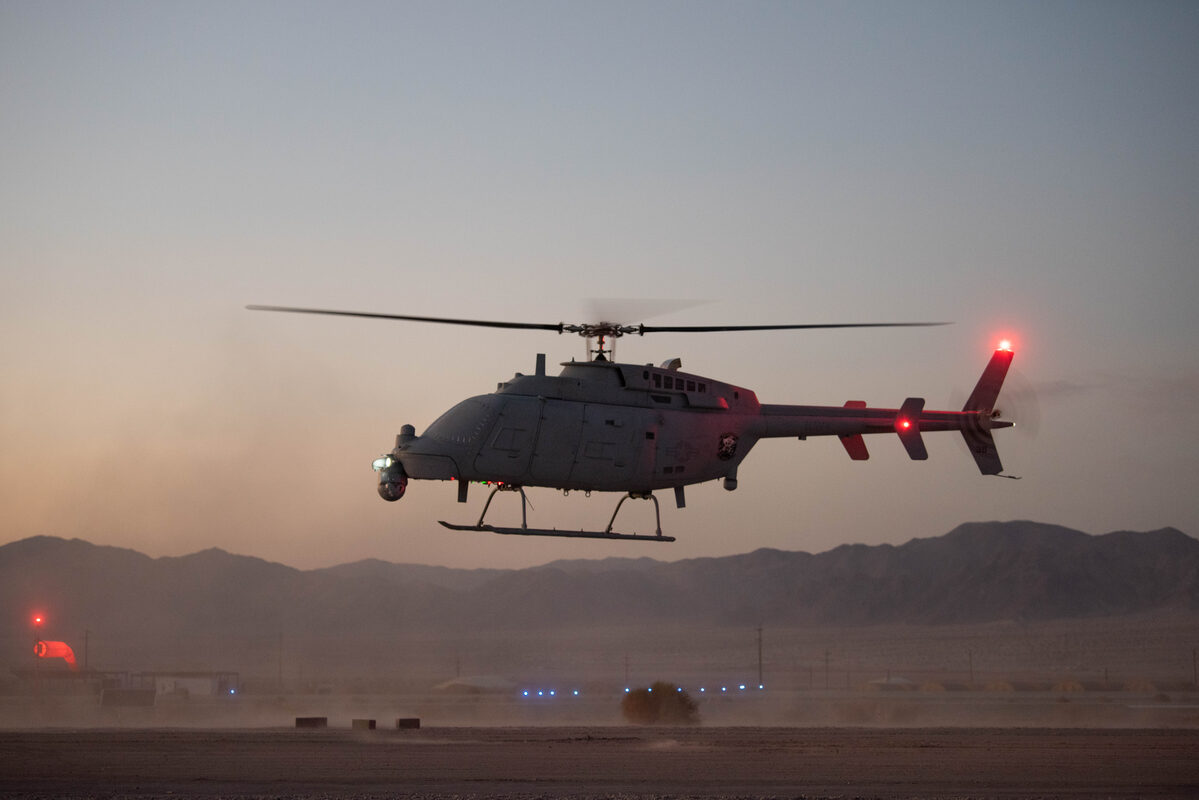
The Navy is retiring the MQ-8C Fire Scout. For four of the unmanned helicopters, retirement now means a new job instead of storage. A release from the Navy's PMA-266 program office, posted to DVIDS on Oct. 22, says the Army's Redstone Test Center (RTC) has taken delivery of four divested MQ-8C aircraft, two Mobile Mission Control Systems, spare engines and support equipment. The aircraft will serve as captive-carry testbeds for Army sensor packages. RTC finished ground testing in August and began flight tests at Dugway Proving Ground, Utah, and Redstone Arsenal, Alabama.
According to the Navy, reusing the airframes saved the Army just over $70 million in procurement costs. The release adds that there were further savings in research, development, test and evaluation (RDT&E) funding, flight hours and other areas, though it gives no figures for those.
A Program Already Headed for the Boneyard
The timing was close. The release says the Office of the Chief of Naval Operations (OPNAV N98) directed the Navy to begin divesting the MQ-8C in February 2024, with a final sundown scheduled by the end of fiscal 2026. By the time the Army sent its request for information, PMA-266 was roughly 60 percent of the way through transferring aircraft, mobile control systems and support equipment to the 309th Aerospace Maintenance and Regeneration Group (AMARG) in Tucson, Arizona, the facility usually called the boneyard.
The fleet had already been shrinking. In January 2023, Seapower reported that the Navy planned to keep only 10 of the 38 MQ-8Cs it had procured in operational service, with the rest placed in Level 2 preservation. The older MQ-8B had already been retired. That 2023 report is background only. It does not describe how the fleet changed afterward, and the new release is the authoritative account of the drawdown's final stage.
How the Transfer Came Together
The PMA-266 release lays out the timeline:
- November 2024: PMA-266 receives a request to evaluate the MQ-8C as a captive-carry testbed for Army sensor packages at the Redstone Test Center, which falls under the Army Test and Evaluation Command (ATEC).
- December 2024: The teams schedule a site visit to Point Mugu, California, to evaluate the aircraft and their mission control systems.
- January 2025: RTC formally requests four MQ-8Cs, two Mobile Mission Control Systems, spare engines and support equipment.
- May 2025: OPNAV N98 approves the request.
- By July 2025: All four aircraft and both control systems are delivered to Redstone Arsenal.
- July 2026: The final assets arrive, following a year of collaborative negotiations. They include communications security (COMSEC) equipment (radios, transponders and modems) that PMA-266 secured with Naval Supply Systems Command Weapon Systems Support (NAVSUP WSS).
- August: RTC completes ground testing and starts flight tests at Dugway and Redstone Arsenal.
The release says the transition and start of flight tests took 14 months. It does not say exactly which milestones that figure runs between. The full sequence, from the first Army inquiry in November 2024 to aircraft flying in Utah and Alabama in August 2026, spans most of two years. One cause of the long tail is visible in the list above: the aircraft reached Redstone fairly quickly, but the COMSEC hardware and the final support items took about another year.
The release also makes clear that the Army team was starting from scratch. CW4 Taylor Kiel, the RTC test director, said that "having zero experience with these systems" was where the effort started. Col. Leigh Irwin, the PMA-266 program manager, called the repurposing "a major acquisition win for both services." The release says flight tests began to build aircrew confidence and give maintainers hands-on experience.
What the Army Is Getting
The MQ-8C is a Northrop Grumman design built on the commercial Bell 407 helicopter. Northrop Grumman says the Bell 407 is a mature helicopter with more than 1,600 airframes produced and over 4.4 million flight hours. The manufacturer says the MQ-8C can take off and land autonomously on any aviation-capable ship and from both prepared and unprepared landing zones, and it describes range and endurance as more than double, and payload capacity more than triple, those of the earlier version.
Seapower's 2023 report, quoting the Navy, described the MQ-8C as capable of more than eight hours of operation and of covering areas out to 150 nautical miles from its host ship. In Navy service it carried an electro-optical/infrared payload and a laser designator, and it was part of the Littoral Combat Ship's mine countermeasures mission package. Its predecessor, the MQ-8B, logged more than 16,600 flight hours over 6,200 sorties and was used to test the APKWS weapon, according to Northrop Grumman.
The Army's purpose is narrower than the Navy's was. A captive-carry testbed carries a sensor or other payload through real flight conditions so engineers can collect data on it, without that payload being fielded on the aircraft. For that job, a helicopter-class uncrewed airframe that can hover, fly slowly and stay airborne for hours is useful, and the Army did not have to build or buy one.
Why It Matters
The headline figure is the $70 million in avoided procurement, but the more important point is the approach. Testing new sensors requires something to fly them on, and buying a new rotary-wing uncrewed platform just for test work would cost money and time. Using an airframe the Navy was already sending to storage avoided that purchase, which is where the Navy's reported procurement savings come from.
The case also shows how much depends on timing. With the Navy about 60 percent through its transfers to AMARG, the Army's inquiry arrived while there were still complete systems, including mobile control systems and spare engines, to hand over. Getting the COMSEC equipment through NAVSUP WSS appears to have been the slowest part, which suggests that for future transfers between services, the communications and security hardware may cause longer delays than the airframes.
There are limits to what this shows. Four aircraft make a small test fleet, not an operational capability, and the release does not name the sensor packages RTC plans to fly or say how long the Army expects to operate the aircraft. Still, the Navy is closing out a program the Army is now beginning to use, and the transfer offers a possible model for other retiring uncrewed fleets: before an aircraft goes to the boneyard, check whether another service needs it.
PMA-266, which ran the handoff, also has cognizance over the MQ-9 MAGTF UAS Expeditionary (MUX) family of systems and is responsible for emerging Group 4 and 5 vertical-lift platforms.
