
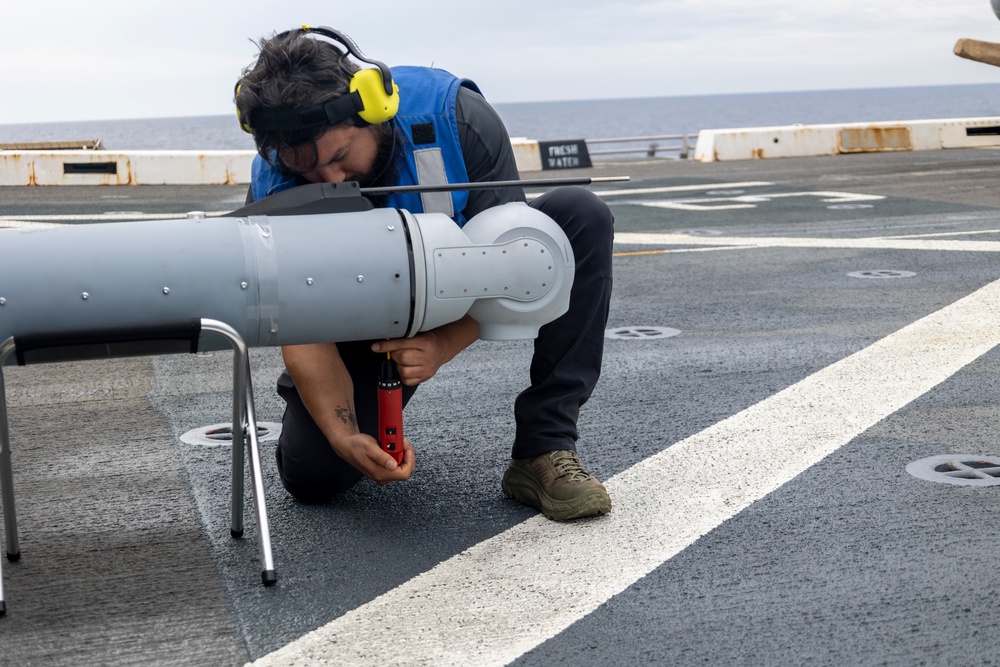
The newest unmanned aircraft watching the Taiwan Strait belongs to a law enforcement agency, not an air force. Shield AI announced on Oct. 13 that it had delivered the first V-BAT to Taiwan's Coast Guard Administration (CGA). The aircraft is a vertical-takeoff drone that the coast guard will fly from its ships. Working with its Taiwanese partner, Aerospace Industrial Development Corporation (AIDC), Shield AI says it will deliver twelve V-BATs over the coming months.
Some basic details are still missing. As Janes reported, neither the CGA nor the two companies has disclosed what the contract is worth or how many aircraft the coast guard plans to buy in total. Taiwan has now fielded the V-BAT publicly, but nobody has said what it costs.
What Was Delivered, and When
The CGA competitively selected the V-BAT in July 2026 under a program it calls "Shipborne UAV," according to the Shield AI release reproduced by Naval News. Janes, citing Shield AI and AIDC, also describes the selection as competitive. Neither outlet names the other bidders or says how many there were.
The aircraft were shown in public before the formal announcement. On Oct. 7, according to the company's account carried by Naval News, the CGA presented "newly arrived" V-BATs at the Port of Taipei to Ocean Affairs Council Minister Kuan Bi-Ling and National Security Council Secretary General Joseph Wu. Shield AI engineers demonstrated aircraft setup within minutes. The release describes the arrivals in the plural while the headline announcement refers to the "first" V-BAT delivered. The available reporting does not resolve the difference, which could come down to how the company counts a formally accepted delivery versus hardware that is simply in the country.
Everything that follows the first aircraft is still in the future tense: twelve V-BATs "in the coming months," with no published schedule.
The Aircraft
Janes, relaying Shield AI's description, calls the V-BAT a Group 3 vertical takeoff and landing (VTOL) unmanned aircraft. It has a ducted-fan design and a heavy-fuel engine and an endurance of more than 12 hours. Shield AI says it was designed and tested for operations in contested electronic warfare environments, providing intelligence, surveillance and reconnaissance (ISR) and targeting capability.
For a coast guard, the main attraction is that the aircraft does not need a runway. The Shield AI release says VTOL aircraft eliminate the need for runways and improve deployment flexibility, and that the V-BAT's single-engine, enclosed-rotor design allows unassisted launch and recovery from ship decks. That is the point of a program called "Shipborne UAV": the drone goes to sea with the ship, which on its face extends the ship's sensor coverage beyond what its own radar and lookouts can see.
According to Shield AI, as quoted by Janes, the CGA will use the V-BAT as a ship-based capability to maintain persistent maritime domain awareness (MDA) for surveillance, coastal patrols and law-enforcement operations. That list is narrower than the targeting role the aircraft was designed for, and it matches the stated mission of a coast guard rather than a combat arm.
Why a Coast Guard?
Shield AI's own framing is about the Strait and its approaches. Co-founder Brandon Tseng, the company's president, is quoted by Janes saying the aircraft will provide the "maritime domain awareness and intelligence picture needed across the Taiwan Strait and its maritime borders." In the company release carried by Naval News and Marine Insight, Tseng compares the CGA's planned use to the US Coast Guard's. He says the V-BAT already does this work for the US service and helped intercept more than 100,000 pounds of narcotics last year. That figure comes from the company, and none of the sources available here independently verify it.
Tseng also says the capability "helps keep the Strait safe from illegal activity and hostile actors." Those are the company's words, and the sources do not say which kinds of activity the CGA aircraft will be tasked against.
The choice also means the CGA's ISR aircraft shares a platform with a US service doing similar work. Any interoperability or shared operating practice that results is a possibility, not something any party has announced.
Local Sustainment Through AIDC
The deal goes beyond selling airframes. According to Janes, Shield AI will train CGA operators and maintenance personnel and establish a localized V-BAT support system in partnership with AIDC. Naval News reports that Shield AI and AIDC entered into an agreement last year covering sustainment, training, autonomy integration and other technical initiatives, intended to ensure Shield AI's products can be deployed, supported and scaled in Taiwan.
AIDC President Jennifer Chuang said in the release that the adoption shows what can be achieved by combining Shield AI's technology with AIDC's localized expertise. Keeping repair and support capability in Taiwan, rather than depending entirely on overseas parts and technicians, is what a localized support system is meant to provide, though the sources give no detail on what work will be done locally. The Naval News report mentions autonomy integration but does not explain what that means in practice for CGA aircraft.
What Isn't Known
- Price. No contract value has been disclosed by the CGA, Shield AI or AIDC, according to Janes.
- Total fleet size. Twelve aircraft are due. Janes notes that the total number the CGA intends to acquire has not been stated.
- Which ships. None of the reporting identifies the CGA vessel classes that will carry the V-BAT.
- Delivery schedule. "Coming months" is the only timeline given.
- Payloads. The sources do not specify the sensor fit for the CGA aircraft.
Why It Matters
The sale shows where one source of demand for unmanned aircraft around Taiwan is coming from. The CGA, a civilian enforcement agency, selected a Group 3 VTOL design that Shield AI says can stay airborne for more than 12 hours, through a program specifically named for shipborne UAVs. That suggests persistent surveillance from ships is being treated as a coast guard requirement rather than an experiment, though the sources do not say so directly. The arrangement with AIDC means the fleet is meant to be supported in Taiwan, not entirely from overseas.
The undisclosed price makes the program harder to assess from outside. Until the CGA publishes the contract value or the planned fleet size, it is not possible to tell whether twelve aircraft is the whole program or the first batch of a larger buy. The next thing to watch is whether the V-BAT appears operating from CGA ships in the Strait. That would be the first evidence that the program is in service.
