
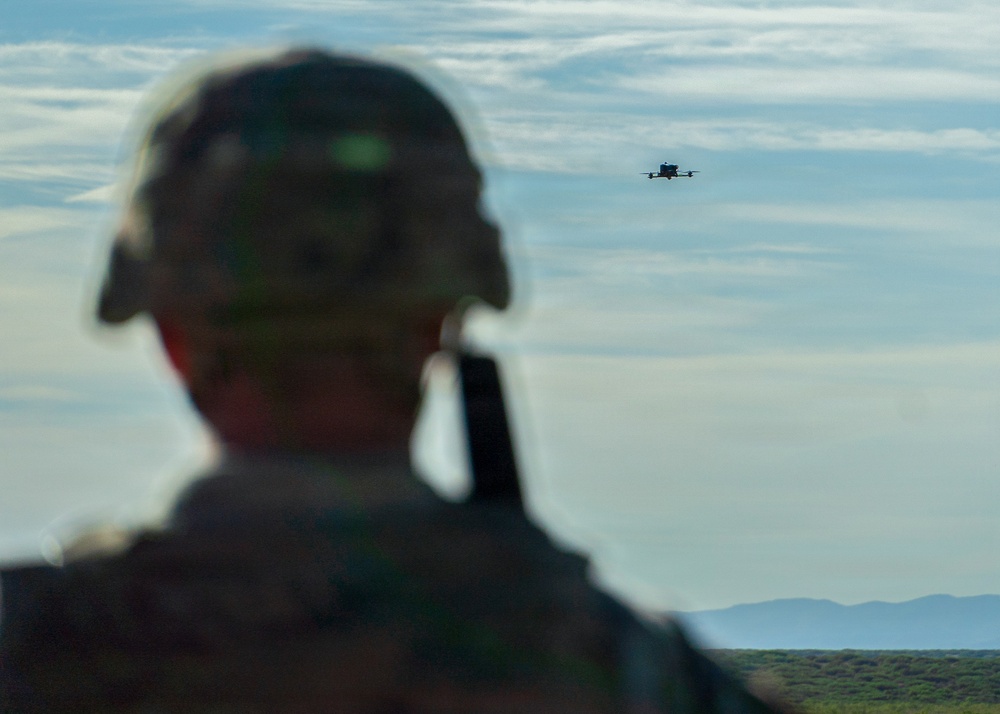
U.S. Customs and Border Protection says it detected more than 37,000 unmanned aircraft flights near the border in fiscal year 2026, down from more than 42,000 the year before. The figures come from a CBP spokesperson's statement to Fox News Digital, published Oct. 14. Read alone, that looks like progress. The military's border task force describes a different trend.
In the same Fox News Digital report, Brig. Gen. Brian Filler of Joint Task Force-Southern Border said the task force recorded 378 drone incursions in the previous 30 days and described the trend as increasing. Most of those aircraft, he said, were commercial camera drones. So one agency reports a year-over-year drop and the other reports a rise, and the public numbers aren't detailed enough to say which is closer to what is happening in the airspace.
What CBP actually said
The FY2026 statement is thin. As DroneXL noted, it doesn't say which border the 37,000 flights were detected on: Mexico, Canada, or both. It also doesn't say how close to the line a flight has to be to count as "near-border."
The FY2025 number can be checked against an earlier disclosure. In February, a CBP official told Cronkite News that the agency recorded 34,682 drone flights within 500 meters of the U.S.-Mexico border in FY2025, a figure not previously disclosed, plus 7,678 on the Canadian border. Those add up to 42,360, which matches the "more than 42,000" CBP gave Fox. DroneXL made the same comparison.
That suggests the FY2025 figure combines both borders and uses a 500-meter detection band. It's a reasonable guess that the FY2026 figure is built the same way, but CBP hasn't said so. If it is, the national total fell by roughly 12 percent, from about 42,000 to about 37,000. If the method changed, the two years can't be compared. Neither the Fox report nor DroneXL's coverage includes a Mexico-only figure for FY2026.
Why 378 and 37,000 can both be true
The task force and CBP numbers measure different things. Spread evenly, 37,000 flights a year comes to a little over 3,000 a month, roughly eight times the 378 incursions JTF-Southern Border counted in its 30-day window. A rising monthly incursion count and a falling annual flight count don't contradict each other unless they use the same definition, and nothing in the public record says they do.
"Flight near the border" and "incursion" sound like they describe the same event. Probably they don't. A flight that stays on the Mexican side inside the 500-meter band would plausibly count in CBP's figure. An incursion, as the word is normally used, means crossing into U.S. airspace. The sources reviewed here don't define either term, confirm that they cover the same geography, or say whether the two agencies share sensor data. Without those details, the only safe reading is that the figures can't be reconciled from the outside.
Local reports add a third scale. Yuma County Sheriff Leon Wilmot told Cronkite News his county gets three or four incursions across the border a week that he knows of. That's one jurisdiction's view, and it doesn't map neatly onto either federal total.
What the drones are doing
The agencies differ on counts but not on purpose. Austin Doctor of the National Counterterrorism Innovation, Technology, and Education Center (NCITE) at the University of Nebraska Omaha told Fox News Digital that cartels want to build a "pattern of life" for U.S. security personnel. In other words, they watch when agents move, where they stage, and where the gaps are. That fits Filler's description of a fleet made up mostly of commercial camera drones. At the border, Doctor said, surveillance and logistics are the dominant roles, with weaponized use more frequently documented inside Mexico.
Weaponization is a separate question, and the evidence for it so far is mostly south of the line. NCITE published a report on Feb. 12, 2026, Mapping Weaponized Drone Attacks Attributed to Mexican Drug Cartels, 2021-2025, by Doctor, Cubukcu, Elson, Grispos and Harms. It analyzes publicly available information on weaponized drone incidents involving the Mexican cartel groups designated as terrorist organizations in 2025. DroneXL puts the count at 221 weaponized incidents in Mexico over that period. That figure comes from DroneXL's coverage, not from the report's abstract, which UASFeed reviewed.
Cronkite News described the cartels' drone use in two parts: smuggling drugs across the border, and attacking rivals. DroneXL pointed to an Oct. 15, 2025 attack in Tijuana on the anti-kidnapping unit of the Baja California attorney general's office as part of the background.
The September operations
Recent operations show how the response is being organized. DroneXL reports that Operation Aguila Alta ran Sept. 7-21 in the Tijuana-San Diego corridor. On Sept. 14, Mexican authorities detained an alleged drone operator after soldiers used CBP information to detect the aircraft. By Sept. 18, according to figures DroneXL attributes to Defense Secretary Ricardo Trevilla, four drones had been disabled. Fox, citing the Mexican defense ministry, put the operation's total at five. DroneXL also reports that 500 troops were sent to five towns in Tamaulipas.
The gap between four and five drones is small, but it fits the larger problem. Even in a single, time-limited operation, the outlets don't agree on the totals. Fox also noted that officials released no before-and-after data showing whether drone traffic declined afterward.
Authority and airspace
CBP's spokesperson told Fox News Digital that DHS has approved counter-UAS authorities for CBP under congressional authority, 6 U.S.C. 124n, and that U.S. Border Patrol counter-UAS operations cover the entire Southwest border and areas extending 100 miles inland. Exactly how those authorities are used day to day wasn't detailed in the statement.
The airspace side has already had problems. Cronkite News reported that a Feb. 11 airspace closure over El Paso lasted under eight hours, and that civil aviation authorities were reportedly more worried about a laser being tested to shoot down drones than about the cartel incursion blamed for the closure. Even a short closure shows that drone defense at the border can affect civil aviation as well as security agencies.
Why It Matters
Counter-drone policy at the border is being argued from numbers that don't line up. A 12 percent annual decline could be read as detection and mitigation working. A rising monthly incursion count could be read the opposite way: the threat is growing faster than the defenses. Funding, authorities and deployments will follow whichever story wins, and right now the public can't check either one.
Closing that gap doesn't take classified detail. It takes definitions. Does "near-border" mean the same 500-meter band each year? Do the figures cover both borders? Is an "incursion" a confirmed crossing into U.S. airspace, and does JTF-Southern Border count from the same sensors as CBP? CBP already broke its FY2025 data out by border and distance once, for Cronkite News. Doing the same for FY2026, alongside a matching definition from the task force, would show whether the cartels' drone activity is shrinking or getting more effective.
For now, both agencies agree that cartels are using drones to watch U.S. security personnel. The question still open is whether there are more of them each year or fewer.
Sources
- DroneXL: CBP Logged 37,000 Border Drone Flights In FY2026, Down From 42,000
- Fox News Digital via WFMD: Cartels use drones to scout border agents and map smuggling routes, expert warns
- NCITE (University of Nebraska Omaha): Mapping Weaponized Drone Attacks Attributed to Mexican Drug Cartels, 2021-2025
- Cronkite News: Concerns grow as Mexican cartels embrace drones for drug smuggling, attacks on rivals
