
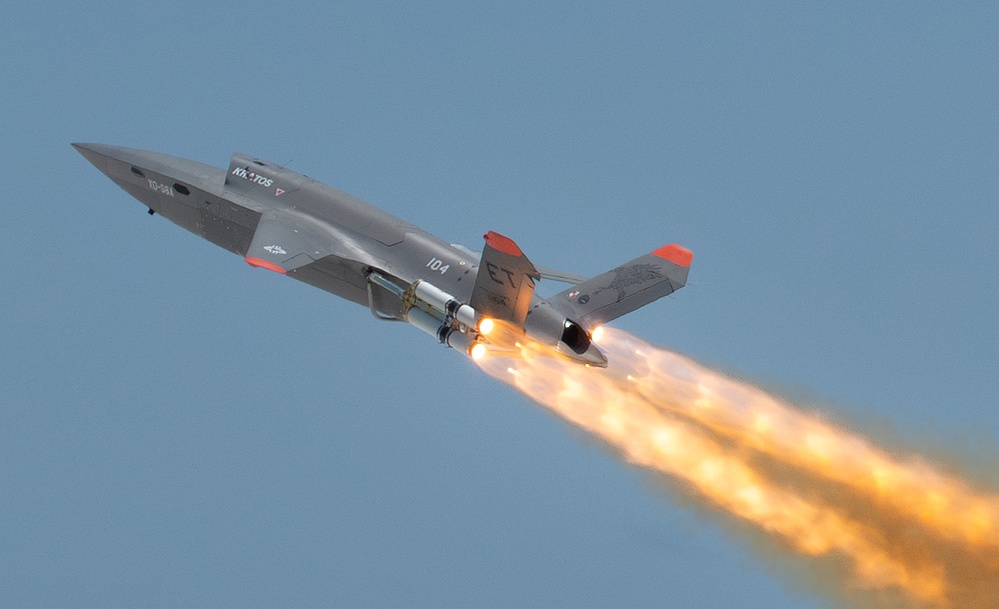
A collaborative combat aircraft has flown in Europe for the first time. On Oct. 12, 2026, Airbus and Kratos announced that the U740 Valkyrie, a European version of Kratos's XQ-58A, had completed its first flight on the continent. The flight took place at a test facility in northern Europe that the companies did not name. Airbus says the program is on track to deliver a combat-ready CCA by 2029. That date matches the war-readiness deadline Germany has set for its armed forces.
Getting the airframe into the air was the first hurdle. The aircraft is American, and Airbus's pitch rests on a European mission system that has not yet flown on it. The next phase of testing is meant to change that.
What Flew
According to Janes, all test objectives were achieved, including:
- a runway-independent, rocket-assisted takeoff
- maneuvers at various altitudes
- speeds up to Mach 0.8
- in-flight mission adjustments
The in-flight mission changes are probably the most relevant result for a CCA. The concept depends on retasking the aircraft during a sortie rather than flying a fixed plan.
The Airbus press release, issued from Ottobrunn and Taufkirchen, gives these figures for the U740:
- length 9.1 m
- wingspan 8.2 m
- maximum takeoff weight about three tonnes
- range over 5,000 km
- service ceiling 45,000 ft
Airbus says the design offers rail launch capability, with conventional runway takeoff and landing as an option. The War Zone adds that the aircraft has an internal weapons bay plus external payload stations under the wings.
The War Zone says the rocket-assisted launch reduces the aircraft's dependence on conventional runways, which could help the Luftwaffe disperse operations or launch from locations where established airfields are unavailable or under threat.
The Brain Is the Product
Janes describes the U740 as essentially a Kratos XQ-58A fitted with Airbus's MARS software, which Janes says will equip both crewed combat aircraft such as the Eurofighter and the CCA. The idea is a shared mission system across the crewed and uncrewed parts of a force, so the drone is not a separate stovepipe.
Airbus calls MARS the "European brain." In its press release, the company says MARS ensures full control over software as well as mission applications, data and system hardware. It also says a strict control hierarchy keeps a human "on the loop," meaning a person supervises and can intervene rather than directing every action. Introducing MARS on the aircraft is the next phase of the program, so the European mission system has not yet flown on the U740.
Airbus Defence and Space CEO Mike Schoellhorn and Kratos CEO Eric DeMarco both gave statements in the release. Schoellhorn described pairing Kratos' proven airframe with Airbus's sovereign European mission system, so the roles are clear: Kratos supplies the airframe, and Airbus supplies the mission system.
The Sovereignty Question
Airbus wants to deliver a "sovereign" CCA to the Luftwaffe by the end of the decade, Janes reports. The War Zone points out the tension: because the airframe is American, the degree of sovereignty Germany obtains will depend on its practical ability to control and modify software, integrate national systems, and support the aircraft throughout its service life.
Airbus's claim of control over software, mission applications, data and hardware is aimed at that concern. The War Zone also says Germany will likely want to integrate national weapons and sensors without depending on a foreign-controlled mission architecture. Whether the claim holds up will depend on integration work and contract terms that the sources do not describe.
Germany's Requirement and the Competition
The War Zone describes the Luftwaffe's current larger uncrewed aircraft fleet as limited to five leased Israeli-made Heron TP drones. Germany is also participating in the Eurodrone program. That outlet also reports that FCAS, the Franco-German-led next-generation fighter program, "hit the buffers" earlier this year. As a result, the near-term question of what flies alongside German fighters has become more pressing.
The War Zone says Berlin has set a goal of being ready for war by 2029, and that reports indicate the Luftwaffe wants a new combat-drone capability on a similar timeline. It also notes that Germany's requirement has been described in press reports as a "Jagdbomberdrohne," or fighter-bomber drone, and that the precise operational concept has yet to emerge publicly. Janes says Airbus is pitching the U740 at a German requirement for 2029 and at other European air forces.
Airbus is not the only bidder. The War Zone lists these reported competitors:
- Anduril
- General Atomics, partnered with Germany's INTEC
- Lockheed Martin
- Boeing and Rheinmetall, pitching the larger Block 3 version of the MQ-28 Ghost Bat
- Helsing and Hensoldt, pursuing the homegrown CA-1 Europa
The field mixes American designs with European ones, which makes the sovereignty argument a central part of Airbus's pitch alongside airframe performance.
Why It Matters
Per Janes, the U740 is the first CCA to fly in Europe, and the flight passed a defined set of objectives, including runway-independent launch and in-flight mission adjustments. With 2029 only a few years away, a flying aircraft is an advantage when a customer is short on time. The War Zone calls the flight a head start in testing the U740 for German requirements.
The flight does not settle the harder question, which is whether a European mission system on a U.S.-designed airframe gives Germany the independent control it wants. The War Zone says substantial work remains before the aircraft can be considered combat-ready, and that the next major milestone is flying it with MARS. How quickly that work progresses will help determine whether the Valkyrie can meet the Luftwaffe's timetable. For a Luftwaffe whose large-drone fleet is currently five leased Herons, and whose FCAS plans have hit the buffers, that timetable matters.
