
Over roughly two weeks, the U.S. Army has set up a new command for autonomy, published a simulation study on how a small team of soldiers handled a mixed air-ground formation, and kept testing drones and robotic systems for one of the most dangerous jobs in ground combat: breaching obstacles. A Defense News analysis published Oct. 13 pulls these threads together. Read side by side, they show an Army moving from experimenting with individual robots toward building formations around them.
Not all of this is new. The command was announced at the start of the month. What the Oct. 13 analysis adds is context: results from Project Sandhills 2.0 at Fort Bragg, the Army Research Laboratory (ARL) study, and a budget line that suggests the service plans to organize units around autonomy.
The new command: FASCOM
On Oct. 1, 2026, Acting Army Secretary Adam Telle signed a memo directing the creation of the U.S. Army Futures and Autonomous Systems Command, or FASCOM. The Army announced it on Oct. 2. The move followed Secretary of War Pete Hegseth's Sept. 30 State of the Force address, where he announced the establishment of an Autonomous Warfare Command.
According to the Army's announcement, the memo covers more than an org chart. Autonomy is to be integrated into at least six formation areas, including aviation, armor, fires, sustainment, engineer and training formations. The Army will designate a Portfolio Acquisition Executive for Autonomy. It will also prioritize acquisition and fielding in the following areas no later than fiscal 2028:
- autonomous fires
- combat vehicles
- watercraft resupply
- breaching
- reconnaissance, surveillance and target acquisition (RSTA)
- collaborative teaming between crewed and uncrewed platforms
The directive also expands authorizations for two specialties: the 15X Tactical Unmanned Aircraft Systems Specialist and the 390A Robotics Technician. The Army says this puts trained autonomy professionals closer to tactical formations. Staffing is often a better guide to an organization's plans than its press releases, and here the Army is adding authorizations for the soldiers who will operate and maintain these systems.
Sandhills 2.0: drones at the breach
Breaching is on that priority list for a clear reason. Defense News describes the Army's Engineer Autonomous Breaching Capability program as calling for prototypes able to breach complex obstacles and minefields under direct observation and fire. Project Sandhills 2.0, run at Range 63 on Fort Bragg, is where the Army has been trying out uncrewed help for the same problem.
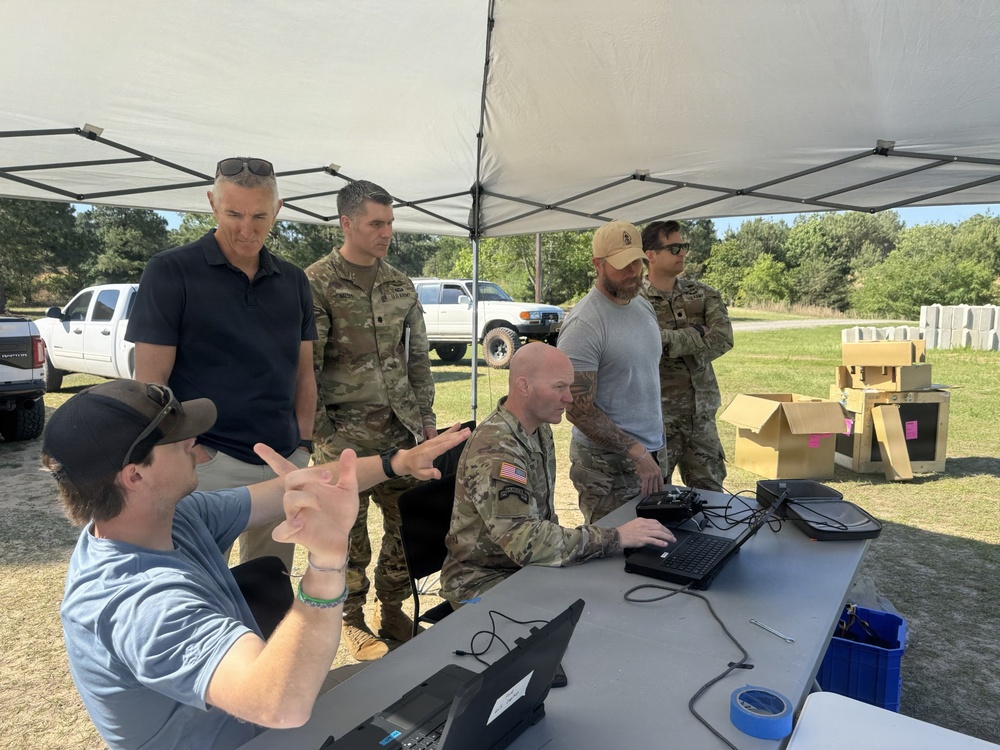
Defense News reports that soldiers in the exercise planned flight routes and operated Bumblebee V2 small unmanned aircraft systems. The project tested how unmanned systems could support contested obstacle breaching, while soldiers and industry partners collected feedback to inform future Army capabilities. The Army said the effort included autonomous trucks, robotic breaching payloads, drone swarms, mine detection and counter-UAS tools operating on the same problem. A counter-UAS turret used a human-authorized effector, which Defense News says underscored that autonomy did not mean removing people from critical decisions. A Defense News photo of a Black Widow drone test flight at the Sandhills Project is dated Aug. 19, 2026.
Formal procurement is moving in parallel. In July the Army selected four companies for the Engineer Autonomous Breaching Capability program, and an assessment is planned for early 2027.
The lab study: 13 soldiers, one mixed formation
The third thread is a Sept. 30 ARL study. Over a two-week simulation, 13 soldiers operated a mixed air-ground formation that included a manned control vehicle, two robotic combat vehicles, a Future Vertical Lift platform and shared launched effects, facing a human-controlled opposing force under contested conditions. Defense News reports that researchers found the formation adapted rapidly, developed effective coordination patterns and maintained stable subjective workload as mission complexity increased.
That result counts for something. Operator workload has long been a central worry for crewed-uncrewed teaming: if every robot adds to the load on already busy soldiers, the formation slows down instead of gaining combat power. Defense News also notes the limit of the finding. The study did not demonstrate autonomous maneuver by an operational brigade. It tested a specific human-machine formation in a simulation under defined conditions, which is useful evidence but a long way from a fielded unit. Defense News adds that another ARL study, on autonomous reconnaissance and screening, identified soldier-robot trust, communications, shared understanding and cognitive load as areas needing further research.
The analysis also says the Army's fiscal 2026 budget justification includes an "Autonomy Formation" effort intended to accelerate robotics for armored and infantry formations. Read alongside FASCOM, that suggests an intent to organize units around these systems, not just buy them.
The scale argument
The underlying argument is set out in a Sept. 29 essay for the Modern War Institute at West Point by retired Col. Dave Rowland and retired Command Sgt. Maj. Brian Hester. Its title states the thesis: autonomy will not automatically change how an Army brigade fights, but autonomy at scale will.
The authors frame the problem as restoring the ability of formations to maneuver despite persistent observation and attack. In that setting, they argue, the first requirement is quantity: with sufficient numbers, commanders can distribute capabilities across the battlefield, mass systems or effects against a problem, and accept the loss or failure of individual platforms without losing the capability. Their point is that adding a single robotic system is not what changes a brigade's behavior.
They also identify a hard constraint: a brigade cannot add dozens of autonomous systems if each requires another operator, screen and continuous stream of instructions. Their proposed path runs from operating individual systems, to supervising multiple systems, to coordinating mixed manned-unmanned teams, and eventually to commanding autonomous formations using the principles of mission command. Seen that way, the ARL study is an early data point on the middle steps: it found stable subjective workload in a mixed formation, though only in simulation. The essay is a reminder of how far there is to go after that.
Why It Matters
For the drone and UAS community, the main point is that the Army is putting its autonomy work into institutions. A dedicated command, an acquisition executive for autonomy, a fiscal 2028 deadline on priority capability areas, and expanded authorizations for drone and robotics specialists together point to organizational structure, not a single program.
The evidence base is still thin, though. Sandhills 2.0 is an experiment that collected feedback. The breaching companies will not be assessed until early 2027. The ARL result came from a simulation that, by Defense News' account, stopped short of demonstrating an operational brigade. The human-authorized counter-UAS effector at Fort Bragg shows that people stayed in the loop for that engagement decision, and Defense News says human decision-making remains central to the Army's approach.
Rowland and Hester's argument is a useful test for what comes next. Success will not be measured by any one robot. It will depend on whether the Army can field enough systems, and supervise them with few enough soldiers, that a force can afford to lose some of them. FASCOM is the organization the Army has directed be established to push that work forward.
Sources
- How autonomous weapons are changing the way brigades fight (Defense News, Oct. 13, 2026)
- Autonomy Will Not Automatically Change How an Army Brigade Fights, Autonomy at Scale Will (Modern War Institute at West Point, Sept. 29, 2026)
- Army announces Futures and Autonomous Systems Command (U.S. Army, Oct. 2, 2026, via Wayback Machine snapshot)
