
The Pentagon wants a large lump of cash to buy robots, and it wants it fast. Speaking on a Project Agincourt panel at the Association of the U.S. Army's annual meeting on Oct. 14, Hegseth said the department is requesting roughly $50 billion in reconciliation funding for autonomous and robotic systems, C4ISRNET reported. He called it a one-time infusion, not a recurring line.
He also gave a sense of scale. The goal, Hegseth said, is "hundreds of thousands of one-way attack systems this year and into the millions in years to come."
That is the money side. The same week at AUSA, Army leaders and the soldiers who run its drone experiments described the other side: the people, ranges and training that decide whether a million drones turn into combat power or just fill warehouses.
Two Pots of Money, Not One
The reconciliation request comes on top of the regular budget. According to C4ISRNET, it is separate from the FY2027 budget request, which already includes $53.6 billion for Drone Dominance. That figure breaks down as follows:
- $16.9 billion for unmanned procurement
- $14.4 billion for counter-unmanned systems
- $13.5 billion for contested logistics
- $4.5 billion for collaborative autonomy
- $4.3 billion for institutional systems and personnel
Two caveats apply. First, C4ISRNET notes that the budget request does not establish that the reconciliation money is the same as the Drone Dominance funding, or that all of it would go to drones. "Autonomous and robotic systems" is a broader label than "drones." Second, even the $53.6 billion Drone Dominance line is not all aircraft. Less than a third of it is unmanned procurement. The rest covers defending against drones, moving supplies under fire, getting machines to work together, and the institutions and people behind all of it.
Read side by side, the two requests could add up to more than $100 billion aimed at unmanned and autonomous warfare. But nothing in the public record yet confirms that they stack that way or say how the reconciliation money would be split.
From 340,000 to "Millions"
The Army's own recent baseline shows how big the jump would be. In December 2025, C4ISRNET recalled, the service announced a $1 billion initiative to buy about 340,000 small unmanned aircraft systems over two years. Hegseth's AUSA language, hundreds of thousands of one-way attack systems this year and millions later, points to a scale well beyond that purchase.
Buying drones at that volume is partly an industrial problem. Factories have to exist, supply chains have to hold up, and designs have to stay current as electronic warfare changes what works. It is also a people problem, and the Army spent much of AUSA on that.
A Warrant Officer Specialty for Robots
C4ISRNET also reported that Acting Army Secretary Adam Telle pointed to MOS 390A, an Army specialty in which, in his words, warrant officers "could keep the speciality and the skills over the duration to teach our soldiers how to do robotics," and to wider access to Army test ranges. Warrant officers are the Army's long-serving technical experts. Leaning on a career specialty to train others suggests the service sees robotics as more than a few hobbyists in each unit.
Telle said greater range access gives developers more chances to test systems and get feedback from military users. That is a quieter constraint than money: soldiers and vendors need places to use the hardware, or much of the training value never happens.
The "New Basics"
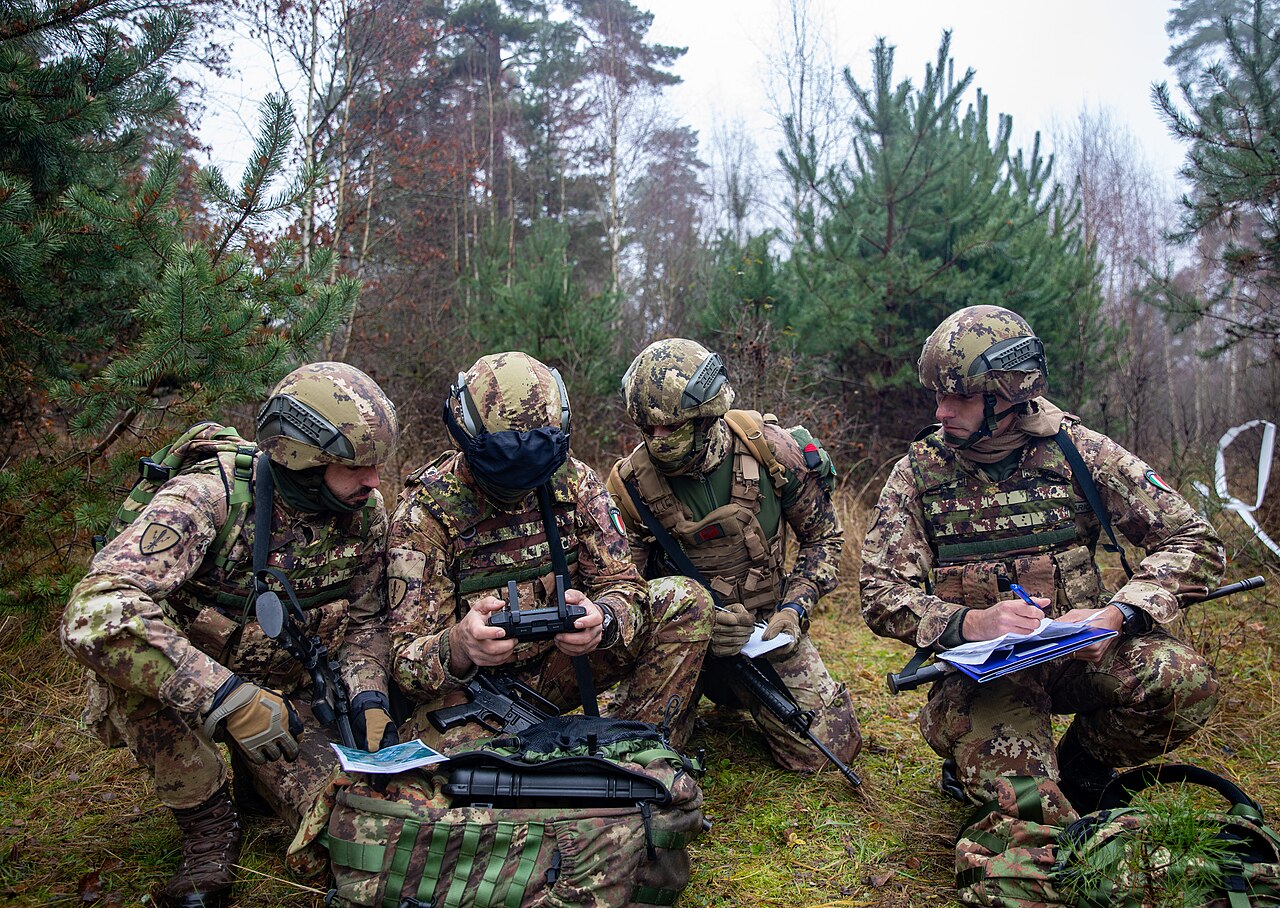
At a separate AUSA discussion on Project Flytrap, officials from the 2nd Cavalry Regiment described what they called "new basics" for soldiers, Defense News reported. Within 2CR, those include unmanned aerial system operation and employment, counter-UAS systems, unmanned ground vehicle use, and camouflage for electromagnetic signatures, meaning hiding a unit's electronic signature from enemy sensors.
"We're going to have UAS all over the place," Command Sgt. Maj. Jesse Clark said.
Flytrap is an Army counter-UAS initiative and multinational exercise. Flytrap 5.0, held in Lithuania with partners including the United Kingdom and Australia and led by V Corps, integrated and tested more than 50 industry-provided technologies, according to Defense News, and 2CR is expanding Flytrap into a battalion-level capability. Col. Timothy Price, the regiment's commander, said in a release that counter-UAS "cannot remain tied to static defense," the problem of protecting units that keep moving rather than fixed sites.
None of this treats drones as a specialist add-on. In 2CR's framing, flying a quadcopter, spotting an incoming one, and keeping your radios from giving away your position join basics such as marksmanship and map reading as core skills.
The Case for Crashing Them on Purpose
A commentary piece in Breaking Defense, written by Col. Dustin Thomas of the Defense Contract Management Agency, argues that the money and the training should be connected on purpose. Under the headline "We need to make industry crash 100,000 drones next year," Thomas argues that the military should balance drone stockpiles with deliberate consumption in exercises, because stored drones can lose combat value as technology and tactics change.
The piece cites Defense Innovation Unit Deputy Director Travis Metz, who told the Senate Armed Services Committee that training should consume drones in the hundreds of thousands per year. Thomas, who attended the first two Drone Dominance Gauntlets, says he saw clear gains between them, including more reliable drones, better-trained operators and closer vendor-operator relationships. He proposes major exercises in which thousands of drones are treated as consumable, so industry can quickly redesign and deliver fixes that are tested at the next event. His bottom line is to enter the next conflict with the most practiced system for designing, building and delivering drones, not the largest drone warehouse.
This is the author's argument, not Breaking Defense's reporting or Pentagon policy. But it addresses an obvious problem with Hegseth's ask. A one-time $50 billion purchase, if it goes mostly into inventory, risks buying a single generation of hardware in a field where designs change in months. If a meaningful share is crashed in training, it buys skilled operators and a production base that is practiced, and the drones in storage matter less.
Why It Matters
Hegseth's request is an explicit statement that the Pentagon wants to go from buying drones by the thousand to buying them by the million. It is also unusual in form: a one-time reconciliation request outside the normal budget, on top of an FY2027 request that already includes $53.6 billion labeled Drone Dominance. Congress will have to decide whether those are two separate pots, how much of the new money actually buys aircraft, and what happens in later years if the "one-time" money buys hardware that needs replacing.
The AUSA panels point to the constraint that money alone can't fix. A robotics-focused warrant officer specialty, wider range access, 2CR's new basics and the push to expand Flytrap to battalion level are all efforts to build the people who will use the drones. Without that, millions of one-way attack drones are just a procurement number. The open question is whether the reconciliation money, if approved, funds that pipeline or mostly fills warehouses.
