
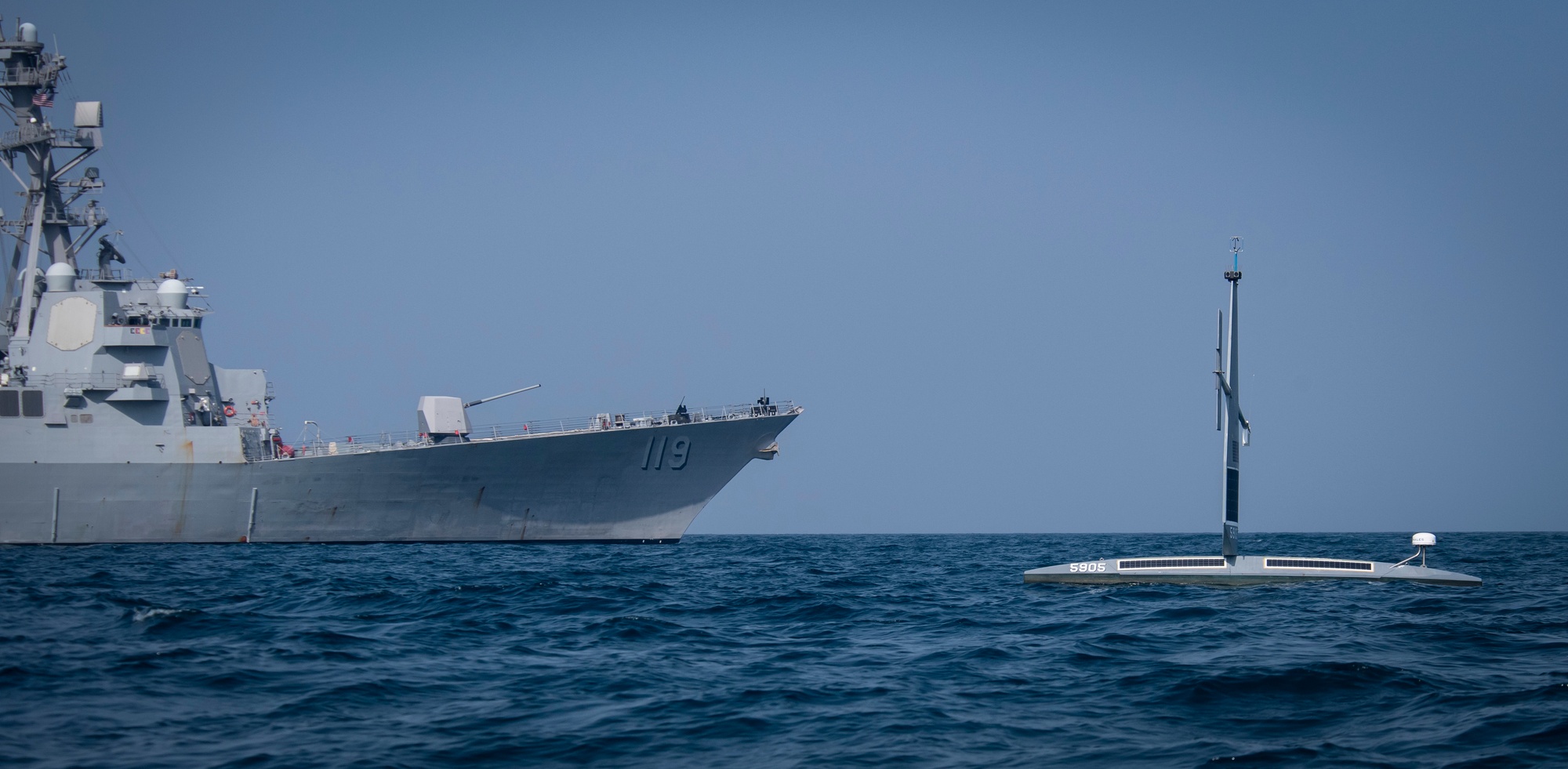
The Defense Innovation Unit has opened the second round of its Suitable Warfighting Adaptive Payloads (SWAP)-USV prize challenge. The first sprint asked for uncrewed boats that launch drones. This one asks for uncrewed boats that shoot them down.
According to the DIU solicitation, the unit and its partner, the Direct Reporting Portfolio Manager for Unmanned Systems (DRPM UxS), are looking for "mature, production-ready, maritime counter-air solutions." That means an uncrewed surface vessel (USV) with an integrated hard-kill weapon that can be forward-fielded within 120 days. Responses are due Nov. 30, 2026, at 23:59:59 Eastern. Breaking Defense, in a report dated Oct. 19, said the solicitation was released the previous Thursday, offers up to $40 million in prize money for this phase, and points toward in-water testing in early 2027.
What DIU Is Asking For
Sprint 2 is the second of three sprints in a 12-month challenge. It runs as a multi-phase prize competition under 10 U.S.C. 4025. DIU lists the threats the boats must be built to counter:
- explosive USVs
- Group 1 to 3 uncrewed aircraft systems
- attack helicopters
- go-fast boats
The solicitation frames the problem as one of cost. It says the Department of War too often relies on "exquisite, multi-million-dollar naval surface and aviation assets" to counter inexpensive threats, and that the cost-exchange ratio is "heavily skewed in favor of the adversary."
The performance floor for the vessel is modest on paper. It needs a minimum range of 200 nautical miles and a sustained cruise of at least 10 knots, which DIU calls threshold values; top performers are expected to substantially exceed them. The weapon carries more of the burden. The effector must be able to engage Group 1 to 3 UAS and rotary-wing aircraft at more than 3 nautical miles, under operator supervision. DIU calls the ability to engage Group 5 aircraft, the largest class of uncrewed aircraft, "highly desired" but does not require it.
DIU wants integrated solutions only. Standalone platform-only or effector-only submissions will not be evaluated. It wants a boat, a launcher and a weapon delivered as one working system. Offerors selected in the down-select must be prepared to demonstrate that system within 30 calendar days. The solicitation also says rapid field rearming by a two-person crew with minimal support equipment, in pier-side, austere or shipboard settings, is highly desired, and the lane descriptions for Categories 2 through 4 call for two-person reloading.
Four Weapon Lanes
The solicitation sorts entries into four effector categories, which it describes as evaluation lanes rather than separate solicitations. Offerors may propose one lane or several:
- CAT 1, Heavy Kinetic: the AGM-114L Longbow Hellfire or the AGM-179 Joint Air-Ground Missile (JAGM). This is the only lane where the government will provide a technical data package for the launcher interface and fire control.
- CAT 2, Precision Rocketry: the Advanced Precision Kill Weapon System (APKWS), with an industry-provided launcher supporting rapid re-engagement of Group 1 to 3 threats.
- CAT 3, Remote Weapon Stations: a remote weapon station integrated with Stinger (or better) missiles, stabilized 7.62 caliber (or better) machine guns, or a high-power laser.
- CAT 4, Alternate Mature Systems: mature, production-line kinetic effectors and launchers, including commercial or defense-inventory alternatives.
The lanes say a lot about what DIU is after. The solicitation states that proposed effectors, launchers and sensors must come from established, active production lines, and that conceptual, developmental or prototype-only solutions will not be considered. The government launcher data package for Category 1 suggests DIU sees integration of a heavy missile on a small boat as the hardest part, though the solicitation does not say so, and the help is offered only for that lane. Category 3 groups very different tools together, from missiles to guns to directed energy, which suggests the right counter-drone weapon for a small boat is still an open question.
How This Fits With Sprint 1
SWAP-USV started in July. As Military Times reported at the time, Sprint 1 asked for USVs integrated with two or more mature aerial drones. It used the same 120-day fielding window, and responses were due Aug. 10. Military Times described the year-long contest as backed by $100 million in prize money. It said the Pentagon was spurred on by the threat of unmanned boats and small drones in contested waters such as the Persian Gulf.
Breaking Defense reported that Sprint 1 in-water testing is expected this fall. Sprint 3, with up to $20 million in prizes, is expected to begin in spring 2027, with on-water testing completed that summer. Breaking Defense also reported that DIU, the DRPM for Unmanned Systems and the DRPM for Robotic and Autonomous Systems have earmarked $200 million for prototype or follow-on production contracts after the competition. That money sits on top of the challenge purses, which total up to $100 million across the three sprints.
Taken together, the sprints follow a clear logic. The first turns a small uncrewed boat into a carrier for attack drones. The second asks for a boat that can defeat hostile aircraft, including the drones, boats and helicopters named among the threats.
Why It Matters
The solicitation itself says current force packages lack enough persistent, distributed capability to search for, track and defeat low-cost threats at an economically sustainable cost. The threat list includes explosive USVs, Group 1 to 3 drones and go-fast boats. These are inexpensive threats, and DIU argues that countering them with multi-million-dollar ships and aircraft is a poor trade. Sprint 2 asks whether part of that defensive job can move onto uncrewed hulls armed with weapons from existing production lines, from APKWS rockets to stabilized machine guns.
The requirements also lean hard toward speed over novelty. "Production-ready," fielding within 120 days, demonstration within 30 days of down-selection and integrated systems only: together these leave little room for concept work. DIU appears to be betting that the parts already exist and that the missing piece is integration on a vessel that can reach 200 nautical miles. The solicitation also calls for engagements under human supervision, with remote firing commands executed under human-in-the-loop safety interlocks, so even on an uncrewed boat the decision to fire stays with a person.
If in-water testing happens on the reported schedule in early 2027 and the $200 million follow-on pool turns into contracts, SWAP-USV could become a fast route from prize challenge to fielded maritime counter-drone capability. The Nov. 30 deadline is the next checkpoint.
