
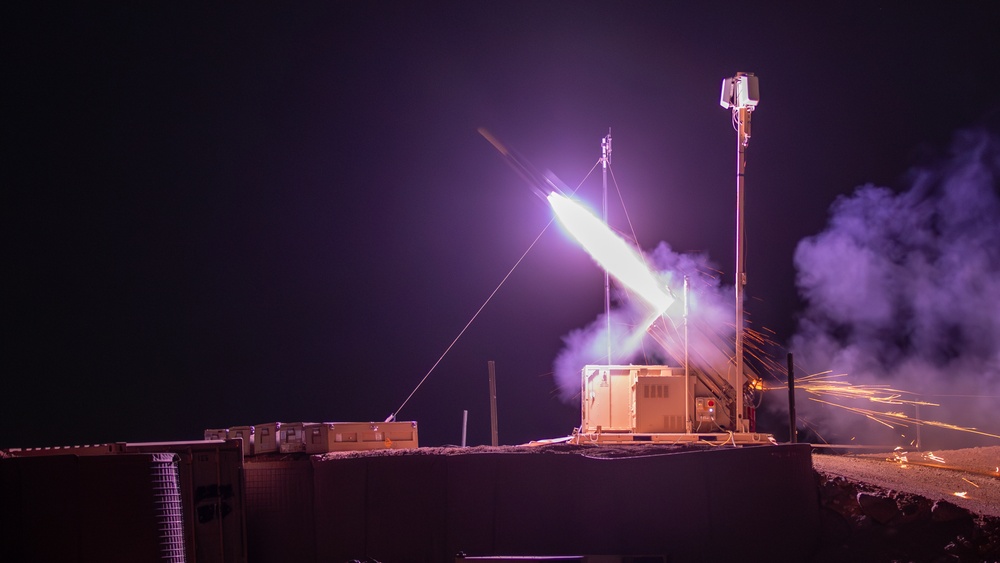
Mykhailo Fedorov, Ukraine's former defense minister, has shown the first product linked to his new defense-technology company. It is an interceptor drone built to hunt Russia's jet-powered Geran-5, and he says it has already scored kills over Kyiv.
"Our new interceptor is already taking down jet-powered Shaheds over Kyiv. Two Geran-5s down in its first week," Fedorov said in a video uploaded on Oct. 12, according to the Kyiv Independent. A day later, an industry source confirmed to Janes that Fedorov's new company will produce interceptor UAVs aimed at Russia's jet-powered drones, with Palantir Technologies as its first investor.
The two shoot-downs are Fedorov's own claims. None of the reports cited here independently confirm them.
What Fedorov Showed
Fedorov posted the first combat results on Telegram on Oct. 12, Interfax-Ukraine reported. He said two Geran-5s had been shot down over Kyiv. The interceptor has not been given a public name.
He described a very short development cycle. "It took just one month from the start of development to the first confirmed shoot-downs," Fedorov wrote, according to Interfax-Ukraine. The Kyiv Independent reported the same claim: one month from concept to the first successful tests.
The drone was developed with Pavlo Yelyzarov, who commands the unmanned systems unit of Lasar's Group, working with military personnel and engineers, Interfax-Ukraine said. Lasar's Group is a special forces unit within the 27th Separate Brigade of Ukraine's National Guard, according to the Kyiv Independent. Janes reported that the group's crews tested the interceptor in Kyiv.
The reports describe the timeline in slightly different ways. Fedorov's quoted video says the two kills came in the interceptor's "first week." Interfax-Ukraine quotes him saying the military shot down the two drones "in just a few days." Janes says the drone struck two Geran-5 turbojet UAVs "in the span of one month" of combat tests, citing Fedorov. All versions come from Fedorov, and none gives dates for the individual engagements.
The Target: A Jet Shahed
The Geran-5 is a different problem from the propeller-driven Shahed-type drones Ukraine has spent years learning to counter. The Kyiv Independent put its maximum speed at 600 km/h (370 mph) and said it flies significantly higher and faster than Russia's older drone models. Fabian Hoffmann of the Norwegian Institute for Defence Studies told the outlet that the Geran-5 "much more resembles a low-cost cruise missile" than a long-range drone like the original Shahed derivatives.
That speed matters for interceptors. A cheap drone that can catch a slow, propeller-driven Shahed may not be able to catch a turbojet target. Fedorov's pitch is that his team has built one that can, and quickly. He said its speed lets it intercept jet-powered Shaheds before they reach the city, according to Interfax-Ukraine.
Human Pilot Now, Autonomy Later
Autonomy is a stated goal, not a demonstrated feature. According to Janes, the interceptor is currently flown by a human pilot, and Fedorov confirmed the aim is to make it autonomous by integrating artificial intelligence. Janes quotes his Oct. 12 post as saying the goal is to make the interceptor "fully autonomous, capable of detecting and engaging Russian drones without operator involvement." Interfax-Ukraine carries the same goal in similar words. Janes said no other details were provided on the level of autonomy.
Readers should not assume either Geran-5 kill was made without a human operator. The available reporting says the aircraft is piloted today.
The Company and the Palantir Money
The interceptor is the first public look at a venture Fedorov announced on Sept. 1. At the time, the Kyiv Independent reported that he planned to start a defense technology company with Palantir CEO Alex Karp as its top investor. The two had met on Aug. 31 at Palantir's office in Washington. Fedorov said then that Ukraine would be the company's priority and that more details would follow.
Janes' Oct. 13 report links the two stories, describing the interceptor as a key product of Fedorov's new, still-unnamed technology company and Palantir Technologies as its first investor. Neither Janes nor the earlier reporting gives the size or terms of Palantir's stake.
The production target is aggressive. "By the end of 2026, we plan to produce hundreds of these interceptors per month," Fedorov said, according to Janes. Interfax-Ukraine reported that he said the team is refining the technology and scaling up production, with the next step being to expand combat deployment to protect more cities. He also said the jet interceptor is only one of several projects under way.
Why It Matters
Jet-powered one-way attack drones narrow the gap between cheap drones and cruise missiles. If Hoffmann is right that the Geran-5 behaves more like a low-cost cruise missile, defending against it with expensive surface-to-air missiles is hard to sustain. The Kyiv Independent noted that multiple Ukrainian and Western defense companies are racing to build interceptors for these faster targets, and it cited President Volodymyr Zelensky's Sept. 28 acknowledgment that Ukraine currently shoots down only 57% of jet-powered drones, "much less than necessary." A drone interceptor that can reach a fast jet target could, if it works at scale, offer a cheaper way to defend, and that is the core of Fedorov's offer.
Several things remain unproven. The combat claims come only from Fedorov. The reported one-month development cycle says nothing yet about reliability across many engagements. The tests so far were carried out by crews of a single National Guard special forces unit, and going from that to hundreds of interceptors per month by the end of 2026, less than three months away, would be a major industrial step. The human-piloted state of the system today, against the autonomy Fedorov says he is aiming for, also means its eventual capability is not yet clear.
The venture itself is notable too. A former defense minister has moved into a privately funded company with a major U.S. defense-software firm as its first investor, and has put out a product with claimed combat results about six weeks after announcing the company. Whether that model can deliver interceptors at scale is the next thing to watch.
Sources
- Palantir to fund Ukrainian interceptor UAV company targeting Russia's Geran-5 (Janes)
- New interceptor drone destroys two Russian Geran-5 drones in first week, Fedorov says (Kyiv Independent)
- Former Defense Minister showcases combat results of new interceptor drone: two Geran-5 drones shot down (Interfax-Ukraine)
- Ukraine's former defense minister Fedorov to open defense tech firm with backing from Palantir CEO (Kyiv Independent)
