
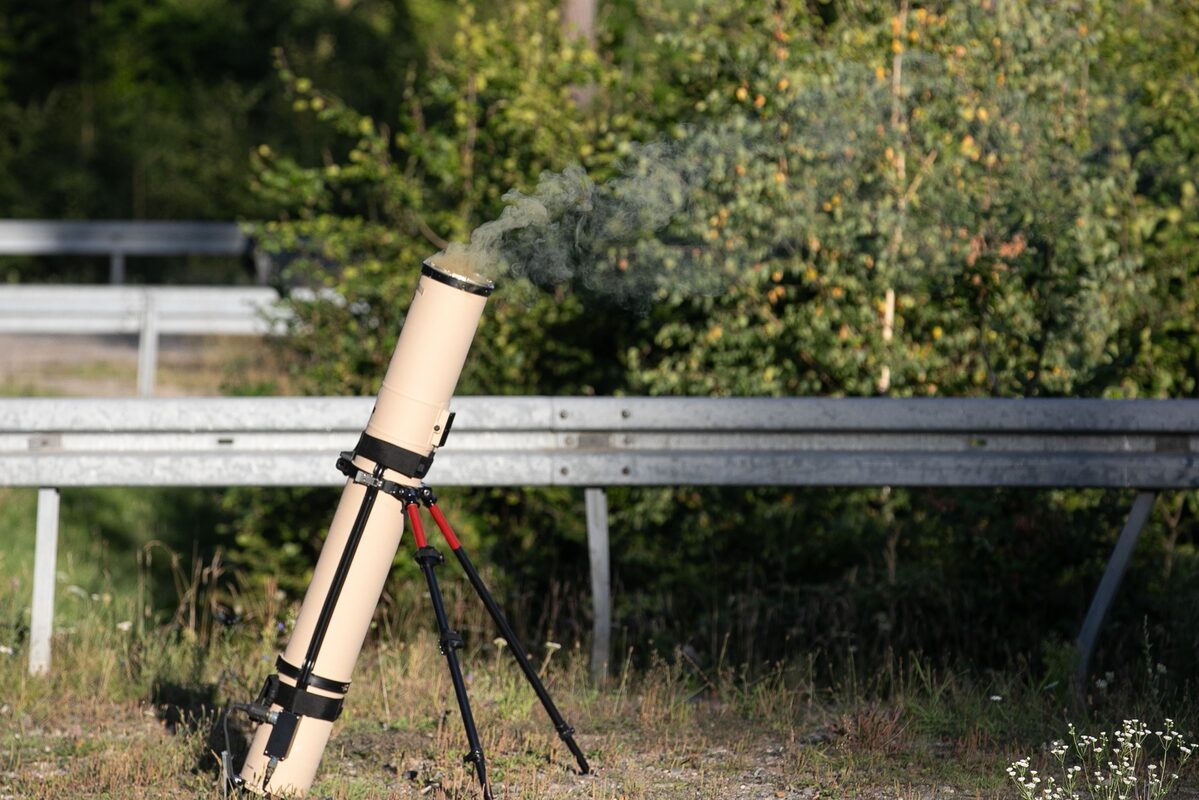
The Indian Air Force has done something it rarely advertises: it has roughly doubled the striking reach of one of its indigenous loitering munitions without fielding an entirely new weapon. According to reporting by Janes, the service has procured a longer-range variant of the Sureshastra Mk1 built by Delhi-based Veda Aeronautics, extending the weapon's reach from an original figure of more than 150 km to as much as 300 km.
The contract, awarded in early 2026, is worth INR 3 billion — about USD 31 million. That figure mirrors, almost exactly, an earlier INR 3 billion order the IAF placed in 2023 for the original 150-plus-kilometre version. In other words, India paid roughly the same money the second time around and walked away with double the range. The company describes the new variant as "enhanced based on operational feedback" — the kind of phrasing that signals the first batch has already been through the wringer of real-world use.
What the Sureshastra Mk1 Actually Is
Strip away the marketing and the Sureshastra Mk1 is a compact, fixed-wing loitering munition designed to look and behave more like a small cruise weapon than a quadcopter. Per Janes, it measures 3.5 m in length with a 3 m wingspan and carries a distinctive V-tail. Crucially, it is jet-powered rather than propeller-driven, and it is catapult-launched — meaning it does not need a runway, a large launch vehicle, or a conventional airfield to get airborne. A crew can set it up, fling it off a launch rail, and send it downrange.
Two design claims stand out. The first is that the Sureshastra Mk1 is built to operate in GPS-denied environments. On a modern battlefield saturated with jamming and spoofing, a loitering munition that falls out of the sky the moment its satellite fix is cut is close to useless; a weapon that can navigate without it is a genuinely different proposition. The second is that the Mk1 is swarm-capable, able to coordinate with other airframes for multi-target engagement rather than being flown one-at-a-time by a single operator.
The airframe is pitched as a multi-role system. Janes lists three roles: strike, in which the munition flies to a target and detonates; intelligence, surveillance and reconnaissance (ISR), where it loiters and feeds back imagery; and decoy, where it can be used to bait and expose enemy air defences. That flexibility is part of why a single platform is attractive to a service that would otherwise need several different systems.
The Range Ladder: 150, 300, 500, 1,500
The 300 km procurement is only one rung on a ladder Veda Aeronautics is openly climbing. The lineup, as laid out by Janes, breaks down like this:
- Original Mk1 — more than 150 km range; the subject of the 2023 IAF contract.
- New Mk1 variant — up to 300 km; the early-2026 procurement worth INR 3 billion.
- Sureshastra Mk2 — more than 500 km range, currently in flight trials.
- Future system — a weapon designed for more than 1,500 km, described as being in development.
That top-end figure is the headline that will draw the most attention outside India. Veda Aeronautics has said the 1,500-plus-kilometre system is modeled on the design principles of Iran's Shahed-series loitering munitions — the long-endurance, cheap-to-build, delta-and-canard family that has reshaped thinking about deep strike over the past several years. A 1,500 km-class weapon is no longer a tactical battlefield tool; it is a strategic-reach instrument capable of holding targets far behind an adversary's front line.
Why Range Doubling Costs So Little
The near-identical price tags on the 2023 and 2026 contracts raise an obvious question: how do you double range for the same money? The reporting does not spell out the engineering, so anything beyond the documented facts would be speculation. But the "enhanced based on operational feedback" framing suggests an iterative refinement of an existing airframe rather than a clean-sheet redesign — the sort of incremental gain that comes from fuel-fraction tweaks, propulsion tuning and aerodynamic clean-up rather than a wholly new and more expensive platform. What is documented is the outcome: the same INR 3 billion outlay, twice the reach.
Why It Matters
Loitering munitions have become one of the defining weapons of contemporary conflict, and range is the single variable that most changes what they can threaten. A 150 km weapon holds a border zone; a 300 km weapon reaches operational depth; a 1,500 km weapon reaches into strategic territory. By buying the 300 km Sureshastra Mk1 at the same price as the original, the IAF has extended that reach quietly and cheaply — the kind of capability jump that does not require a splashy new-program announcement and can be absorbed into existing force structure.
There is also an industrial signal here. Veda Aeronautics is a Delhi company delivering an indigenous, jet-powered, swarm-capable, GPS-denied-tolerant munition to India's air force under repeat contracts — a marker of a maturing domestic loitering-munition industry rather than a one-off prototype. And the explicit acknowledgment that the future 1,500 km system borrows from Shahed-series design principles is telling: the proven, low-cost, long-range Iranian template is now shaping procurement thinking well beyond its origin, and a nuclear-armed regional power is building toward that class of reach. For India's neighbours, and for anyone tracking the diffusion of deep-strike loitering munitions, the Mk1 order is less interesting for what it is than for the ladder it sits on.
Two caveats are worth keeping in view. The Mk2's 500 km range is a flight-trial figure, not a fielded capability, and the 1,500 km system remains in development — so the far end of Veda's ladder is aspiration backed by testing, not yet an operational weapon. What is contracted and paid for today is the 300 km Mk1.