
The US Army runs a small fleet of ships that few people outside logistics circles know about, and it is spread thin across the Pacific. At the Association of the US Army (AUSA) annual meeting on Oct. 12, the general responsible for much of that fleet said the service will not close the gap by building more crewed boats alone.
"We're also moving into the autonomous lane," Maj. Gen. Frederick L. Crist, commanding general of the 8th Theater Sustainment Command, told a briefing, according to Janes. He said that "just in August, USARPAC had the opportunity to conduct an experiment by retrofitting an existing commercial vessel ... with a kit to provide autonomous navigation."
That vessel was the HOS Resolution, a 257-foot offshore supply ship. The experiment shows how US Army Pacific (USARPAC) plans to move cargo across the region's long distances when it has too few ships and too few mariners to crew them.
A Fleet Stretched Thin
Army watercraft carry vehicles, containers and supplies between ships, piers and shorelines where large vessels cannot easily go. In the Indo-Pacific, distances are vast and ports may be contested, so that job matters more there than almost anywhere. The fleet is small. The War Zone reports that the Army has eight Logistics Support Vessels (LSVs) in total. As of 2024, the 5th Transportation Company had two LSVs, 10 Landing Craft Utility (LCUs) and four tugs, according to Government Accountability Office figures cited by the outlet.
Stars and Stripes described the August test as part of a five-pronged strategy to cope with the Army's watercraft shortage. The strategy also includes pulling prepositioned watercraft out of storage, using contractor-owned, contractor-operated watercraft, training Army mariners on contracted vessels and leveraging host-nation capacity in places such as Japan and the Philippines. Crist's AUSA remarks touched on the commercial side of that mix. Maritime distribution "will not be solved entirely by army watercraft; it's going to be a broad portfolio of systems-of-systems," he said, per Janes. That portfolio includes commercially owned and operated operational support vessels contracted through US Transportation Command (USTRANSCOM). The Army is also considering commercial vessels crewed by Army mariners. Janes also notes the Army has begun replacing its legacy LCM-8 landing craft with the Maneuver Support Vessel Light (MSV(L)).
The force structure is changing too. The War Zone reports that a second composite watercraft company is planned at Yokohama North Dock in Japan, and that the 10th Support Group on Okinawa has been reflagged as the 45th Sustainment Brigade.
The Resolution Experiment
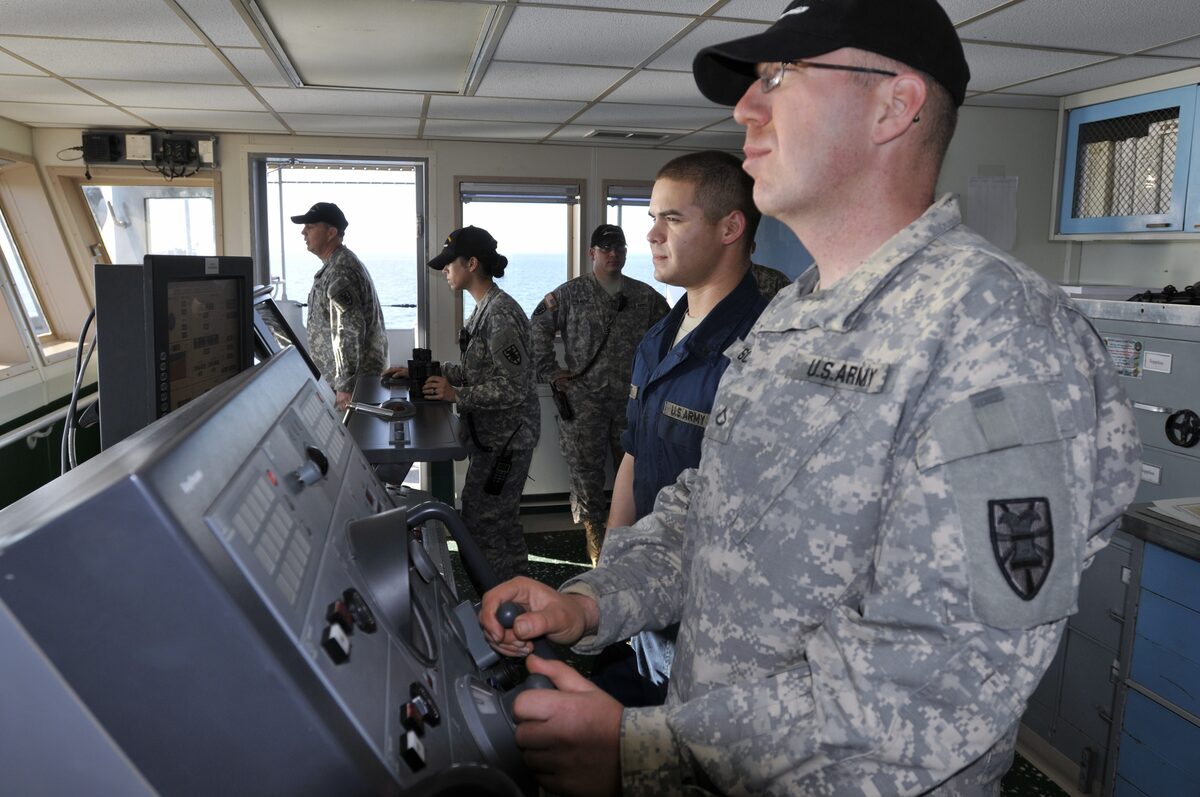
The HOS Resolution belongs to Louisiana-based Hornbeck Offshore Services. It is a commercial workboat, not a purpose-built military vessel. According to Stars and Stripes, the ship left Pearl Harbor on Monday, Aug. 17, for an 18-hour fully autonomous open-sea transit to the Big Island of Hawaii, with the return trip set for that Wednesday. Army mariners with the 8th Theater Sustainment Command oversaw the voyage.
Boston-based Sea Machines Robotics supplied the autonomy. Its SM300 is a drop-in system, and the company spent nine days in Louisiana in May installing it aboard the Resolution. Tanner Stiker of Sea Machines told Stars and Stripes that the system is on upwards of 230 vessels. He also said the Resolution is the largest boat retrofitted with autonomy across the Defense Department.
The Resolution stayed fully crewed during the test. Chief Warrant Officer 2 Joshua Way told Stars and Stripes the goal is to send a vessel of this size into a contested environment and have it dock or deploy its ramp, controlled from a remote location.
From Bridge Kit to Full Autonomy
Crist described a phased approach, according to The War Zone. The first step is retrofit kits that handle navigation, which is what the Resolution test demonstrated. Later kits would cover propulsion and engine-room functions, and the end state is fully autonomous vessels. A navigation kit takes over steering and route-following, but a ship still needs people for many other tasks, such as tending engines and handling lines. Stiker told Stars and Stripes that engine-room automation is a planned second phase of testing, and The War Zone suggests that blending autonomy with propulsion and engine-room activities could improve reliability and reduce maintenance demands, which would be a bigger change than navigation alone.
The War Zone reports that the Army wants to add autonomy to both its current and future watercraft. It also wants to acquire up to 100 purpose-built uncrewed surface vessels (USVs). The figure comes from earlier in the year. In June, according to Military Times as cited by The War Zone, Maj. Gen. Gavin Gardner told reporters he wanted as many as 100 drone boats, some able to carry eight to 10 shipping containers. UASFeed has not reviewed the original Military Times report, so that figure is relayed here secondhand.
The Navy's Cautionary Example
Adding autonomy to a ship does not mean anyone will use it. The War Zone notes that the Navy modified USNS Apalachicola with autonomous capabilities before its 2023 commissioning, but put the ship into service without any plan to use them operationally. The Army will face the same question: whether the kits become part of normal operations, with the training, procedures and command trust that requires, or stay a demonstration capability that sits idle.
Why It Matters
The Army's maritime logistics problem comes down to numbers. It has eight LSVs in the whole service and a modest number of landing craft and tugs at its Japan-based composite watercraft company, and it must cover a theater of vast distances. Every additional crewed ship also needs a trained crew. A kit that a vendor can install on an existing commercial hull in nine days offers a much faster way to add capacity. It also fits with the Army's broader plan to use contracted commercial shipping, which Crist described as part of a portfolio of systems.
The Resolution test also matters for the wider uncrewed-systems field. Much of the attention on maritime drones has gone to small, fast attack craft. The Army's interest is less dramatic: autonomous ships that carry cargo into places where putting a crew at risk is undesirable. If the service follows through on autonomy for existing ships and a fleet of up to 100 purpose-built USVs, uncrewed logistics vessels could become a real part of Pacific sustainment rather than a side experiment.
Much remains unproven. The public reporting does not detail how the August transit performed. The engine-room and full-autonomy phases are still plans (Stiker described the engine-room work as a planned second phase), and the 100-USV goal has not been confirmed in a primary source reviewed by UASFeed. The Apalachicola shows that installing autonomy is only the first step. The test of the Army's approach will be whether its mariners trust and use the systems in exercises and operations.
