
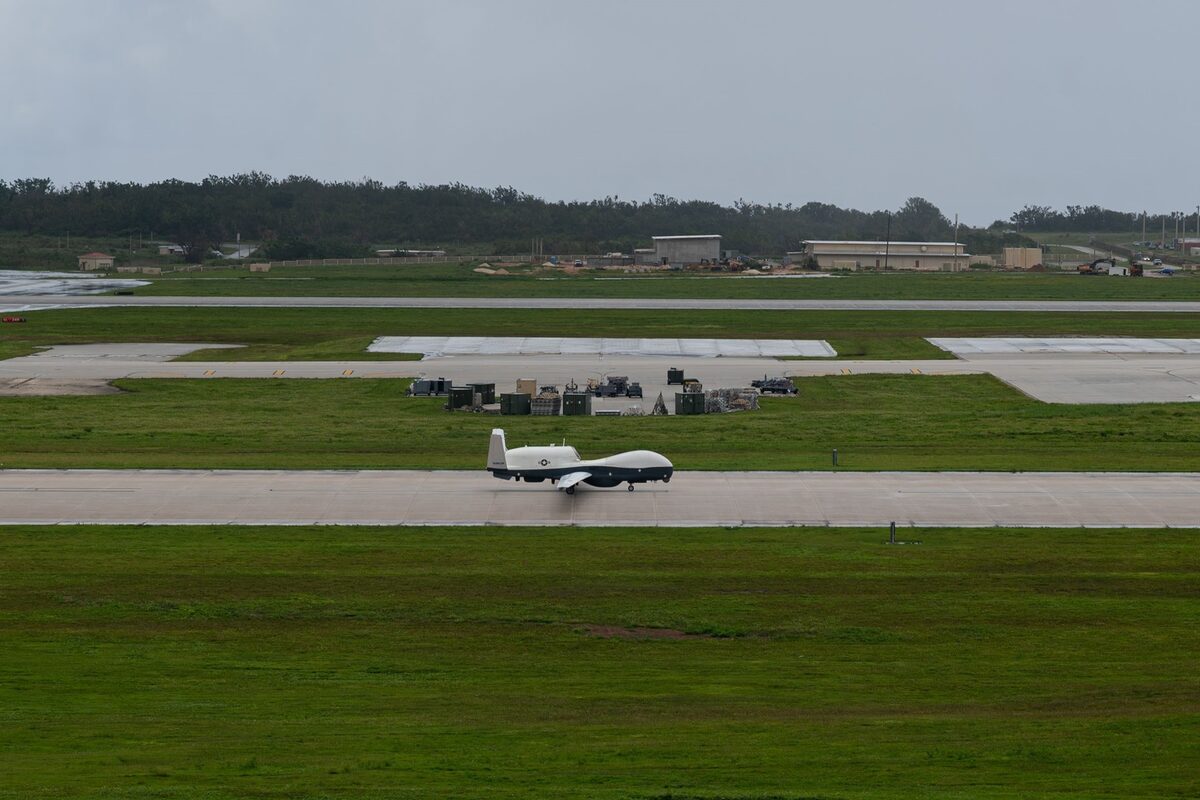
Four NATO allies have taken the first formal step toward buying one of the alliance's largest unmanned aircraft. At the NATO Summit's Defence Industry Forum in Ankara, Turkey, on July 7, 2026, Denmark, Finland, Germany, and Norway signed a letter of intent to jointly procure up to five Northrop Grumman MQ-4C Triton high-altitude, long-endurance drones, according to reporting from C4ISRNET, Defense News, The Defense Post, and Naval News.
The agreement is not a signed contract — a letter of intent signals political and budgetary commitment among the four nations to move toward acquisition, without locking in a price tag or delivery schedule. Neither figure has been disclosed. But the choice of aircraft, and the timing, is telling: the Triton is built specifically for the kind of persistent, wide-area ocean watch that NATO's northern flank has increasingly needed as Arctic shipping lanes open and Baltic seabed infrastructure has come under repeated scrutiny following cable and pipeline incidents in the region.
What the Triton Brings
The MQ-4C Triton is a Northrop Grumman-built unmanned aircraft derived from the RQ-4 Global Hawk airframe but purpose-built for maritime intelligence, surveillance, and reconnaissance. Per C4ISRNET's reporting, the aircraft cruises above 50,000 feet, can stay airborne for more than 24 hours at a stretch, and has a range of roughly 7,400 nautical miles — figures that let a single aircraft loiter over enormous stretches of open water far longer than a manned patrol plane could.
NATO Secretary-General Mark Rutte framed the acquisition in exactly those terms. "These aircraft can fly for long periods at high altitude and cover large areas, including over open water, more efficiently than most other aircraft can," Rutte said, according to C4ISRNET and Defense News, which both carried the remarks from the same July 7 announcement.
The four signatory nations are not entering unfamiliar territory. The Triton is already flying in U.S. Navy service, where, according to Naval News, it augments the P-8 Poseidon maritime patrol aircraft, and Australia is separately in the process of procuring four Tritons of its own. Northrop Grumman builds the aircraft itself, while a slate of European companies is being brought in to handle the ground segment and mission systems — meaning the four allies are buying into an established production and sustainment ecosystem rather than standing up a new one from scratch.
Not NATO's First Triton
This would not be the alliance's introduction to high-altitude ISR drones. The Defense Post's coverage places the new letter of intent alongside NATO's existing Alliance Ground Surveillance (AGS) fleet — a five-unit fleet of RQ-4D Phoenix aircraft. Naval News reports that the new Tritons will complement that AGS fleet, which operates from Sigonella airbase in Italy. The Ankara agreement effectively extends that high-altitude ISR concept northward and adds the maritime-specific Triton variant to the alliance's unmanned inventory, rather than replacing the Sigonella-based fleet.
European industry is also being written into the program from the outset. Naval News reports that while Northrop Grumman will build the Triton airframe, Airbus Defence and Space and other European companies will provide the ground segment, data management, command and control, infrastructure, and mission support — a division of labor The Defense Post's coverage also names Airbus Defence and Space as part of. C4ISRNET independently reports that European industry will handle mission support, data systems, and infrastructure, though its reporting does not name specific contractors. The overall structure is similar to how NATO's existing AGS fleet blends a U.S.-built airframe with allied operations and sustainment.
Geography Is the Point
The rationale offered by all four outlets centers on geography. Norway and Denmark both have direct exposure to the High North and the Greenland-Iceland-UK gap, a chokepoint historically watched closely for submarine and surface transit. Finland's accession to NATO brought a long Baltic and Arctic coastline into the alliance's collective surveillance responsibility. Germany, while less Arctic-facing, has significant Baltic Sea interests and has taken a leading role in funding alliance-wide capability gaps since 2022.
Together, the four nations' maritime approaches span the Atlantic sea lines of communication, the Baltic Sea, and Arctic waters — precisely the "large areas... over open water" Rutte referenced. None of the reporting specifies operating bases, squadron structure, or which of the four nations would host the aircraft, and no source indicates whether the eventual fleet would be pooled multinationally, as with the AGS Global Hawks at Sigonella, or split among national air forces.
What's Still Unknown
The publicly available reporting leaves several operational questions open. No cost estimate has been released — Triton unit costs in other national programs have historically run into the hundreds of millions of dollars per aircraft, but none of the four outlets cited a figure for this deal. No delivery timeline has been announced. It is also unclear whether "up to five" represents a firm order, a ceiling under negotiation, or a number that could shrink depending on how cost-sharing among the four nations is finalized. A letter of intent, by its nature, precedes contract negotiation, and each of these details would typically be resolved before a definitized purchase agreement is signed.
Why It Matters
The Ankara letter of intent is a concrete data point in a broader trend: NATO's northern and eastern members are converting years of rhetoric about Arctic and Baltic vulnerability into actual procurement. Undersea cable and pipeline damage in the Baltic over the past several years has repeatedly exposed how thin persistent maritime domain awareness is across that theater, and a high-altitude, long-endurance platform like the Triton is one of the few tools that can watch large volumes of water continuously rather than through periodic manned-aircraft sorties or satellite passes. Bundling four allies' demand into a single letter of intent also signals a preference for pooled, NATO-style capability development — echoing the AGS model at Sigonella — rather than each nation fielding a standalone national ISR drone fleet. Because no contract value, delivery date, or basing plan has been finalized, this remains a statement of intent rather than a done deal, and the specifics that determine how quickly the alliance's maritime surveillance gap actually closes are still to be negotiated.
Sources
- NATO to add up to five Northrop Grumman Triton drones for maritime surveillance — C4ISRNET
- NATO Eyes Northrop Grumman's MQ-4C Triton Drone for Maritime ISR — The Defense Post
- Four NATO Allies to Procure Up to Five MQ-4C Triton HALE UAVs — Naval News
- NATO to add up to five Northrop Grumman Triton drones for maritime surveillance — Defense News
