
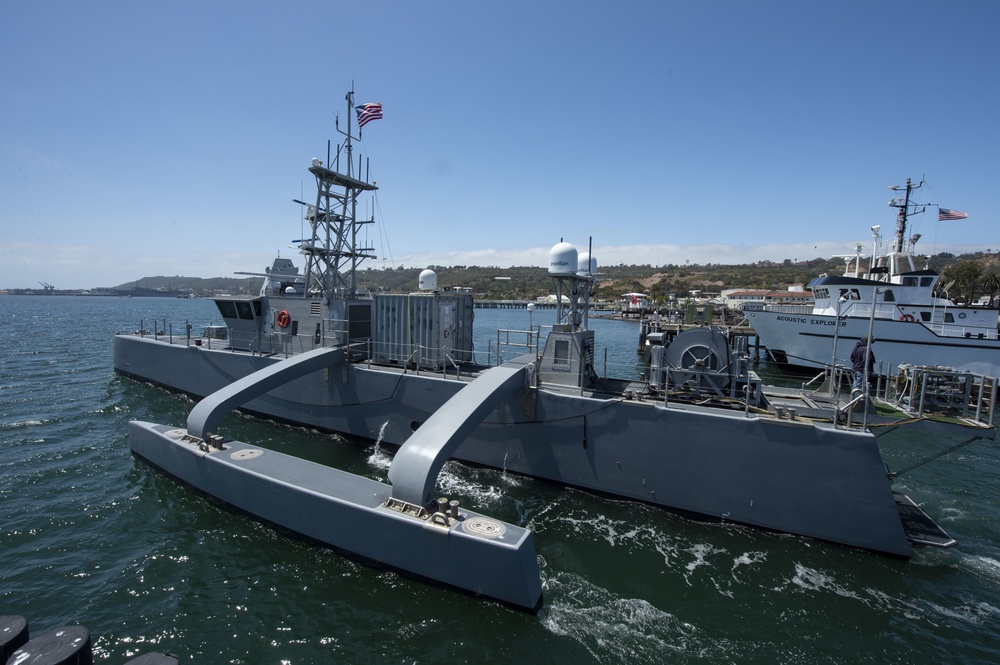
The U.S. Navy is preparing to open the next chapter of its Medium Unmanned Surface Vessel (MUSV) "marketplace," with a request for prototype proposals set to drop Aug. 1, 2026. This time, the service is zeroing in on a specific mission set: high-capacity logistics vessels capable of hauling containerized payloads across the water without a crew aboard, Defense One reported July 9.
The announcement, confirmed by a Navy spokesperson, is the latest signal that the service's unconventional acquisition approach for unmanned surface vessels — recurring, competitive "marketplaces" rather than a single locked-in program of record — is becoming the default way the Navy intends to build out its drone-boat fleet. "The MUSV continues to be a strictly Navy-led program," the spokesperson told Defense One. "We will evaluate all requirements and release recurring marketplaces as the fleet demand signal evolves."
What the August RFP Is Actually Asking For
The upcoming solicitation narrows in on logistics-support vessels: unmanned surface craft built to move containerized cargo point to point, presumably to resupply distributed naval forces without tying up crewed hulls or helicopters. It's a more specific ask than a general-purpose USV requirement, suggesting the Navy has moved past broad concept validation and is now shopping for vessels tailored to a defined operational problem — sustaining a distributed fleet, likely in the Indo-Pacific, where distances between resupply points are enormous.
That focus builds directly on requirements the Navy has already published for the MUSV line: vessels capable of roughly 2,500 nautical miles of range at 25 knots, a 25-ton payload capacity, and the ability to operate in up to sea state 7 — rough enough water to sideline a lot of smaller craft. Whether the August logistics-specific RFP will hew to those exact numbers or introduce its own benchmarks remains to be seen, but the underlying design pressure is the same: long endurance, heavy lift, and open-ocean survivability, all without a crew.
How We Got Here: From MASC to the Marketplace
The MUSV marketplace model is a fairly recent pivot. In March 2026, the Navy terminated the Modular Attack Surface Craft (MASC) program, a more traditional program-of-record effort, in favor of the marketplace approach. Rebecca Gassler, the Navy's portfolio acquisition executive for robotic and autonomous systems, framed the shift as a way to skip the years-long gap between prototype testing and fielded capability. "Our goal is to create a regular and recurring marketplace, not just for the MUSV, but for other classes of vessels as well, over time, designed to match the growing demand for unmanned systems across a range of missions," Gassler said at the time. Rather than a year of prototyping and development, she said, the Navy would review a company's business plan and manufacturing capabilities, run an at-sea test, and then it would be "off to the races" for production.
That philosophy played out in May, when the Navy selected seven companies to build and demonstrate MUSV prototypes at sea: Sea Machines, Leidos, Saronic Technologies, Galliano Marine Services, PacMar Technologies, Birdon, and Huntington Ingalls Industries. The mix spans established defense primes and shipbuilders alongside newer autonomous-vessel specialists — a deliberate hedge that lets the Navy compare radically different design philosophies side by side rather than betting the program on a single contractor's approach.
At-sea testing for that cohort is running from roughly June or July through October 2026, depending on the source. Winners of that demonstration phase receive $15 million each, according to Naval News, and become eligible to move into fixed-price production contracts or leasing agreements, with first deliveries expected as early as fiscal year 2027, per Navy Times.
The Money and the Math
The scale of ambition behind the marketplace is tied directly to the 2026 reconciliation bill, colloquially referred to in Navy reporting as the "One Big Beautiful Bill." C4ISRNET reported the effort is backed by roughly $2.1 billion from that legislation. Naval News, citing Navy planning documents, reported a larger, multi-year figure: about $1.95 billion invested in fiscal year 2026 alone — enough to procure 36 MUSVs — plus another $3 billion allotted over the following five years, for a total of roughly $5 billion and 81 vessels procured by fiscal year 2031.
Whatever the precise dollar figure that ultimately lands, the trajectory is the goal that ties it all together: the Navy's "Golden Fleet" push aims to grow the unmanned surface fleet from just 4 vessels today to 30 by 2030, with the buildup weighted toward the Indo-Pacific theater.
Why It Matters
The MUSV marketplace is a live test of whether the Pentagon can actually acquire uncrewed hardware at the speed its own rhetoric demands. Ditching the MASC program of record for a recurring, multi-vendor competition is a bet that fielding capability fast — testing on the water and moving straight into production, in Gassler's words — beats the slower certainty of a traditional single-award program. If it works, the MUSV effort becomes a template other services and other domains within the Navy could copy. If the August logistics RFP stalls, or if the at-sea demonstrations wrapping up in October reveal reliability gaps in sea state 7 conditions or the 25-ton payload targets, it will test how much political and budgetary patience remains behind the Golden Fleet's 4-to-30-vessel target by 2030. With $2.1 billion in reconciliation funding and a roughly $5 billion, six-year procurement plan already in play, the stakes for getting the acquisition model right — not just the hardware — are now measured in billions of dollars and a hard six-year deadline.
