
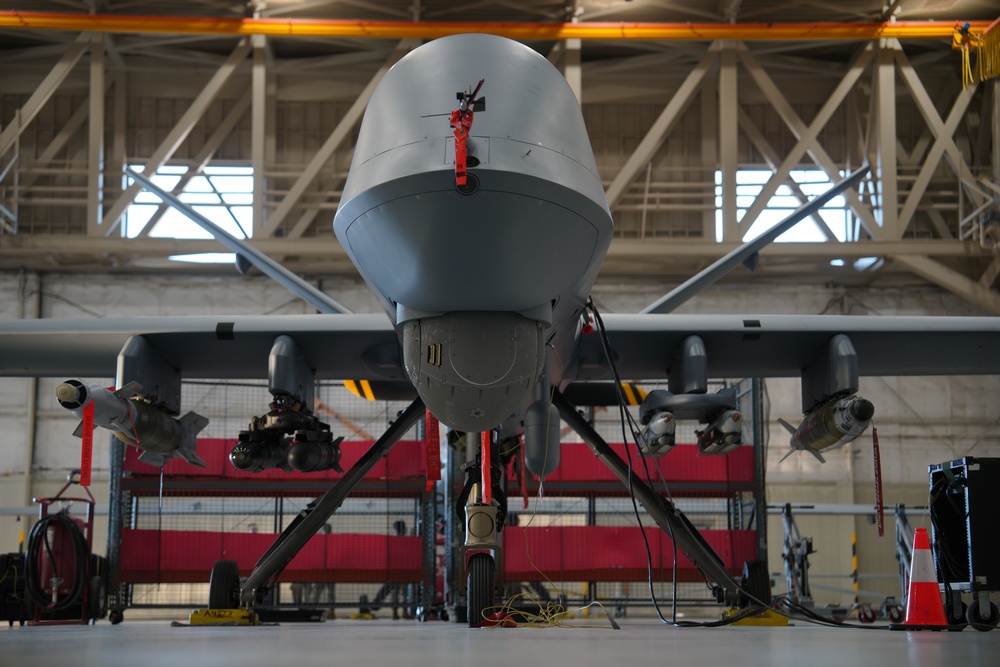
The Defense Innovation Unit has opened the bidding for what it hopes will be the next generation of American hunter-killer drones — and it wants them cheap, modular, and built to be lost in combat without wrecking the budget. On March 13, 2026, DIU updated a Commercial Solutions Opening titled "Massed Modular Aircraft" (MMA), a solicitation seeking a low-cost, mass-producible unmanned aircraft to take over the strike and intelligence, surveillance and reconnaissance missions currently flown by the General Atomics MQ-9A Reaper. Responses are due July 23, 2026, at 11:59:59 PM ET.
The timing is not subtle. According to reporting from Breaking Defense and Aerohaber, the push comes after the U.S. lost nearly 30 MQ-9A Reapers during recent operations against Iran — a staggering attrition rate for an aircraft that has anchored American armed overwatch missions for two decades. DIU's own language, cited in both outlets, frames the problem bluntly: continued reliance on "low-density, high-value" aircraft like the Reaper is "unsustainable" against modern, advanced air defenses.
What DIU Is Actually Asking For
The solicitation, filed under opportunity number PROJ00626, lays out a demanding but achievable performance envelope for a next-generation medium-altitude drone. Per the official DIU submission page, the aircraft must deliver:
- A minimum payload of 2,800 pounds
- A combat radius of at least 2,300 nautical miles
- A self-deploy range of at least 8,000 nautical miles, one-way
- Cruise airspeed of at least 200 knots true airspeed
- The ability to operate from runways 6,000 feet or shorter
- Onboard power generation of 25 kW with 5 kW of cooling capacity for sensors and payloads
DIU wants a full-scale flying prototype within 21 months of contract award — an aggressive schedule by traditional acquisition standards, but consistent with the agency's mandate to move faster than the Pentagon's legacy procurement pipeline. The program's ultimate target is 20 mission-ready aircraft fielded by fiscal year 2031.
Perhaps the most consequential number in the solicitation isn't a performance spec at all: cost. DIU's own solicitation language defines "exquisite" aircraft as those costing $30 million or more and explicitly frames that price class as unsustainable — a clear signal that DIU wants MMA priced below that threshold. That would mark a significant reduction from the Reaper's price tag, which Aerohaber puts at up to $50 million per aircraft depending on configuration — roughly a 40 percent cut in unit cost or more for an aircraft expected to match or exceed the Reaper's reach and payload.
An OTA Built for Speed — and Skin in the Game
DIU is running the MMA competition as an Other Transaction Agreement under 10 U.S.C. 4022, the authority the Pentagon increasingly leans on to bypass the slower Federal Acquisition Regulation process for prototype work. That legal structure comes with a catch: to qualify, bidders must satisfy at least one of three conditions — participation by a nontraditional defense contractor or nonprofit research institution to a significant extent, an all-small-business team, or a contribution of at least one-third of the prototype's cost from non-federal sources.
That cost-share option is a deliberate filter. It pushes out pure paper proposals and rewards companies willing to put their own capital behind a design they believe in. It also opens the door to a wider field of entrants than a traditional Reaper follow-on competition might have drawn — from established prime contractors to newer drone manufacturers that have built reputations on attritable, lower-cost airframes.
Notably, the solicitation also signals that DIU expects follow-on production contracts to be awarded without further competition once a winning design is validated — a strong incentive for companies to invest heavily in the initial bid, since the prototype phase could effectively decide who builds the production run.
General Atomics: Out of Production, Not Out of the Fight
The most pointed subplot in this competition involves General Atomics Aeronautical Systems, the company that has built the MQ-9 Reaper family for the better part of two decades and, by extension, the incumbent DIU is explicitly trying to unseat. General Atomics halted MQ-9A production in 2025, but the company has confirmed it intends to compete for the MMA contract rather than cede the mass-produced strike-ISR drone market to a challenger.
"Competition brings out the best in General Atomics, and keeps us on our toes," company president David Alexander said in comments reported by Breaking Defense and Aerohaber. "We're going to respond, and we're going to offer America something no other company possibly can — a chance to retain its 30-year investment in this technology with a superior product that exceeds the requirements and dramatically reduces risk to success."
That response will be closely watched. General Atomics has more institutional experience building and sustaining medium-altitude, long-endurance armed drones than any other U.S. company, but the MMA program is explicitly designed to reward a different manufacturing philosophy — modular, mass-producible, and priced to be expendable — rather than the exquisite, decades-long sustainment model the Reaper represented. Whether General Atomics can retool around that philosophy, or whether a newer entrant without legacy Reaper baggage has the advantage, is likely to be one of the defining storylines of this competition.
Why It Matters
The MMA program reflects a broader reckoning underway across the U.S. military's unmanned aircraft posture. The MQ-9 Reaper was built for a permissive air environment — flying largely uncontested over conflict zones where adversaries lacked sophisticated integrated air defense systems. Losing nearly 30 of them in a single set of operations against Iran is a hard demonstration that those conditions no longer hold, and that a $50 million aircraft flown in relatively small numbers is a liability against modern surface-to-air missile networks and electronic warfare.
DIU's solution — cheaper, modular, mass-producible aircraft explicitly designed "with the expectation that some will be lost in combat," as the agency put it — mirrors a shift already visible in Ukraine and in other U.S. attritable-drone efforts: trade exquisite capability per airframe for numbers, resilience, and replaceability. A fleet of sub-$30 million drones that can absorb losses without crippling a squadron's combat power is fundamentally more survivable than a smaller fleet of $50 million aircraft that each represent an outsized operational and financial loss when shot down.
The 21-month prototype timeline and fiscal 2031 fielding goal also test whether DIU's OTA-driven acquisition model can deliver a genuinely new class of aircraft — not just a software tool or a small tactical drone, but a full medium-altitude strike/ISR platform with intercontinental self-deploy range — on a schedule that would be unthinkable under traditional Pentagon acquisition rules. If it works, MMA could become a template for how the U.S. replaces other aging, high-value unmanned platforms. If General Atomics wins with a modernized design, it validates the incumbent's ability to adapt to a lower-cost mass-production model. If a challenger wins, it would mark one of the most significant realignments in the U.S. military drone industrial base since the Reaper itself entered service.