
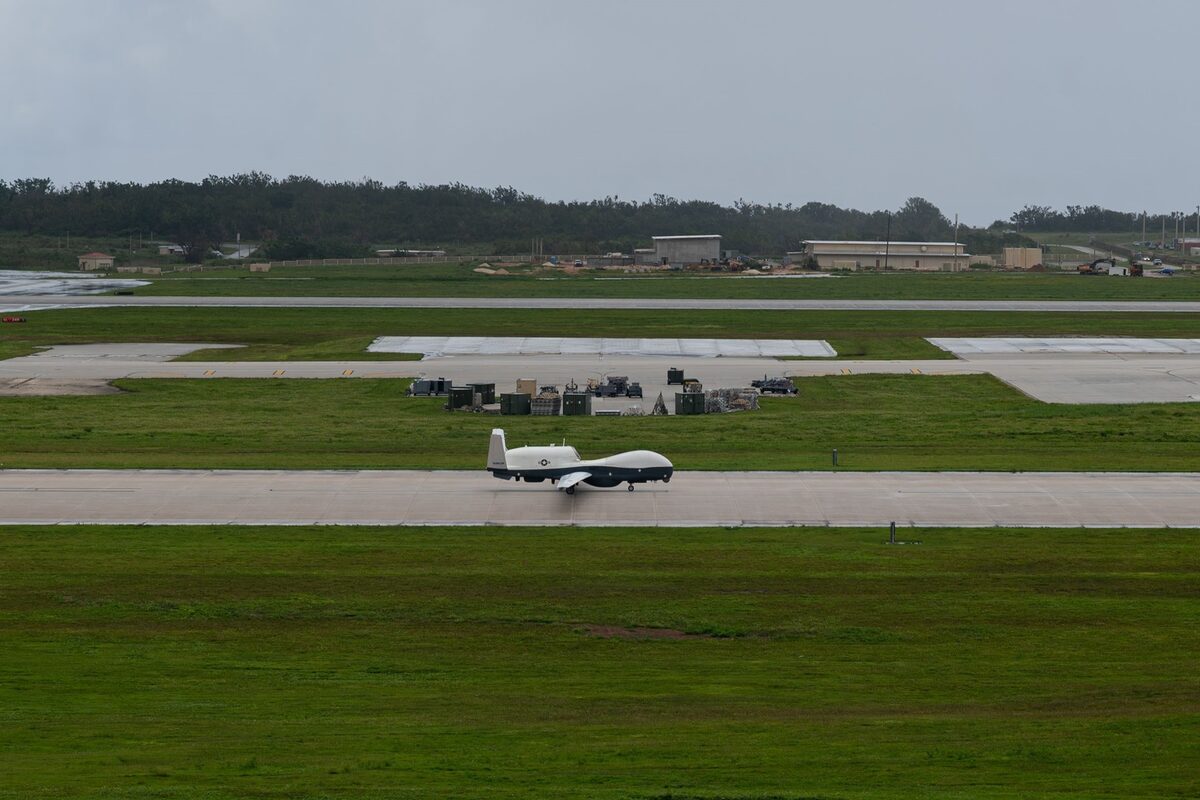
NATO is adding a new high-altitude surveillance drone to its alliance-owned fleet. Denmark, Finland, Germany and Norway announced on July 7, 2026, at NATO's Defence Industry Forum in Ankara that they will jointly procure up to five Northrop Grumman MQ-4C Triton unmanned aircraft, marking the alliance's first acquisition of the maritime-focused, high-altitude, long-endurance platform.
The announcement was delivered by NATO Secretary-General Mark Rutte at the Ankara forum, where the Triton buy was unveiled alongside other air-defense and surveillance investments, including the Saab GlobalEye aircraft NATO selected for its airborne early-warning and control role. Rutte framed the Triton procurement as evidence of transatlantic industrial cooperation, saying the program "is genuinely made in NATO and is creating jobs on both sides of the Atlantic."
What the Triton Brings to NATO's ISR Picture
The MQ-4C Triton is built around persistence and reach. Northrop Grumman's airframe is engineered to fly above 50,000 feet, remain airborne for more than 24 hours per sortie, and cover a 7,400 nautical mile range — figures that let a single aircraft watch vast stretches of ocean without returning to base. Under the arrangement announced in Ankara, Northrop Grumman will build the airframes while European industry — including Airbus Defence and Space and other European companies — will supply mission support, data infrastructure and ground systems, distributing both the workload and the industrial benefit across the Atlantic.
That combination of altitude, endurance and range is purpose-built for maritime domain awareness — tracking shipping, monitoring undersea infrastructure, and watching for submarine and surface-vessel activity across areas too large for crewed patrol aircraft to cover continuously. For NATO, whose northern members have spent the past several years watching increased Russian naval and undersea activity near cables and pipelines in the Baltic and Norwegian Sea, that persistent maritime watch is the primary selling point.
Filling a Gap Next to the Phoenix Fleet
The Tritons will not operate alone. They are set to complement NATO's existing Alliance Ground Surveillance (AGS) fleet — RQ-4D Phoenix drones, a NATO-owned variant of the Global Hawk, based at Sigonella, Italy. The RQ-4D fleet has served as NATO's primary alliance-owned unmanned ISR capability, but it was designed primarily for overland and broad-area ground surveillance rather than the maritime-specific sensor package the Navy-derived Triton carries.
Adding Tritons effectively gives NATO a second unmanned ISR type with a distinct mission focus: RQ-4D for wide-area ground and general surveillance, MQ-4C for sustained maritime watch. Because the Triton is a maritime derivative of the same Global Hawk airframe family as the Phoenix, the two platforms can share elements of ground infrastructure and operating concepts even as they perform different roles — though none of the reports on the announcement specified whether the new Tritons will also be based at Sigonella or operate from a separate site.
Why the High North
The four nations behind the purchase — Denmark, Finland, Germany and Norway — are notable for their geography. Denmark (via Greenland and the Faroe Islands), Finland and Norway all sit on or near NATO's Arctic and High North flank, a region where sea ice retreat has opened new shipping lanes and where allied militaries have flagged growing Russian submarine and surface activity around subsea cables and pipelines. Persistent, high-altitude maritime surveillance is difficult to sustain in that environment with crewed patrol aircraft alone, given the distances involved and the harsh operating conditions — precisely the gap a long-endurance UAV is designed to fill.
No purchase price was disclosed in the announcement, and the reporting available does not specify a delivery timeline, a lead nation for the acquisition contract, or where the aircraft will ultimately be based.
Q&A: The Basics
How many Tritons are being bought, and by whom?
Up to five MQ-4C Triton aircraft, jointly procured by Denmark, Finland, Germany and Norway.
Is this NATO's first Triton?
Yes — reporting on the announcement describes it as NATO's first acquisition of the Triton platform, distinct from the RQ-4D Phoenix aircraft already flying in NATO's Alliance Ground Surveillance fleet.
What can the Triton do that the RQ-4D can't?
The Triton is a maritime-focused HALE (high-altitude, long-endurance) UAV, built for persistent surveillance of ocean and coastal areas, complementing the more ground-surveillance-oriented RQ-4D fleet already based at Sigonella.
Who builds it?
Northrop Grumman produces the airframe; European industry — including Airbus Defence and Space and other European companies — will contribute mission support, data infrastructure and ground systems.
What was announced alongside it?
Rutte's Ankara remarks also touched on other NATO air-defense investments, including the Saab GlobalEye aircraft selected for NATO's airborne early-warning and control role, positioning the Triton buy as part of a broader alliance ISR modernization push rather than a standalone purchase.
Why It Matters
This is NATO's first move to bring the Triton — a platform purpose-built for sustained maritime watch — into its own alliance-owned ISR inventory, rather than relying solely on member states' national assets or the ground-surveillance-oriented RQ-4D fleet. For a bloc increasingly focused on undersea infrastructure security and Arctic shipping-lane monitoring, a small fleet of aircraft that can loiter above 50,000 feet for more than a day at a stretch, covering thousands of miles of ocean per sortie, closes a real capability gap that crewed maritime patrol aircraft struggle to fill continuously. The joint procurement structure — four nations sharing the buy, with European industry supplying ground infrastructure around a US-built airframe — also signals how NATO intends to fund future alliance-owned capabilities: pooled national investment paired with transatlantic industrial participation, a model Rutte explicitly highlighted as a selling point in Ankara. With no price tag, timeline or basing decision yet public, the announcement is a commitment in principle; the details that follow will determine how quickly NATO's maritime blind spots in the High North actually start closing.
Sources
- NATO to add up to five Northrop Grumman Triton drones for maritime surveillance — C4ISRNET
- Four NATO Allies to Procure Up to Five MQ-4C Triton HALE UAVs — Naval News
- NATO Announces MQ-4C Triton Acquisition — The Aviationist
- NATO's Rutte says allies to buy up to five Triton surveillance drones — Al-Monitor
