
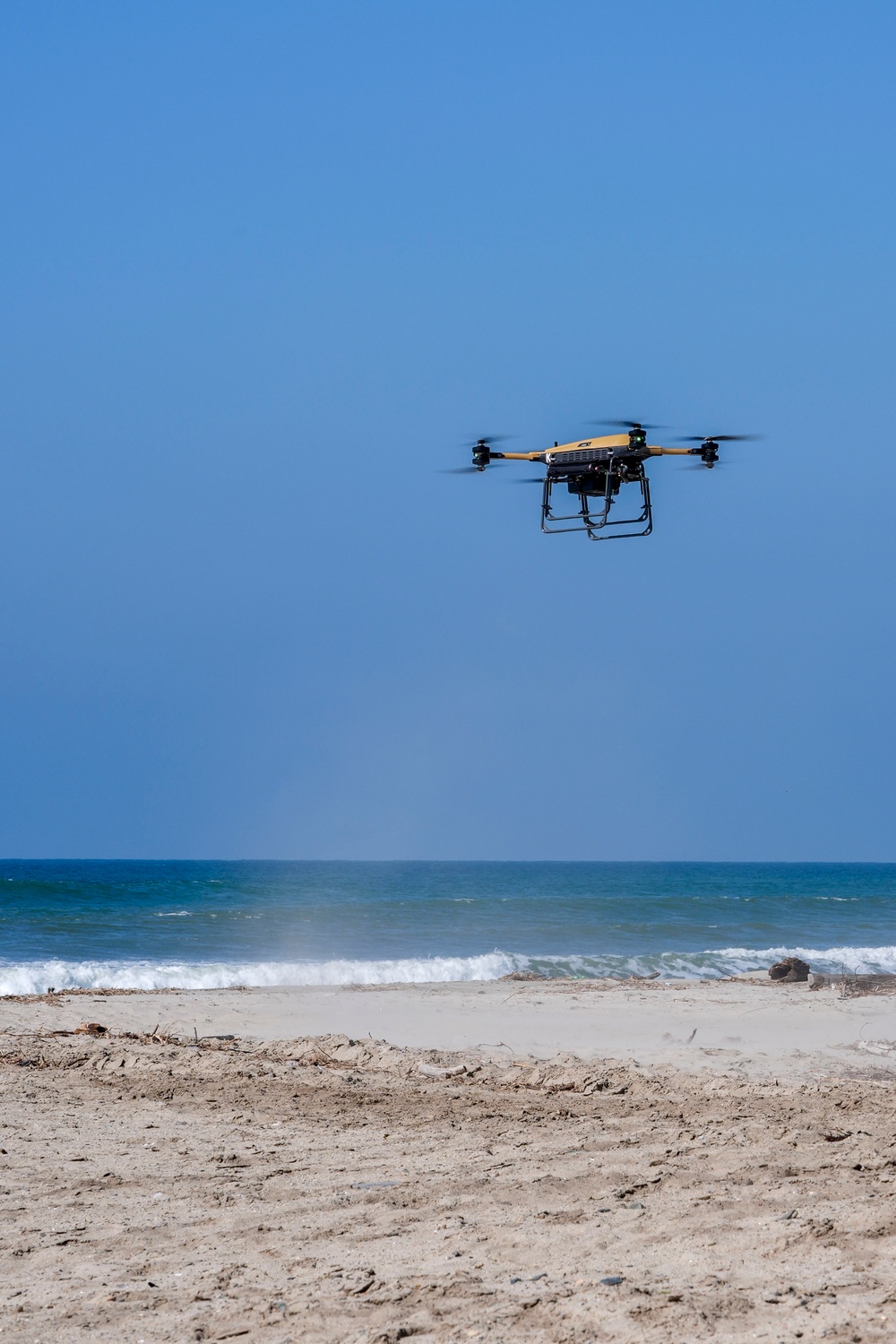
The U.S. Army has awarded Elroy Air a $46 million contract to continue development of the company's Chaparral autonomous cargo aircraft, deepening a logistics relationship that has now run roughly two years and signaling that runway-independent resupply is moving from demonstration toward a program the service intends to field.
The award appeared in the Department of War's daily contracts release on Aug. 17, 2026, which lists Elroy Air Inc. of South San Francisco, California, as receiving a $46,058,871 firm-fixed-price Phase III Small Business Innovation Research (SBIR) contract. The listing describes the work as development of an autonomous Group-IV hybrid VTOL unmanned aircraft system for modular, multi-mission payload delivery. The award itself was made Aug. 6, 2026, and publicly disclosed 11 days later. Army Contracting Command at Aberdeen Proving Ground, Maryland, is the contracting activity overseeing the deal. The listing was independently reproduced by HSToday's own reprint of the same official document, confirming the dollar figure, contract type and contracting office.
Elroy Air confirmed the award in a company statement issued Aug. 18, 2026, tying the contract directly to Chaparral's role in what the Army calls contested logistics — the problem of moving supplies to troops in environments where roads, airfields or communications may be degraded, jammed or under fire.
What the Money Buys
According to reporting from DroneDJ, the new funding is earmarked for a specific set of capability upgrades rather than a wholesale redesign of the aircraft. The work will add cyber-protected communications, GPS-denied navigation, and improvements to autonomy and reliability intended to let Chaparral operate in harsh operating conditions where satellite navigation and unsecured links cannot be assumed to work.
That distinction matters. A cargo drone that depends on GPS and open radio links is of limited use in the electronic warfare environment the Army has spent the last several years training against — one where adversaries jam or spoof position data and intercept unsecured transmissions. Layering in GPS-denied navigation and cyber-protected comms is what would let Chaparral transition from a demonstrated concept to something deployable near a contested front.
The Chaparral airframe itself is a Group-IV hybrid-electric VTOL aircraft — vertical takeoff and landing, no runway required — designed to carry more than 500 pounds of cargo over distances up to 450 miles, per DroneDJ's reporting. That combination of payload and range is aimed squarely at resupply missions: moving ammunition, medical supplies, spare parts or other materiel to units operating away from established logistics hubs.
A Two-Year Relationship, Not a Cold Start
This is not the Army's first contract with Elroy Air. Both DroneDJ and Elroy Air's own release describe the $46 million award as building on roughly two years of prior Army contracts, and note that Chaparral has already been demonstrated at the military's T-REX technology-acceleration event. The Phase III SBIR structure of the new award is itself a signal: Phase III contracts in the SBIR program are reserved for technology that has already cleared earlier research and prototyping phases and is being pulled toward operational use, typically funded directly by the acquiring service rather than through the SBIR program office's own budget.
Elroy Air CEO Dr. Andrew Clare framed the award as validation of the broader category. "This contract reinforces the critical role that heavy-lift autonomous hybrid VTOL drones will play in modern defense operations," Clare said, according to DroneDJ's reporting.
On the manufacturing side, DroneDJ reports that Elroy Air plans to build Chaparral domestically through a partnership with Kratos Defense & Security Solutions — a detail that aligns with a broader push across the Pentagon's unmanned systems portfolio to source airframes and components from U.S.-based suppliers rather than overseas manufacturers.
Why It Matters
Contested logistics has become one of the Army's most persistent worry lines. Planning for a potential large-scale conflict against a peer adversary assumes that fixed airfields, ports and predictable supply routes will be prime targets from the opening hours of a fight — the same assumption that has driven the Army's broader interest in distributed, runway-independent resupply options over the past several years.
A VTOL cargo drone that does not need a runway, can fly hundreds of miles on a single mission, and can navigate and communicate without depending on GPS or unsecured links addresses that problem directly rather than incrementally. It offers a way to keep forward units supplied even when the airstrips and road networks that traditional logistics relies on are degraded, contested or simply unavailable.
The Phase III SBIR structure of this award also matters as a signal in its own right. Phase III contracts indicate the Army is not funding early-stage research anymore — it is funding a system it intends to move toward fielding. Combined with a domestic manufacturing partner already lined up in Kratos, the pieces described in this award point toward Chaparral being positioned as more than a one-off demonstrator, even though the contract itself does not specify a program of record, a fielding timeline, or unit quantities.
What remains unconfirmed by the sources reviewed here is exactly how the $46 million breaks down across the specific upgrades listed — GPS-denied navigation, cyber-protected comms, autonomy and reliability improvements — and what testing or fielding milestones the Army has attached to the work. The official contract listing does not itemize the scope beyond identifying it as development of the Group-IV hybrid VTOL UAS for modular multi-mission payload delivery.
