
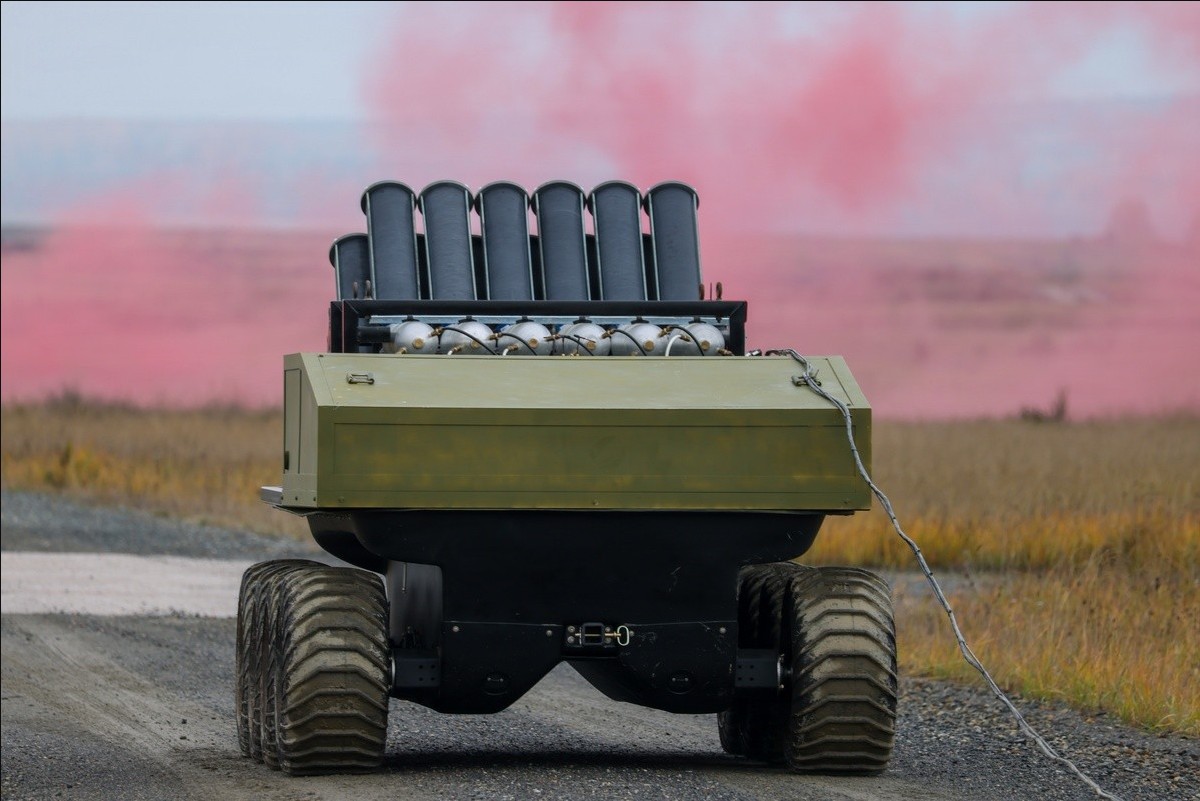
On Nov. 12, an unmanned ground vehicle drove out of a shipping container at Grafenwoehr Training Area in Germany. It then launched a group of drones that carried out a strike on their own. A second robotic vehicle carrying a Javelin missile system came out of the tree line. A TRV-150 drone dropped smoke over a target. Paratroopers from the 173rd Airborne Brigade flew a first-person-view (FPV) drone into a target.
The event was a live-fire demonstration run by the Army's DEVCOM Armaments Center with U.S. Army Europe and Africa (USAREUR-AF) and the 7th Army Training Command. It was the most public look yet at an effort called R3ACT, short for Remote Rapid Response Autonomous Contingency Team. The idea behind it is to pack modular air and ground robots into containers, store them forward, and open them when a crisis starts.
It was a demonstration, not a program milestone. In the Army's own account, a senior adviser calls it "the art of the possible." Army Recognition reports that Army officials confirmed no procurement decision or fielding timeline for the R3ACT, R3NEGADE, HIV3 or FIR3FLY platforms, and none of the other reporting mentions a fielding schedule, a quantity, or a buy decision.
What was on the range
According to the Army release posted on DVIDS on Nov. 13, the demonstration included these systems:
- TRV-150: a drone that dropped smoke onto a target.
- R3NEGADE UGV with HIV3 launcher: an unmanned ground vehicle carrying the HIV3 swarm drone launcher. It fired a group of drones that conducted an autonomous strike.
- 173rd Airborne Brigade FPV strike: soldiers hit a target with an FPV drone.
- Second R3NEGADE with Javelin: a remotely operated weapon system equipped with a Javelin missile.
- TRV-400 with FIR3FLY: shown on static display as part of a containerized system, carrying a developmental anti-armor capability called FIR3FLY.
The Army release says only "a group of drones" and gives no number. Stars and Stripes had a reporter at the range on Thursday. That reporter saw a UGV launched from a pre-positioned shipping container fire a swarm of 18 drones. Army Recognition gives the same figure. It describes the R3NEGADE coming out of a standard 20-foot shipping container and launching 18 FPV drones from the HIV3 launcher.
Stars and Stripes added details the Army release does not include. First, the Javelin-armed UGV carried two launchers. Second, resupply drones armed with rockets launched tandem attacks together with one-way attack drones. The paper also reported that the demonstration combined military munitions with commercially available technology.
The container is the point
The drones got the attention, but the program's officials talked mostly about the shipping container. Alex Tomosieski, the R3ACT program manager, told the Army that the goal is to place modular air and ground platforms inside containerized systems so commanders can pre-position capabilities. He added that this helps shift risk away from soldiers.
"It provides a standoff in both time and space and provides multiple dilemmas for the adversary," Tomosieski told Stars and Stripes.
The logic is simple. A standard container can be stored at a chosen location, mixed in with ordinary logistics, and opened when needed. If the robots inside can drive out and launch on their own, the first troops to meet an advancing force do not have to be people.
Troy Brannon is a strategic adviser for the Army's Expanded Maneuver-Air portfolio at DEVCOM Armaments Center, and he led the demonstration. In the Army release he summed up the goal as "scalability, lethality, reach and autonomy." He was more direct there too: "It's about scale. We need scalable, cheap, affordable, lethal options for our warfighters."
Where it fits
The Army ties the demonstration to two larger efforts.
The first is How the Army Fights. Army Recognition describes it as the Army's October 2026 warfighting framework. The DVIDS release, Army Technology and Army Recognition all say the demonstration lines up with its strike and endurance elements. The DVIDS release also cites NATO integration.
The second is the Eastern Flank Deterrence Initiative. Col. Michael Weisman, a senior Army spokesman in Europe, said in a Friday statement reported by Stars and Stripes that the systems allow the U.S. and its allies to slow or stop advancing forces. He called them a key part of that initiative.
The event also follows a much larger unmanned exercise. Stars and Stripes notes that Saber Junction, which ended in September, featured nearly 2,000 unmanned systems. Grafenwoehr was a much shorter event; Stripes says the action was over within a few minutes.
What the Army didn't say
Several important things are missing from the public record.
Performance data. None of the four sources reports figures on strike accuracy, how many drones hit, the communications architecture, or resistance to electronic warfare. Those factors largely decide whether a swarm works against a real opponent. The Army release says the strike was autonomous but does not explain what that means: who picked the targets or how much a human was involved.
Program status. Brannon's "art of the possible" framing points to a technology showcase. None of the four sources reports a procurement decision, a fielding date, unit quantities, or cost figures. FIR3FLY is explicitly called developmental, and it was only on static display.
Vendors. The sources name the platforms (R3NEGADE, HIV3, TRV-150, TRV-400, FIR3FLY) but say nothing about who makes them or how they would be bought. Stars and Stripes' and the Army's mention of commercially available technology suggests off-the-shelf parts are part of the mix. They do not say which ones.
Why It Matters
The demonstration shows the Army working on a specific problem: how to place cheap, lethal unmanned systems where commanders can use them before a fight begins, without having to put operators beside them. A robot that drives out of a container and launches a swarm does not need a crew in place at the start. That is the "standoff in both time and space" Tomosieski described.
Brannon's repeated focus on scale and affordability matters too. It suggests the Army sees mass, meaning large numbers of cheap drones, as the measure that counts. Whether the Army can actually produce that mass is a separate question. It depends on unit cost, production capacity, and how the systems perform under jamming, and none of that was made public.
For now, R3ACT is a working concept with a clear purpose, a policy framework behind it, and a live-fire event completed. It has no announced buy decision. The useful next signals would be a FIR3FLY test firing, published electronic-warfare results, or a budget line. Until then, the 18-drone swarm at Grafenwoehr is a proof of concept.
Sources
- US Army evaluates unmanned capabilities during live-fire demonstration in Germany (DVIDS)
- US Army tests drone swarms and armed ground vehicles in Germany (Army Technology)
- Army puts drone swarms and robotic missile launchers to the test in Germany (Stars and Stripes)
- US Army launches 18-drone swarm attack from UGV in Germany exercise under new warfighting strategy (Army Recognition)
