
The Army has begun its first "Manufacturing Rodeo" with a cheap, expendable strike drone that it wants built at scale. A solicitation from Army Contracting Command-Detroit Arsenal (ACC-DTA), reproduced by sUAS News, asks industry for a standardized Group 1 first-person-view (FPV) one-way attack and loitering strike line. The unit cost is "strictly restricted" to a maximum of $3,000. The goal is 400 flight-ready aircraft and 20 ground control stations by March 1, 2027.
The solicitation does more than buy a drone. The Office of the Assistant Secretary of the Army for Acquisition, Logistics and Technology (ASA(ALT)), Army Materiel Command and ACC-DTA call the sUAS effort the supply-chain stress test that serves as the operational baseline for the Army's inaugural Manufacturing Rodeo. Vendors are judged on more than whether the aircraft flies. They also have to show where every part comes from, and the Army plans to check that claim in person.
What the Army is asking for
The technical requirements in the solicitation describe how the Army now expects small strike drones to fight:
- Electronic-warfare resilience. Command-and-control links must be frequency-agile and multi-band. The solicitation also asks for zero-RF-signature fiber-optic tethered options, so a drone can fly with no radio signal for a jammer to find or block.
- Navigation without GNSS. The solicitation calls for alternate navigation modalities such as visual odometry for environments where satellite signals are denied.
- A 1:20 control ratio. One ground control station must be able to control 20 expendable air vehicles.
- Open architecture. Designs must follow a Modular Open Systems Approach (MOSA) using MAVLink-M, connect to ATAK through Cursor-on-Target messaging, and use APEX or sUPI payload attachment geometries.
- Munition safety. Munition interfaces must accommodate Department of War-compliant Electronic Safe and Arm Devices (ESADs), the devices that keep a munition safe until it is meant to arm, along with training weights, inert payloads, government lethality kits and commercial warheads.
Every submission must include a full bill of materials on the Defense Contract Management Agency (DCMA) template. It must detail all subcomponents, wafer fabrication and manufacturing origins. Drones and ground control equipment must also conform to the Drone Dominance Supply Chain Framework, which the solicitation describes as more restrictive than the National Defense Authorization Act and says the government will verify. The framework is published at DroneDominance.mil and includes minimum required standards for Gauntlet III.
The Army supplies some of the parts
The Army is not asking contractors to build the whole aircraft themselves. Selected performers will receive Government Furnished Equipment (GFE) made in Army depots:
- battery packs in 6S2P and 6S4P configurations
- brushless DC motors in 2807 and 3115 sizes
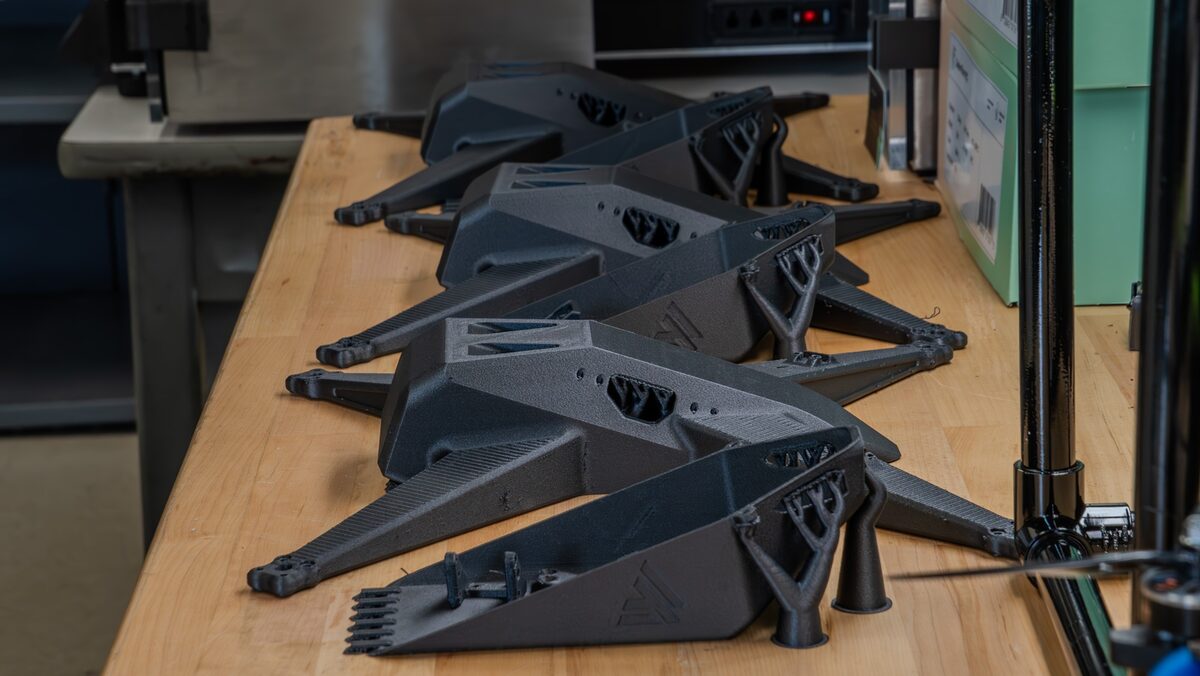
- frame kits in 7-inch and 10-inch classes
Selected performers use these depot-made parts to produce the 400 aircraft. Ten percent of the aircraft and ground control units are due early, on Feb. 15, 2027, for testing and operator training. The solicitation says physical plant audits and DCMA teardown inspections will verify 100 percent continental U.S. assembly and enforce complete exclusion of covered foreign-adversary hardware, silicon and firmware, so production claims will be inspected on site.
The $3,000 cap applies to the whole platform while the aircraft must also carry frequency-agile radios or a fiber-optic option, a vision-based navigation capability and an ESAD-compliant munition interface. Companies that want the work must show they can document the origin of every component at that price.
The solicitation also looks past the 400-aircraft batch. Successful performers unlock priced options for scaled production of up to 10,000 aircraft, with assembly moving into shared co-production lines inside Army depot facilities, and the systems compete at the Army's Drone Dominance Gauntlet III event, scheduled for March 2027.
From SkyFoundry to component manufacturing
The emphasis on parts fits a shift in Army plans this fall. Janes reported that the Army's SkyFoundry program has been renamed "Advanced Manufacturing for sUAS." The Army is moving from manufacturing complete drone systems to producing components.
SkyFoundry's original goal was ambitious: up to 10,000 drones a month in 2026, or 120,000 a year. Jon Strzelec, the advanced manufacturing lead for sUAS at Army Materiel Command, told Janes on Oct. 6 that the American economy is not positioned to produce 120,000 drones. He said the Army is using the program to "induce some of the requirements to the American economy from the industry side of the house to where they can ramp up with an actual demand behind it instead of a hope."
The Rodeo solicitation is consistent with that approach. Army depots supply batteries, motors and frames, and industry supplies the rest of the aircraft and the integration work. A government order with real demand behind it is the kind of signal Strzelec described for commercial suppliers.
"See where it breaks"
Acting Army chief Adam Telle announced the Manufacturing Rodeo at the Association of the U.S. Army annual conference on Oct. 12, according to Defense One. He described it as a public competition planned for 2027, meant to expose where the industrial base is failing to meet demand.
"We need to strain the nation's larger industrial base. We're going to stress-test the supply chain, the manufacturing processes, and see where it breaks," Telle said.
Telle said the Army needs to "make millions" of one-way attack drones, and he explained why sourcing matters as much as airframe design. "It may look simple, but it's a flying supply chain. If somebody else controls one part, they can break the whole thing," he said. Defense One noted that parts for such drones are largely made in China.
That concern helps explain the solicitation's strictest requirements. Asking for wafer fabrication origins on the bill of materials, conformance to a framework more restrictive than the NDAA, and DCMA teardown inspections all point to the same question: whether a $3,000 strike drone can be built without hardware, silicon or firmware from covered foreign adversaries, and where that effort fails.
Why It Matters
The sUAS Rodeo is a small order with a large diagnostic purpose. Four hundred aircraft will not change force structure. The way the Army is buying them is the point. The program pairs depot capacity with commercial integrators, requires sourcing documentation down to the semiconductor fab, and sets a hard price ceiling. Together, those choices make the procurement a measurement tool. The results should show which parts of a domestic FPV supply chain can be built cheaply and which cannot.
The requirements also amount to a public statement of what the Army now wants from small strike drones. That includes jam-resistant or fiber-optic links, GNSS-independent navigation, one operator station for 20 aircraft, open interfaces into ATAK, and safe-and-arm compliant warheads. Vendors that meet those standards at $3,000 should be well placed as the Army works toward Telle's goal of "millions." Vendors that cannot meet them will help show the gaps the Rodeo was designed to find.
The schedule is short. The first 40 aircraft are due in mid-February, and the full batch of 400 is due March 1, less than four months after the solicitation's Nov. 16 virtual industry day.
