
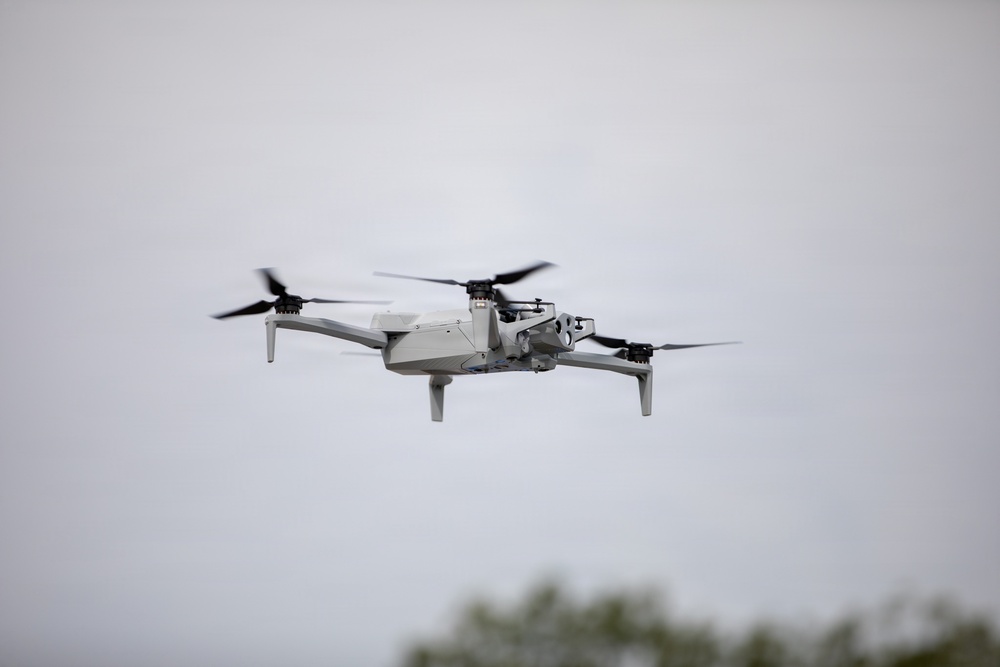
Ukraine's Ministry of Defence and its defense-tech cluster Brave1 have finished a round of tests on domestically built reconnaissance drones meant to replace the DJI Mavic. The commercial quadcopter has become a key tool for tactical-level reconnaissance, according to both bodies. According to the ministry, drones from nine Ukrainian manufacturers went through evaluation. Makers whose aircraft proved combat-ready are now moving toward MoD contracts.
The ministry announced the results on November 12, 2026, and Brave1 published its own account the next day. Together the two statements give the clearest description so far of what Kyiv wants from a homegrown Mavic successor. They leave out nearly everything an outside observer would need to judge whether the effort worked.
What the Ministry Is Asking For
The Ministry of Defence statement, published in Ukrainian, sets four requirements for a replacement:
- Electronic warfare resistance. The drone has to keep working under jamming and without GPS.
- Endurance. Flight time of at least 60 minutes.
- Longer control range. The operator should be able to fly from farther away and so from a safer position.
- A familiar interface. Troops should not need lengthy retraining to switch over.
The tests examined resistance to electronic warfare, the quality of the video link and data transmission, and flight duration, along with other characteristics important for frontline work.
The last requirement shows what the ministry is really after. A familiar interface suggests the aim is a drone that troops can pick up without weeks of retraining, a cost units can ill afford at the front, however capable an aircraft is on paper.
In its English-language account, Brave1 says the goal is "not to create a simple copy" of the DJI aircraft but a functional alternative. The cluster ties the push to conditions at the front, where the kill zone keeps expanding and civilian drones are increasingly unable to meet the requirements.
How High Is the Bar?
The 60-minute minimum is the most concrete number in either statement, and it is demanding. As DroneXL noted, DJI rates the Mavic 3 Pro at 43 minutes of flight and the Mavic 4 Pro at 51 minutes. Both are manufacturer ratings, not figures measured in these trials.
In other words, Ukraine is not asking domestic firms merely to match the Mavic's endurance. Measured against the Mavic 4 Pro's rated 51 minutes, a 60-minute minimum is at least nine minutes more, and it comes with flying without satellite navigation and holding a datalink under jamming. Whether any of the nine entrants actually reached that standard in testing has not been published.
What the Statements Leave Out
The gaps are large. DroneXL points out that neither the ministry nor Brave1 identifies:
- the nine manufacturers that took part;
- how many of them passed;
- the size or value of any resulting contracts;
- where and when the test flights took place.
Some of this may be deliberate, since naming producers of front-line reconnaissance drones and their test sites carries obvious security risks, though neither source says why the details were withheld. Still, the result is that the announcement cannot be checked. Both sources are government bodies reporting on their own program, and the sources we reviewed include no independent confirmation of the test results, the performance numbers achieved, or the claim that any entrant is combat-ready.
The headline claim, that some Ukrainian drones proved combat-ready against a 60-minute, GPS-independent standard, should therefore be read as an official assertion and not a demonstrated result.
A Long-Running Promise
The effort is not new. According to DroneXL, the first showing of Mavic-alternative drones, featuring eight manufacturers, took place in November 2024. The outlet also reports that Defense Minister Mykhailo Fedorov promised troops a Mavic analogue in January. Two years after that first demonstration, the ministry is describing the latest round as tested and heading toward contracts, not as fielded in numbers.
That pace suggests how hard the problem is. Matching a mass-produced consumer drone on cost, reliability and ease of use is difficult even before EW resistance and extra endurance enter the requirements. Doing all of it at once, at a scale that could replace a widely used commercial product, is harder still.
Why It Matters
Dependence on a foreign commercial supplier is a strategic weakness for any military. Brave1 says civilian drones are increasingly unable to meet frontline requirements as the kill zone grows. A Ukrainian design built from the start for jamming and GPS denial would, if it works as described, reduce both a supply-chain risk and a performance ceiling.
The requirements also amount to a public statement of what Ukraine wants from a front-line reconnaissance quadcopter in late 2026: operation without GPS, an hour in the air, standoff control range, and controls troops already know. Those criteria may well interest drone developers and procurement offices beyond Ukraine.
What the announcement does not yet show is that the problem has been solved. Until the ministry or the manufacturers disclose who passed, what they achieved and how many aircraft are being bought, the program's success is a claim, not a fact. The next useful signal will be contract awards, if they are announced with numbers attached.
Sources
- Brave1 and the Ministry of Defence test Ukrainian drones to replace Mavic; top performers to be contracted for military (Brave1, 13 Nov 2026)
- Ukrainian drones to replace Mavic passed testing: the most effective will be contracted for the army (Ukraine MoD, 12 Nov 2026, in Ukrainian)
- Ukraine Tests 9 DJI Mavic Replacements With a 60-Minute Flight Bar (DroneXL, Nov 18 2026)
