
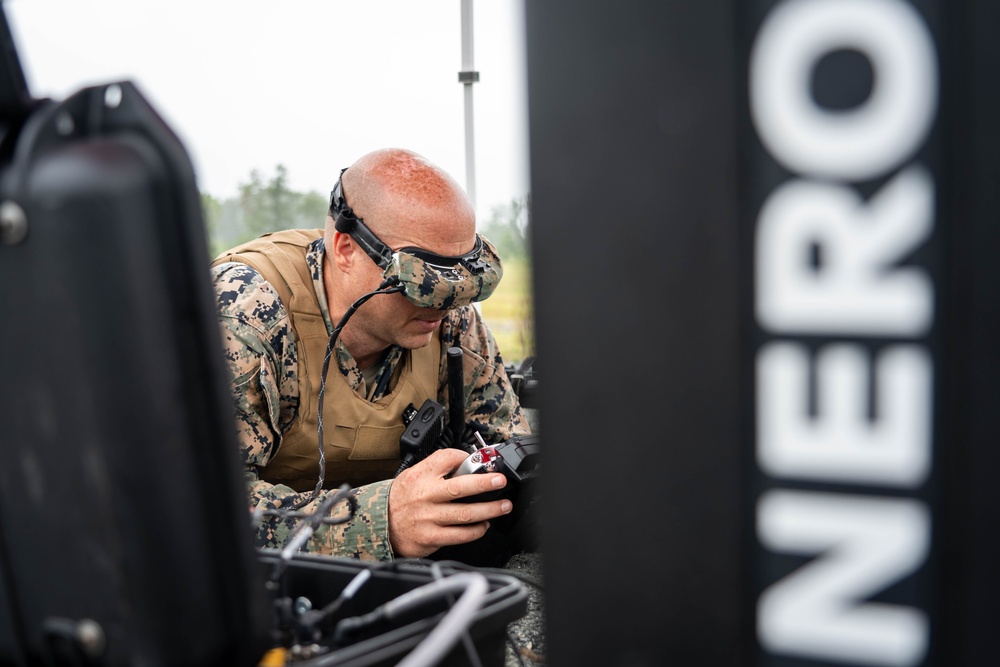
Neros, the Torrance, California-based maker of the Archer first-person-view (FPV) attack drone, has raised $250 million in a funding round that triples its valuation to $2.5 billion, Bloomberg reported August 11. The round was led by Sequoia Capital and the American Strategic Technology Fund, and the company said the new capital will go toward expanding drone production to meet surging demand from the U.S. government for attack drones.
The raise comes just weeks after Neros landed the largest single contract in its short history: a $500 million firm-fixed-price indefinite-delivery/indefinite-quantity (IDIQ) award from Army Contracting Command at Aberdeen Proving Ground, Maryland, for the Archer FPV small unmanned aircraft system under the Army's Purpose-Built Attritable System program, according to GovConWire. The contract covers the drones themselves along with support equipment, testing, engineering support and training, with a completion date of June 30, 2031.
What Is the Archer, and Why Does the Army Want It?
The Archer is a first-person-view attack quadcopter — the same basic category of small, expendable drone that has become a defining weapon of the Ukraine war, where operators fly them by video feed directly into armor, personnel or fortified positions. According to GovConWire, Neros builds the Archer with no Chinese-made components, a design choice aimed squarely at Pentagon supply-chain requirements that increasingly bar Chinese-sourced parts from military hardware, including the DJI-dominated commercial drone components that flooded the FPV market early in the Ukraine conflict.
Pricing reported for the Archer places it at roughly $2,000 for a bare airframe and around $5,000 once fitted with a warhead — figures consistent with the broader push toward "attritable" systems: platforms cheap enough to be built, fielded and lost in large numbers rather than treated as exquisite, recoverable assets. GovConWire reports the Army is targeting up to 10,000 Archer drones annually under the Purpose-Built Attritable System program that the IDIQ falls under — a separate, narrower effort from the Pentagon's broader "Drone Dominance" initiative, which GovConWire describes as aiming to acquire more than 200,000 small attack drones by 2027 through up to $1 billion in fixed-price orders.
Scaling to a Million Drones a Year
Neros's ambitions extend well beyond the Army's 10,000-unit annual target under the IDIQ. The company is scaling toward production of 1 million drones a year by 2028, a target that reflects both the scale of the fresh capital infusion and the broader market Neros is chasing — one that spans not just U.S. military orders but allied and coalition demand as well.
That international dimension is already underway in a more limited form. According to citybiz, Neros has tested early prototypes of the Archer with Ukrainian forces — a real-world proving ground on one of the most intense FPV drone battlefields in the world, the same operational environment that has driven rapid design iteration across the FPV attack-drone industry over the past several years.
Company Background
Neros was founded in 2023, according to GovConWire, by a team that includes former teenage FPV drone racers — a lineage increasingly common among the founders of the current wave of attack-drone startups, many of whom cut their teeth in competitive racing-drone circuits before pivoting to military applications as the war in Ukraine demonstrated the battlefield potency of cheap, agile FPV airframes.
The $2.5 billion valuation places Neros among the better-capitalized entrants in a crowded and fast-consolidating field of U.S. drone startups competing for Pentagon dollars as the department pushes to reduce reliance on foreign-made small drones and build a domestic industrial base capable of high-volume attritable production.
Why It Matters
The Neros raise and its underlying $500 million Army contract are a concrete signal of where Pentagon procurement dollars are flowing: toward cheap, mass-producible, Chinese-component-free FPV attack drones rather than exclusively toward large, exquisite unmanned systems. A tripled valuation on top of a five-year, half-billion-dollar IDIQ tells other investors and competitors that the government is prepared to back attritable-drone manufacturers at industrial scale, not just fund prototypes.
The stated goal of 1 million drones a year by 2028 is also a bet on the durability of the attritable-warfare doctrine that Ukraine popularized — the idea that dominance in future conflicts depends on out-producing an adversary in cheap, disposable systems rather than fielding fewer, more expensive ones. If Neros and peer companies can actually hit that kind of volume, it would mark a meaningful shift in U.S. industrial capacity for small attack drones, an area where China's commercial drone manufacturing base has long held a structural advantage. Neros's early prototype testing with Ukrainian forces also underscores how U.S. drone startups are increasingly using coalition battlefields as a proving ground for combat-relevant design iteration, alongside their growing domestic military contracts.
