
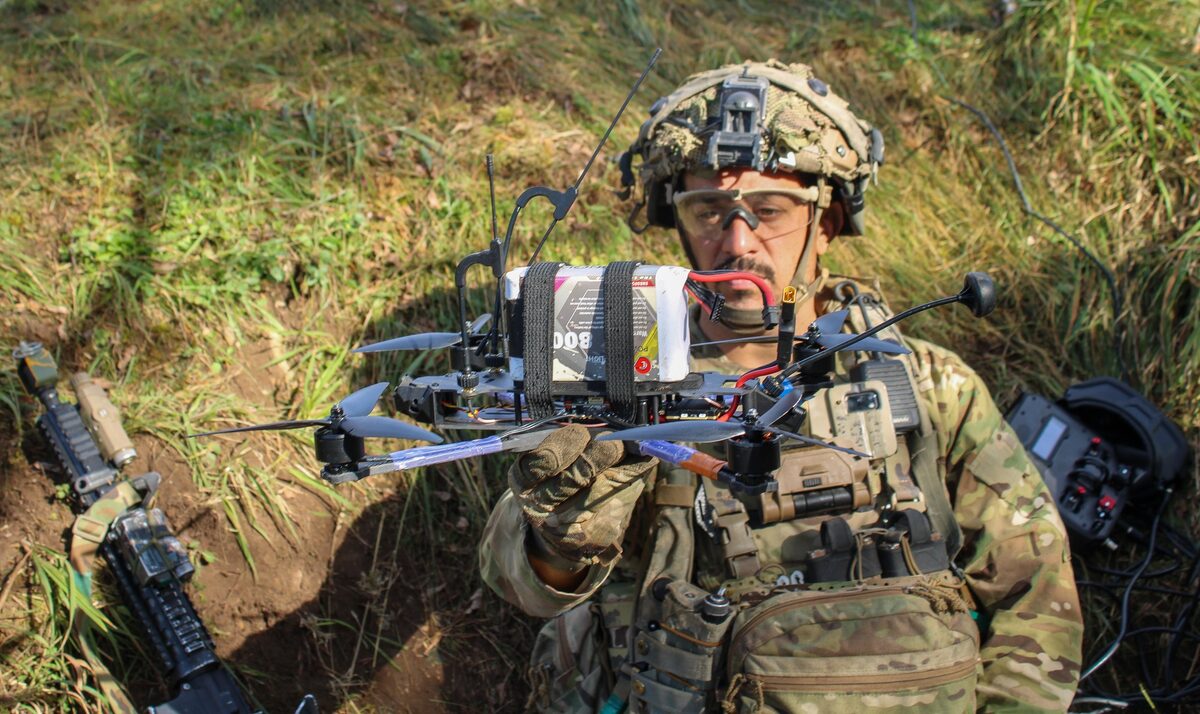
The British Army has acquired more than 10,000 drones over the past year through a fast-track procurement effort called Project Rapstone. That is a striking number for a force that, by its own account, still fields a comparatively small footprint of front-line attack drones. The explanation, according to the officer running the program, is that most of those 10,000-plus aircraft were never meant to reach a battlefield at all. They exist to put controllers in soldiers' hands, over and over, until manual flight becomes muscle memory.
Lt. Col. Matt Keogh, speaking at a UK defense industry exhibition, disclosed the figure and the reasoning behind it to Business Insider. Rapstone, he said, deliberately avoids buying large quantities of the newest drone models. The logic is blunt: Ukraine's war has shown that whatever quadcopter or ISR platform looks cutting-edge today can be countered, jammed, or simply out-classed within weeks or months. Buying thousands of a hot new airframe is a way to lock in obsolescence, not capability.
Training Before Hardware
Rapstone launched in September 2024 with a mandate to get first-person-view (FPV) and intelligence, surveillance and reconnaissance (ISR) drones into soldiers' hands quickly. But the pipeline it built runs through the human operator first. Under the program's training track, a soldier doesn't touch an FPV attack drone cold. Entry to the FPV course requires prior experience flying ISR surveillance drones — a discipline Britain says it was training soldiers on "way before Ukraine" made drone warfare a daily fixture of the news cycle.
From there, trainees log 30 hours in a flight simulator before they're allowed onto a two-week operator course, with an optional second two-week course for those training to command drone teams rather than just fly. Every soldier who completes the pipeline is issued a personal kit: a drone, a controller, goggles, and batteries. According to Keogh, most soldiers who have gone through Rapstone's training to date have flown ISR drones rather than FPV attack quadcopters — reconnaissance and surveillance, not strike.
Navigation without GPS is one of the biggest challenges FPV pilots face, per Business Insider's reporting. Ukraine's front lines are saturated with Russian electronic warfare that jams and spoofs satellite navigation signals across whole sectors, according to DroneXL, to the point that GPS-guided drones can lose their lock or get spoofed off course. Britain's answer is not a more jam-resistant guidance chip — it's a pilot who can fly by sight and feel, the way FPV racing pilots have always flown, with no satellite assist to fall back on.
Where the Real Money Is Going
Rapstone's training-heavy drone buy is only half of what the UK Ministry of Defence disclosed this month. On September 16, 2026, the MOD announced a contract worth up to £400 million ($540 million) awarded to drone manufacturer Tekever for its AR5 long-endurance surveillance drone, which can carry up to 50 kg of sensor payload. The AR5 will replace the Watchkeeper system, a surveillance drone the British Army has flown since 2014. The MOD says the Tekever deal is expected to support more than 1,000 UK jobs by 2030.
Separately, and announced the same day, the MOD detailed a £16 million ($21 million) deal covering more than 1,025 small drones: 245 FOXE-NATO drones from Evolve Dynamics — sub-250-gram aircraft carrying infrared cameras; 670 Skydio X10 INTL drones supplied through Marlborough Communications, which the MOD says can be flight-ready in under a minute and fly up to 45 mph; and 110 SONORA training drones from a partnership between Brigantes Consulting and Harmattan AI, which the MOD says are built to train soldiers before they use similar drones in real operations. The MOD says this £16 million deal forms part of Project Rapstone itself, unlike the separate Tekever contract. The announcement was unveiled by Luke Pollard MP, the UK's Minister for Defence Readiness and Industry, at the Defence Vehicle Dynamics event.
Rapstone itself has also been getting new money on top of the training pipeline. A £5 billion drone package announced in June added £50 million ($67 million) to the program over 12 months, on top of whatever Rapstone had already spent building the 10,000-drone training fleet Keogh described.
Two Procurement Tracks, One Strategy
Laid side by side, the two September 16 announcements read less like unrelated news items and more like two halves of a single bet — and one of them sits inside the other. Rapstone spends its training money on volume and repetition: thousands of low-cost, replaceable training drones and a curriculum built around manual, sensor-independent flying skills that don't expire when a new jamming technique or drone model shows up. The £16 million small-drone deal is itself part of Rapstone, per the MOD, pairing operational aircraft — the FOXE-NATO and Skydio X10 — with SONORA trainers built specifically to prepare soldiers before they fly similar drones for real. The £400 million Tekever AR5 contract is the one piece that sits outside Rapstone: a comparatively small batch of a single exquisite platform Britain intends to field and rely on operationally, replacing the aging Watchkeeper system.
That split answers a question that has dogged Western militaries watching Ukraine: how do you modernize a drone force when the technology cycle is measured in weeks rather than years? Buying heavily into any single current-generation FPV or ISR drone risks fielding a fleet that's tactically obsolete before it's fully issued. Britain's approach, at least as described by Keogh, is to treat the airframe as disposable and the pilot's skill as the durable asset. A soldier who can fly manually, without GPS, having trained on ISR drones before moving to FPV, can in principle be handed whatever drone comes off the production line next — old or new — and still be effective.
Why It Matters
The UK's approach is a direct policy response to one of the clearest lessons of the Russia-Ukraine war: drone technology on both sides has iterated so fast that today's cutting-edge FPV design can be countered or superseded within a matter of weeks, driven largely by escalating electronic-warfare countermeasures. A military that commits heavily to any single generation of hardware risks fielding a fleet that's already behind the curve by the time it reaches units in the field.
By funneling most of its 10,000-drone Rapstone buy into training rather than combat stockpiles, and by building a curriculum around GPS-denied manual flight specifically, the British Army is trying to insulate its drone force from that obsolescence cycle. The skill transfers even when the hardware doesn't. Meanwhile, the £400 million Tekever contract — the one piece of this month's announcements that sits outside Rapstone — shows the MOD is still willing to commit real money to a single, fielded platform, the AR5 replacing a decade-old Watchkeeper system, for a mission where a defined, procured capability is needed now rather than a rotating training fleet. The £16 million small-drone deal, by contrast, shows that same train-first logic operating inside Rapstone at a smaller scale: the FOXE-NATO and Skydio X10 aircraft are meant to be flown operationally, while the 110 SONORA drones exist specifically to train soldiers on them first. Together, the AR5 contract and Rapstone's own mix of training and fielded hardware suggest a doctrine taking shape across NATO militaries more broadly: fund the pilot pipeline at volume, and make deliberate, separate bets on the handful of platforms that need to be procured on their own timeline.
