
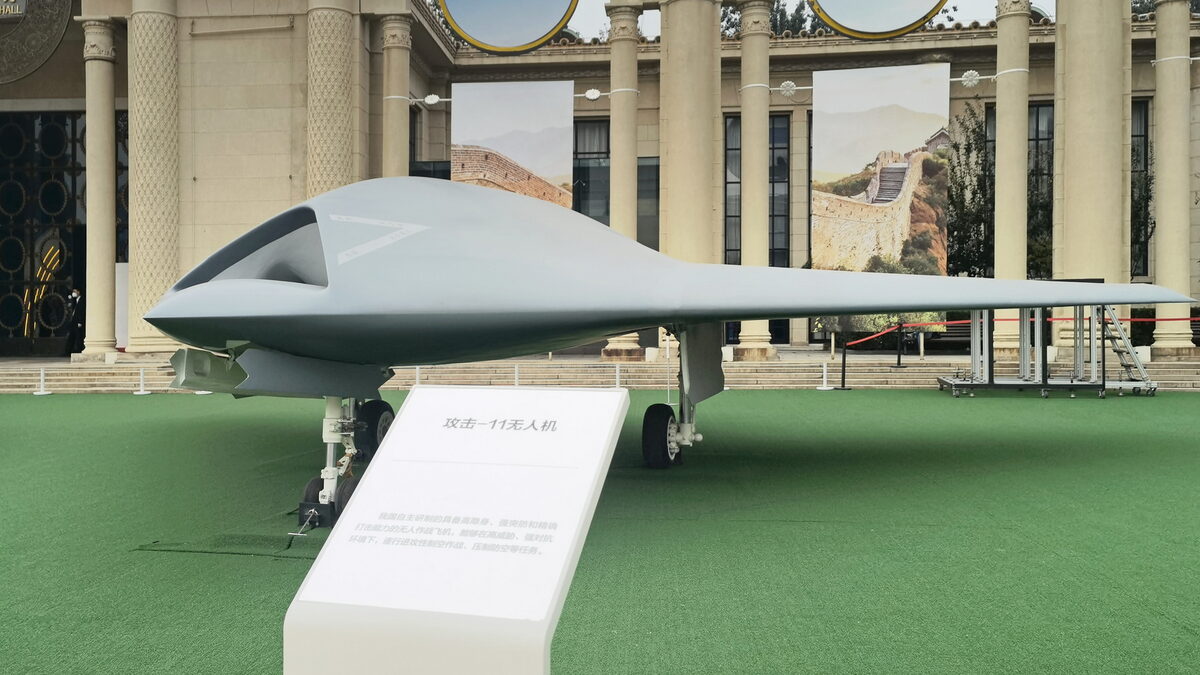
Since its first public appearance, China's GJ-11 flying-wing combat drone has mostly been seen from a distance: a dark shape on parade, a blurry runway photo, a short service-entry film. On Nov. 9, 2026, China Central Television (CCTV) aired footage that changes that. The segment shows the aircraft's underside up close, including two internal ventral weapon bays. It also shows operators planning sorties with crewed fighters, and it describes what CCTV calls the type's first live-fire strike mission.
The footage is useful, and it was also released at a pointed moment. It aired two days before the 77th anniversary of the founding of the People's Liberation Army Air Force (PLAAF). This article separates what the video actually shows from what the broadcast claims.
What the Footage Shows
The clearest new detail is the weapons layout. According to Janes, the footage confirms that the aircraft splits its weapons across two internal bays located within the blended wings. Janes reports CCTV said the ventral bays can accommodate "a variety of air-to-surface munitions." The War Zone adds that the two ventral bays have separate sets of doors with distinctive serrated edges, a common feature on low-observable aircraft.
The video also shows a dorsal air intake and a shielded exhaust nozzle. Global Times, the state-run outlet, quotes Chinese military commentator Song Zhongping saying both are designs that enhance stealth. Global Times also reports CCTV's statement that all weapons are carried internally in a belly weapons bay, which matches what the camera shows.
The footage does not give bay dimensions or weapon range. The War Zone says the internal arrangement and dimensions remain unclear, but it judges that each bay can likely accommodate at least a 1,000-pound-class weapon and likely a 2,000-pound-class one. That is an assessment, not something the broadcast stated.
There is also a smaller change worth noting. DroneXL, citing The Aviationist, says the new footage shows the landing gear retracting after takeoff. In the PLAAF film released in November 2025, when the service said the GJ-11 had entered service, the gear stayed down. DroneXL also reports that CCTV said the aircraft went through a series of tests at a desert facility in northwestern China.
Planning Missions With J-16s and J-20s
Much of the broadcast covers manned-unmanned teaming (MUM-T). Janes reports that the footage showed operators planning sorties with a GJ-11 operating in concert with the Shenyang J-16 multirole fighter and, separately, with the Chengdu J-20 stealth fighter. The mission set CCTV cited includes air strikes and suppression of enemy air defenses (SEAD).
DroneXL summarizes how CCTV describes the drone's roles. It can act as "the eyes of crewed fighter jets," scout enemy air defenses, draw fire as a decoy, or launch guided munitions at a crewed aircraft's direction. That puts the GJ-11 in the role of a stealthy forward element, a sensor and shooter that can operate closer to defended airspace than a crewed fighter should, with a crewed aircraft directing the strike.
That concept is easy to describe and hard to make work. The footage does not show how datalinks, task allocation, or contested-spectrum operations are handled, and a broadcast segment would not be expected to. The earlier November 2025 PLAAF film is what showed the GJ-11 flying in formation with a J-20 and a J-16D electronic warfare aircraft.
The Live-Fire Claim
The story at the center of the segment involves two operators. Global Times identifies them as Shi Xiaoran and Fu Ting, both born after 1995. They are among the first batch of female drone operators trained independently by the PLAAF. Janes likewise notes the PLAAF's training of an initial batch of servicewomen as GJ-11 operators. Global Times says the two completed conversion training in just five months and scored a first-round hit in what it calls the GJ-11's first live-fire strike mission.
Shi's account, as reported by Janes, includes one specific detail. Cloud cover initially obscured the target. After circling once more, she found it, released the weapon, and scored a hit. This is the most interesting operational detail in the broadcast, because it suggests the crew could make a second pass after a failed first attempt instead of aborting. It is also unverified. DroneXL notes that the broadcaster did not say when the test happened or which weapon was fired, so the hit cannot be checked from outside China.
The "first" in "first live-fire" is the weakest part of the claim. The War Zone calls it somewhat puzzling, since the UCAV has racked up test sorties for years, including at forward operating locations, and it finds it almost inconceivable that a live weapons delivery had not been conducted before now. The outlet suggests something may have been lost in translation, such as the use of a new internal sensor or a new type of weapon delivery. The broadcast does not say which, so "first" should be read as framing, not as a technical record.
Global Times also quotes Song Zhongping, who says the model has likely achieved combat and support capability, with technical maturity sufficiently assured. That is a state-media view, not independent analysis, though the retracting gear and the visible internal carriage are consistent with a program well past the prototype stage.
Not the GJ-21
Readers who followed earlier coverage of the GJ-21 should not mix the two up. DroneXL describes the GJ-21 as the GJ-11's carrier-based variant, which Chinese state media reported on Oct. 30 had taken off from and landed aboard the Type 076 amphibious assault ship Sichuan. This footage concerns the land-based PLAAF GJ-11, which carries the name Xuanlong, or "Mystery Dragon," according to The War Zone. The details here (desert test facility, J-16 and J-20 teaming, the PLAAF operator cadre) all relate to the air force program.
Why It Matters
Several points are now clearer than before. The GJ-11 has two internal weapon bays that CCTV says can take a variety of air-to-surface munitions. It is being flown by a PLAAF operator cadre that includes a first batch of women trained by the service. And it is being presented as part of a mixed crewed-uncrewed force alongside China's front-line fighters rather than as a standalone strike platform. Stealthy internal carriage combined with roles like SEAD and decoying is a design aimed at operating in defended airspace, which is also the problem that collaborative combat aircraft programs elsewhere are working on.
DroneXL makes that comparison, pointing to the U.S. Air Force's YFQ-44A firing an AIM-120 on July 15. Both nations are now showing uncrewed aircraft releasing live weapons, though the missions differ: an air-to-air shot at a digital target from a U.S. CCA prototype versus a claimed air-to-surface strike from China's flying-wing UCAV.
The broadcast also leaves out the things analysts most want to know: weapon types, range, endurance, datalink resilience, and how many aircraft are in service. Timed to the PLAAF's anniversary, the segment works as a message as much as it reveals capability. The weapon bays, the intake and the nozzle are visible evidence. The live-fire milestone, as presented, is a claim with no date and no named weapon.
