
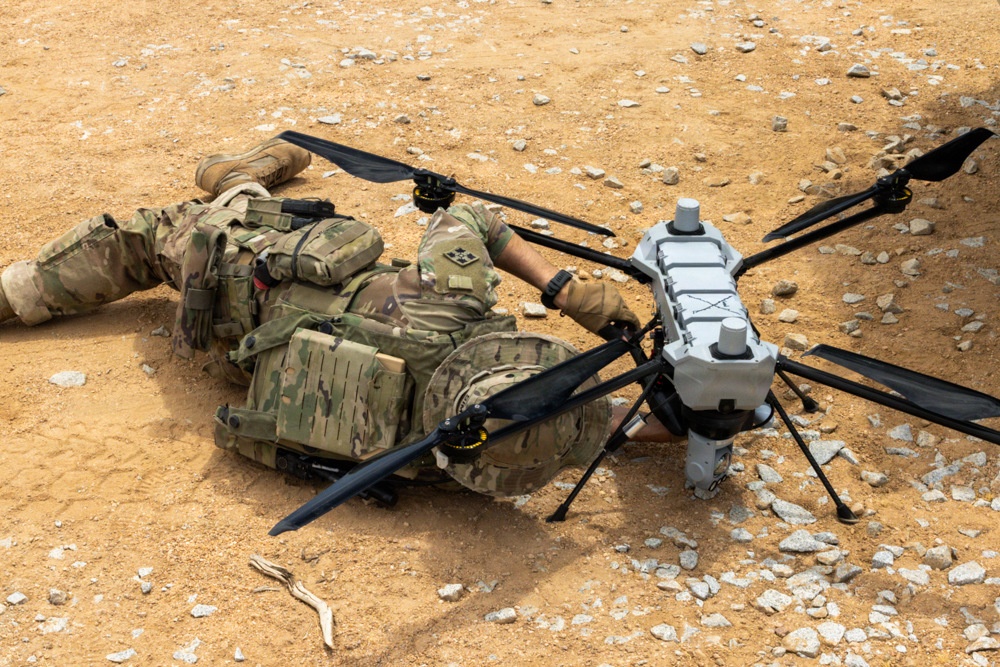
The U.S. Army has shown a kit that turns ordinary mortar rounds into munitions a drone can drop. The kit is called the Munitions Air-dropped Lethal Effects Tool, or MALET. It was developed by the DEVCOM Armaments Center at Picatinny Arsenal, New Jersey, and it attaches to standard 60mm and 81mm rounds. It gives a falling round the two things it lacks: a fuze that works when the round is dropped, and stable flight on the way down. It can also be taken off again, so the same round can still go down a mortar tube.
The Armaments Center announced MALET on Nov. 4. On Nov. 5, The War Zone and Stars and Stripes added coverage and context. The Army highlights a recent live-fire test. Live 60mm mortar rounds were released from an uncrewed aircraft while it was moving. According to the program, they oriented correctly and detonated within the desired target area. The Army released only still images, and TWZ noted it could not independently confirm how well the system worked.
What MALET actually is
A mortar round is built to be fired from a tube. Dropping one from a drone raises two problems: the round needs a fuze function that works after a drop, and it needs aerodynamic stability on the way down. MALET adds both without requiring field modifications or manually removing safety mechanisms.
The Army describes the kit as non-destructive and removable. That detail matters more than it might seem. A mortar section carrying MALET kits does not need a separate supply of "drone rounds." The rounds it already has can be used either way, in the tube or under a drone, depending on what the situation calls for. The kit adds a fuze function and the aerodynamic stability required for a drone drop. Clipping it on does not compromise the mortar, nor does removing it, and once it is off the round is again a conventional tube-fired munition.
According to the Armaments Center, work began in 2024 in its Fuze and Mortar Divisions, with input from the Energetics and Warheads Directorate. Project lead Brad Armstrong said test drops at several Army facilities helped mature the fuze and safety features before the recent live test from a moving UAS.
Where it fits: the CLIK family
MALET is not a standalone product. The War Zone reports that it is part of Picatinny's Common Lethality Integration Kit, or CLIK. CLIK is a family of components meant to fit together. Besides MALET, it includes AUDIBLE, a weapons release system, and Gunslinger, a fire control software package.
Taken together, the pieces describe a complete chain. A drone carries the munition. A release system drops it. Fire control software helps point the weapon where it is most likely to strike. MALET helps the munition fall stably and function when it arrives. The Army has not said which drones it used in testing. Picatinny's approach appears to be a set of kits that can be fitted to different aircraft, not one integrated weapon tied to a single airframe.
Why not just fire the mortar?
The obvious question is why the Army wants to drop mortar rounds when it already has tubes to fire them from. The answer is mostly reach. The War Zone puts the range of tube-fired mortars at about 2 to 3.5 miles. It also notes that an earlier Army solicitation for drone-delivered systems listed a desired operational range of 20 to 40 kilometers, or about 12.5 to 25 miles.
That gap is the argument. The Army's stated goal is to drastically extend the range of mortars, and a drone carrying a 60mm or 81mm round could in principle take it well beyond where the tube could send it.
There is also a logistics argument. Mortar rounds are already in the Army's stockpiles, supply chains and training pipelines. A removable kit lets the service draw on that existing stock without buying and qualifying a whole new family of purpose-built drone bombs.
Beyond 60 and 81mm
Ryan Gorman is Senior Scientific Technical Manager for Indirect Fire Munitions at the Armaments Center. He said the MALET architecture could be applied to munitions other than 60mm and 81mm rounds. Stars and Stripes likewise reports him saying the technology could eventually be adapted to other kinds of ammunition. Gorman said other concepts are being held close and described them only as "unique."
That caution leaves open how far the approach goes. If the method can be adapted to other ammunition, a set of drone-drop kits for different munitions is plausible. For now, the Army has publicly shown only the two mortar calibers.
The Ukraine context, and an awkward history
Stars and Stripes presents the effort as the Army applying lessons from Ukraine, where drones dropping mortar rounds have become battlefield bombers. That kind of improvised use is not new. The War Zone notes that dropping munitions from drones has been practiced for about a decade, going back to ISIS fighters at Mosul in 2016 and 2017.
The War Zone also recalls that the Army was criticized last year for a social media post, since deleted, that described a live-grenade drop from a UAS at Grafenwoehr as a first. The criticism was that the post presented a decade-old battlefield practice as a breakthrough. MALET arrives against that background. What is new this time is not the idea of dropping ordnance from drones. It is that the Army has engineered and safety-tested the method so it can be used with standard rounds already in its inventory.
Stars and Stripes also ran a photo caption showing a drone mortar drop during an Army exercise at Fort Hood, Texas, on Oct. 27. The caption is the only detail given; it does not say whether MALET was involved.
Why It Matters
Militaries around the world are working out how to field drone-delivered munitions at scale, not just as battlefield improvisation. Two features stand out in MALET. One is that the kit is removable. That keeps a unit's mortar ammunition usable both ways and avoids creating a separate stockpile that would need its own supply chain. The other is that it belongs to CLIK, which suggests the Army is building standard, interchangeable parts for drone strike, including release hardware and fire control software, rather than a series of one-off solutions.
The difference between 2 to 3.5 miles of tube range and the 20 to 40 kilometers (about 12.5 to 25 miles) named in the earlier solicitation shows what is at stake. Drones could carry light infantry firepower well past the range of the weapons that normally fire it. Whether that holds up will depend on drones, release systems and software the Army has not yet described in public.
What comes next
According to the Armaments Center, MALET kits will go to major exercises in the fall so soldiers can try them and give feedback. After that, the program plans to hand the technology to industry partners and the acquisition community to produce it at scale. The Army has not announced production quantities, costs or a fielding date; Stars and Stripes says it is not clear when the system could be fielded. It also has not said which drones will carry MALET-equipped rounds in those exercises.
