
U.S. Special Operations Command has told industry it is planning for wars without satellite navigation. In its SOF Week 2026 briefing, the command's fixed-wing acquisition office lists "no expectation of GPS" among the operational needs driving future strike aircraft. That line explains why a small Pittsburgh navigation company would want to be close to SOCOM's newest buying channel. It does not mean the company has sold anything there yet.
On Monday, Nov. 2, KEF Robotics said it had been accepted into SOF RACER, the rapid-acquisition consortium SOCOM opened in August. KEF makes Tailwind, a camera-based navigation system built to keep drones on course when GPS is jammed or unavailable. The news is real, but it is narrower than a headline might suggest. Membership in SOF RACER is free. It comes with no contract, no funding and no promise of work. It only makes KEF eligible to bid.
What SOF RACER Actually Is
SOCOM's Special Operations Forces Acquisition, Technology and Logistics directorate (SOF AT&L) launched SOF RACER on Aug. 6, 2026, with the contracting-technology firm GovSignals. According to the launch release, it is an other-transaction consortium meant to give non-traditional companies and established defense contractors a fast track to deliver capability unique to special operations. According to DroneXL, BMNT, a Palo Alto consultancy, turns SOCOM's needs into problems companies can bid on.
The model is built for speed. Winners receive Other Transaction Authority (OTA) agreements rather than traditional contracts, and a successful prototype can move into production without a new competition, BMNT president Brian Miller told National Defense Magazine, as reported by DroneXL. That provision gives the consortium its real weight: a prototype award can become a production program without a second competition, so getting in early matters.
Plenty of companies want in. SOCOM spokesperson Navy Cmdr. Joe Vermette told National Defense in September that the consortium had received more than 1,800 membership applications, according to DroneXL. That figure is useful context for KEF's announcement. Acceptance puts a company in a large pool. It does not set it apart from that pool.
The First Two Calls Were Not About Navigation
The opportunities SOF RACER has released so far show where SOCOM's near-term attention is, and navigation is not among them. The first two calls were due Oct. 23. The first asked for a human-performance database, referred to as HPDMS. The second, Opportunity 0002, sought a sensor-fusion platform.
According to an executive summary from BW&CO, the sensor-fusion call is run by SOCOM's Program Executive Office for Tactical Information Systems. It asks for fusion of at least five sensor types at the edge, with no dependence on the cloud. Questions were due Oct. 16, and proposals were due Oct. 23 at 5:00 p.m. Eastern, limited to six pages. SOF RACER membership was required to submit. SOCOM said it could make anywhere from zero to five prototype OT awards, with a follow-on production ceiling of $75 million over five or more years, awarded without new competition.
Both deadlines passed more than a week before KEF announced its acceptance. Whatever KEF wins through SOF RACER will have to come from later calls.
Where SOCOM Says It Is Heading
The case for KEF's move rests on SOCOM's own planning documents. In a SOF Week 2026 deep-dive released by SOF AT&L's Program Executive Office for Fixed Wing and marked for public release (Distribution A), a slide titled "Strike Future Needs" lists the driving operational needs behind the next generation of strike capability: "sophisticated threat systems, contested/congested electromagnetic environment, no expectation of GPS."
The same slide lists the critical technologies it names: automation and autonomy, secure and resilient communications, advanced navigation and sensing, and modular payloads and effects. It also draws a clear line between eras. It describes the irregular-warfare and counter-violent-extremist mission as "GPS-reliant." Near-peer competition, by contrast, calls for a "contested environment" and "next-gen guidance." A separate slide lists Assured Position, Navigation, and Timing among the key enablers for meeting its challenge.
In plain terms, SOCOM is telling industry that the satellite navigation special operators relied on for two decades of counterterrorism work cannot be assumed against a capable adversary. That is the problem Tailwind is pitched to solve.
KEF's Track Record
KEF is not new to government work, but it is new to SOCOM. According to DroneXL's review of USAspending, the company has received 11 prime awards since 2019. They came from the Air Force, the Army and NASA. None came from SOCOM. The most recent is a $1.25 million Air Force Small Business Innovation Research (SBIR) Phase II award that began June 1, 2026.
That history is typical for a startup coming out of the SBIR pipeline. It shows that federal research customers have funded the technology repeatedly. It does not show a production program, and it does not show any prior buying relationship with special operations.
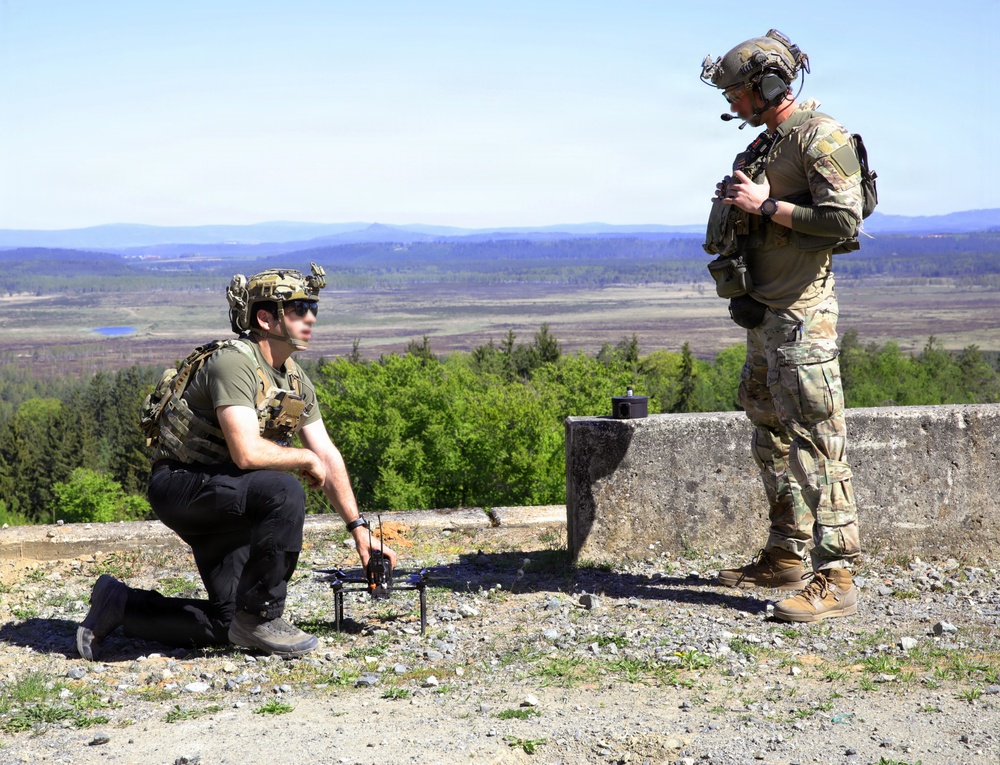
KEF has also been showing the system outside the lab. In August, according to DroneXL, the company demonstrated Tailwind on drones built by Orqa at Fort McClellan, Alabama, under jamming conditions, with personnel from the Army's 1st Special Forces Command watching. Demonstrations like that matter to acquisition offices that want proof a navigation system works when GPS is actively being jammed.
Why It Matters
The story here is less about one company than about how SOCOM is signaling demand and how small firms are positioning to meet it. The fixed-wing office's briefing reads as a requirement in waiting. If future strike systems must work with no expectation of GPS, someone will have to supply the alternative navigation, and SOF RACER's structure means early prototype winners could reach production without facing a second competition.
For KEF, consortium membership is the price of admission to that future. Without it, the company could not bid on a SOF RACER navigation call at all. With it, KEF is one member of a consortium that drew more than 1,800 applications, waiting for a call that matches its product. The first two calls, on human-performance data and edge sensor fusion, did not.
For readers trying to judge similar announcements, the distinction is worth keeping in mind. "Accepted into a consortium" means a company can compete. It does not mean the company has won. The milestones that would actually show SOCOM is buying GPS-denied navigation through SOF RACER are a published navigation-focused call, a prototype OT award and, eventually, a production follow-on. None of those has been reported yet.
What has happened is that SOCOM put its assumption in writing: future fights will be electronically contested, and GPS cannot be counted on. Companies building navigation for that environment now know where to watch for the next opportunity.
Sources
- SOCOM Plans for War Without GPS. KEF Robotics Just Got in Line (DroneXL, Nov. 2, 2026)
- SOF AT&L PEO Fixed Wing Overview, SOF Week 2026 briefing slides (socom.mil)
- USSOCOM SOF RACER Sensor Fusion Platforms Prototype: Executive Summary (BW&CO)
- USSOCOM in Partnership with GovSignals Launches SOF RACER Consortium (Business Wire via Yahoo Finance, Aug. 6, 2026)
