
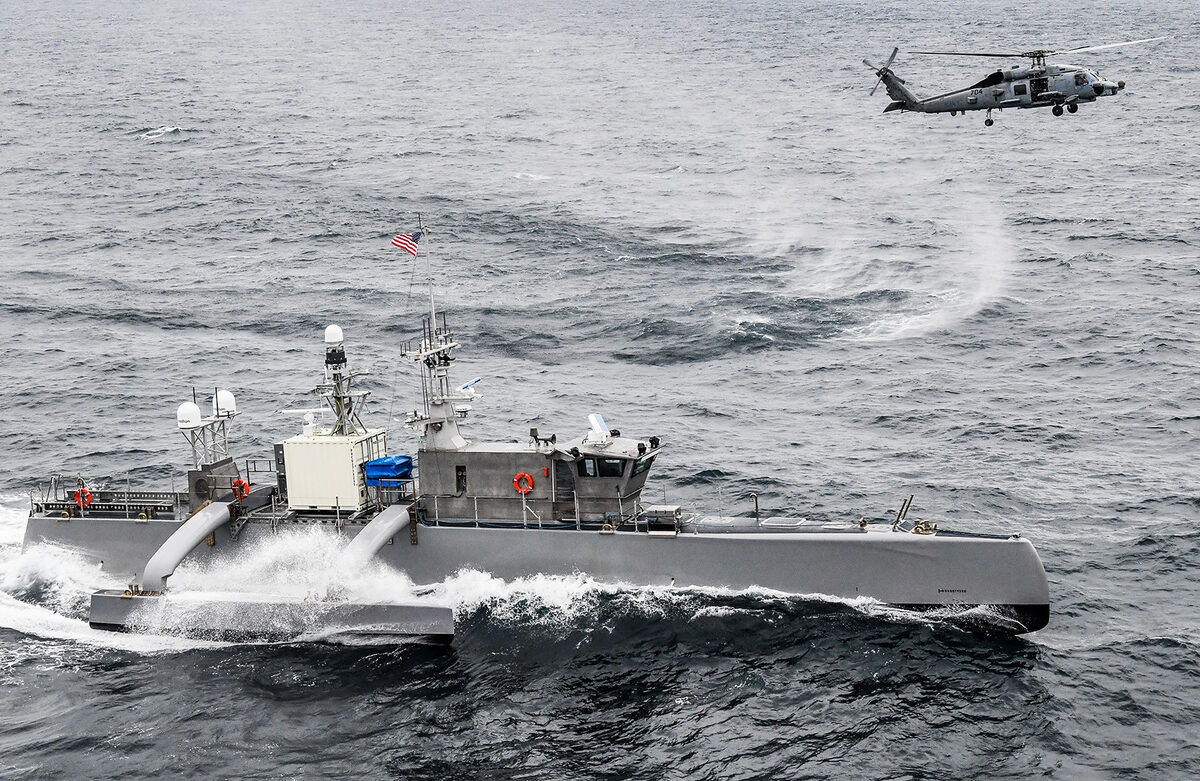
When the USS Theodore Roosevelt Carrier Strike Group left on deployment Oct. 8, it took along something no carrier group had sailed with before: a medium unmanned surface vessel. Acting Navy Secretary Hung Cao announced the deployment at the Association of the U.S. Army conference. He said the strike group "deployed on October 8 with a medium-sized unmanned surface vessel," which made it the "first carrier strike group to ever deploy with a large-size unmanned surface vessel."
On the same day the strike group sailed, the Navy's second-ranking officer was telling a congressional commission that one deployment is not enough. Vice Chief of Naval Operations Adm. James Kilby wants drone boats built into the routine by which ships are certified for deployment. He also made clear that the service is not yet fully prepared to receive them.
Which boat went?
The Navy has not said. DefenseScoop reported that multiple Navy spokespersons did not clarify the vessel model, and that a Leidos source, asked whether the Leidos-built Sea Hunter or Seahawk was deploying with the group, referred questions to the Navy because the vessels are now Navy-owned.
The public record does offer a clue about Seahawk's whereabouts. On Oct. 16, eight days after the Roosevelt group departed, Defense Visual Information Distribution Service (DVIDS) published a photo from Joint Base Pearl Harbor-Hickam. It shows Lt. Alan Yancoskie, commanding officer of the Sea Hunter-class USV Seahawk, briefing Rear Adm. Kurt Mole and Capt. Victor Taylor. The caption says Seahawk "is currently underway in the U.S. 3rd Fleet area of operations" and that its operations "represent continued progress in the U.S. Navy's efforts to integrate unmanned systems into Fleet operations."
Seahawk became an operational asset only this spring. At an April 14, 2026, signing ceremony at Naval Information Warfare Center (NIWC) Pacific, presided over by Rear Adm. Christopher Alexander, the prototype medium USV was officially transferred from an experimental role with the acquisition community to the operational fleet. Capt. Darren Gerhardt also attended.
None of this confirms that Seahawk is the boat with the Roosevelt group. The caption does not mention the strike group, and the Navy has not tied the two together. Defense News described the deployment only as a MUSV going to the Pacific with the Roosevelt group.
From one-off to standard equipment
Kilby's testimony to the National Commission on the Future of the Navy on Oct. 8 is the bigger story, because it describes where the Navy wants this to go. "I see a world where it's part of your certification exercise," he said, according to Defense News, referring to the proficiency tests Navy ships must complete to show they are qualified for various warfighting operations and mission areas. In his telling, a ship or element would have to demonstrate it can use the capability, because it may pick up the unmanned system on arrival and "you've got to be certified to use it."
Kilby also pointed to a new organization, the Robotic and Autonomous Systems Warfighting Development Center at Joint Expeditionary Base Little Creek-Fort Story in Virginia Beach. Defense News reported that Kilby said the center is based on the Navy Fighter Weapons School, also known as Top Gun. Kilby said the surface community would certify an element to go forward and operate with the fleet, and that the center's commander would create the total tailored force package when it works with other robotic and autonomous systems.
He was also blunt about the gap. Kilby said he was "not satisfied" with where the Navy stood in preparing to receive the soon-to-arrive MUSVs, though he believed the service had what it needed to "provide the governance and structure you need moving forward." He noted that the Navy will have manning, training and equipping responsibility for these systems, and said the service needs to do a better job of integrating with the capability so it knows what it is receiving.
The numbers behind the push
The Navy operates four MUSVs today, originally built as test beds and later transferred to the service. Defense News reported that the Navy expects to receive its first formal delivery of the 30 MUSVs it is buying by the end of fiscal 2027, after announcing last month that it had selected three companies to build them. Going from four boats to dozens is the reason Kilby's concern about readiness to receive them matters now.
The acquisition side is being reorganized too. DefenseScoop reported that Cao appointed Christopher Miller as portfolio acquisition executive for robotic and autonomous systems. Last year the Navy merged its separate Large and Medium Unmanned Surface Vessel efforts into a single program, the Modular Attack Surface Craft (MASC) program.
Cao made the case in terms of mass. He called the deployment a "force multiplier," adding: "Imagine having more guns out there." More hulls without crews is one way to spread sensors and, eventually, weapons across more ocean; Defense News noted the Navy has cited roles ranging from reconnaissance and surveillance to controllable weapons carriers, thanks to modular payloads.
Not just a demonstration
Uncrewed boats have already been used in real operations. According to DefenseScoop, Cao mentioned at the AUSA panel the Navy's use of Saronic's Corsair USV to rescue a downed helicopter pilot and gunner in the Strait of Hormuz over the summer. That mission had nothing to do with strike group integration, but it shows an uncrewed vessel being used for a time-critical task in a real-world operation, not just an exercise.
Why It Matters
A carrier strike group is a core unit of the Navy's deployed power. Putting an unmanned surface vessel into that formation, even once, starts to make drone boats part of how the Navy operates rather than a separate experiment.
Kilby's testimony shows the harder problem. Buying 30 vessels is an acquisition task. Making them a normal part of a certified force requires trained operators, sustained support, and tactics that commanders trust. The Little Creek development center is one part of the Navy's answer to that, and Kilby's own "not satisfied" shows how much remains to be done.
Disclosure is still a gap. The Navy has publicized a first, but has not said which vessel deployed. Until it does, outside observers can judge the milestone only from photos, captions and brief official remarks, not from what the boat actually contributes at sea.
Sources
- US Navy wants more visible role for drone boats as one deploys for the first time (Defense News, Oct. 29, 2026)
- US Navy deploys unmanned maritime drone to support carrier strike group in historic first (DefenseScoop, Oct. 16, 2026)
- USV Seahawk visits JBPHH (DVIDS, Oct. 16, 2026)
- Seahawk Unmanned Surface Vessel Transferred to Fleet During Signing Ceremony (DVIDS, Apr. 14, 2026)
