
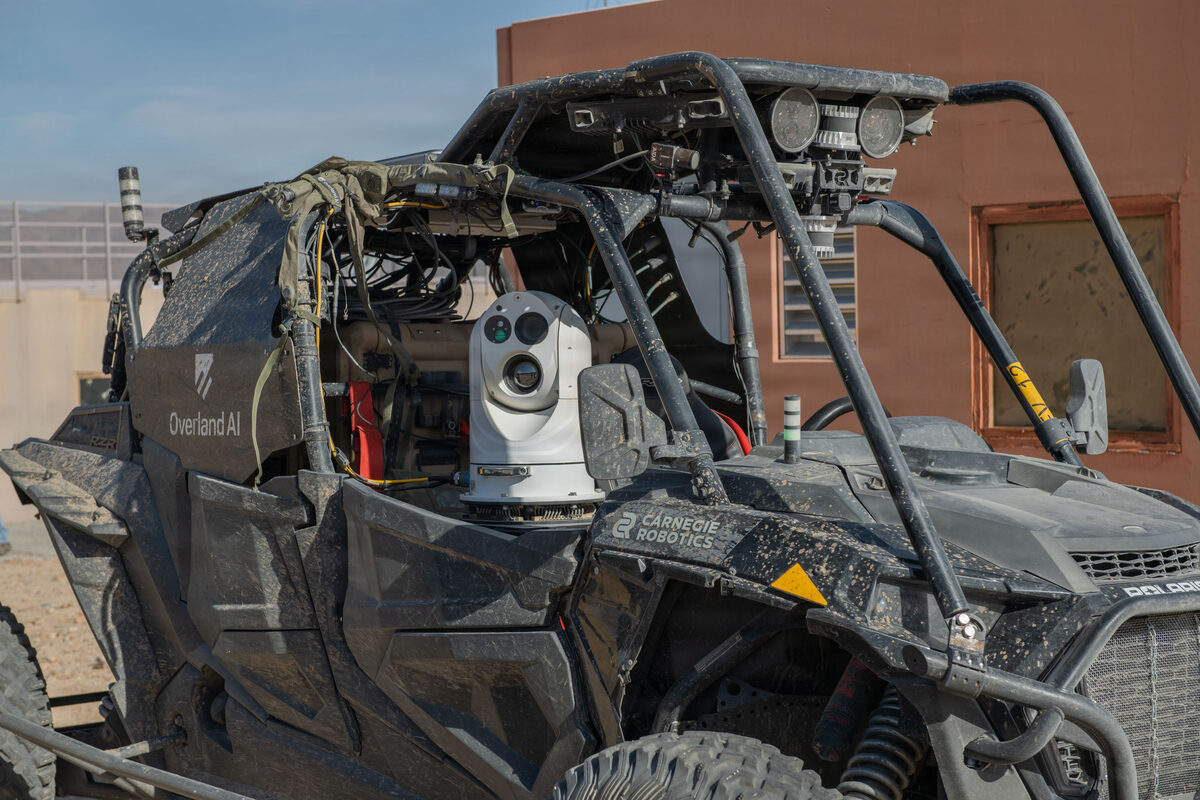
On Oct. 15, four driverless ground vehicles crossed the St. Vith Range at Fort Knox, Kentucky, hunting for enemy targets. They handled their own movement and detection, and three of them carried drones that could fly ahead to scout or strike from above. None of them was allowed to engage a target on its own decision.
The demonstration ran in front of about two dozen distinguished visitors. It was a showcase for DARPA's RACER program (Robotic Autonomy in Complex Environments with Resiliency), and Jason Gregory, a DARPA technical advisor, described it as the first time the team had gone "from satellite imagery all the way down to the tactical ground," in the Army account DARPA republished on Oct. 27.
How the Run Worked
The scenario started far above the battlefield. According to defence-industry.eu's account, an operator received satellite imagery indicating a simulated threat and sent the robotic team to investigate. From there the four unmanned ground vehicles (UGVs) handled movement and target detection by themselves.
Gregory described how little the human has to specify. "We can drop a 10-digit grid on a traversable mobility corridor that the ground vehicles use with their onboard sensors to understand the terrain and then drive to it comparable to a human," he said. The vehicles work out their own path over the terrain to reach the area.
The handoff back to the human came at the point that matters most. The lead vehicle, which carried a closed box on top, drove down a road while the other three waited at the start. Halfway up a hill it spotted a potential target and stopped, waiting for a command. Two other vehicles then moved along the road to provide cover and support, and a simulated rocket hit a target about 300 yards away on an adjacent hill. Gregory summed up the arrangement plainly: "It's controlled engagement. All the mobility, all the movement, all the detections, all of that is autonomous. But they don't pull the trigger until a human says pull the trigger."
Three of the four UGVs carried a drone payload, to be used for deeper reconnaissance or to hit targets from the sky. In a real-world scenario, the Army account says, the drone in the closed box could be launched to get a closer look at potential targets or packed with munitions to strike from the air. An image caption on DARPA's release identifies Anduril's autonomous one-way attack platforms integrated onto Overland AI's autonomous ground vehicles to engage simulated targets after receiving the mission commander's approval. One-way attack drones are expendable munitions that fly into their target. Putting them on an autonomous ground carrier means the drone's launch point can move forward without a crew going with it.
Why Fort Knox, and Why Now
The location followed a request. Fort Knox was chosen for the end-to-end test after U.S. European Command (EUCOM) asked DARPA how robotic assets could be deployed beyond the forward line of troops, the boundary past which friendly forces are not normally positioned. According to defence-industry.eu, EUCOM's request focused on early warning: robots pushed out ahead of the line to detect threats so soldiers can decide how to respond. Gregory said stakeholders had recommended Fort Knox specifically as a representation of the European theater.
That focus explains the shape of the demo. A ground robot that can travel off-road to a coordinate, search on its own and then carry a drone further forward is a sensor-and-strike node that puts no crew at the front. The human approval step keeps the use of force under the chain of command, even when the platform doing the finding is far from the operator. Gregory also said different payloads could let the same vehicles haul food, ammunition and other supplies or support casualty evacuation.
The work is not done. The next test is expected in December, when DARPA officials plan to ask a group of soldiers how they would deploy the vehicles. "Soldiers are the best evaluators because they give you honest feedback," Gregory said. That is a shift from engineers and observers to the users who would actually employ the system.
A Software Program Reaching Its End
RACER, one of DARPA's 238 programs, has been a software effort rather than a vehicle program. Gregory said the team has completed about a five-year program on software development for autonomous mobility to go high-speed off-road in complex environments. The goal is for a vehicle with a sensor suite and drive-by-wire controls to be equipped with autonomy software so a soldier can task it instead of driving it manually, at speeds on par with a human driver.
According to ExecutiveGov, which reported in January, the program is coming to an end, but DARPA expects its impact to continue. RACER has contributed to the emergence of new companies focused on off-road autonomy, including Field AI and Overland AI, whose vehicles carried the Anduril payloads at Fort Knox. ExecutiveGov also reports that the autonomy stack is considered transferable to agriculture, construction, mining and transportation, all sectors that need machines to move through unstructured outdoor environments.
ExecutiveGov adds that late-2025 Army demonstrations used RACER platforms for tasks such as combat breaching support at Fort Hood and long-range reconnaissance at the National Training Center. The Fort Knox event adds a further step: pairing the off-road driving with strike payloads under a human decision point.
Why It Matters
The Fort Knox run brings together off-road ground autonomy, drone payloads carried on vehicles, and a clear human decision point for lethal force. Together they point to a concept of operations in which robots go first into contested ground, find targets, and carry air assets forward, while soldiers stay back and keep the authority to approve engagement.
For the drone community, the important detail is the carrier. Mounting one-way attack drones on autonomous ground vehicles separates the launch point from the crew. If the December soldier evaluation goes well, it could give EUCOM's request for robots beyond the forward line of troops a more concrete answer, though that outcome is not yet established.
The controlled-engagement model also matters for the policy debate. DARPA is framing the system as autonomous in movement and detection but human-gated in engagement, the line Gregory drew when he said the vehicles do not pull the trigger until a human says so. How that line holds up as speed, numbers and communications limits increase is the question these systems will face next.
