
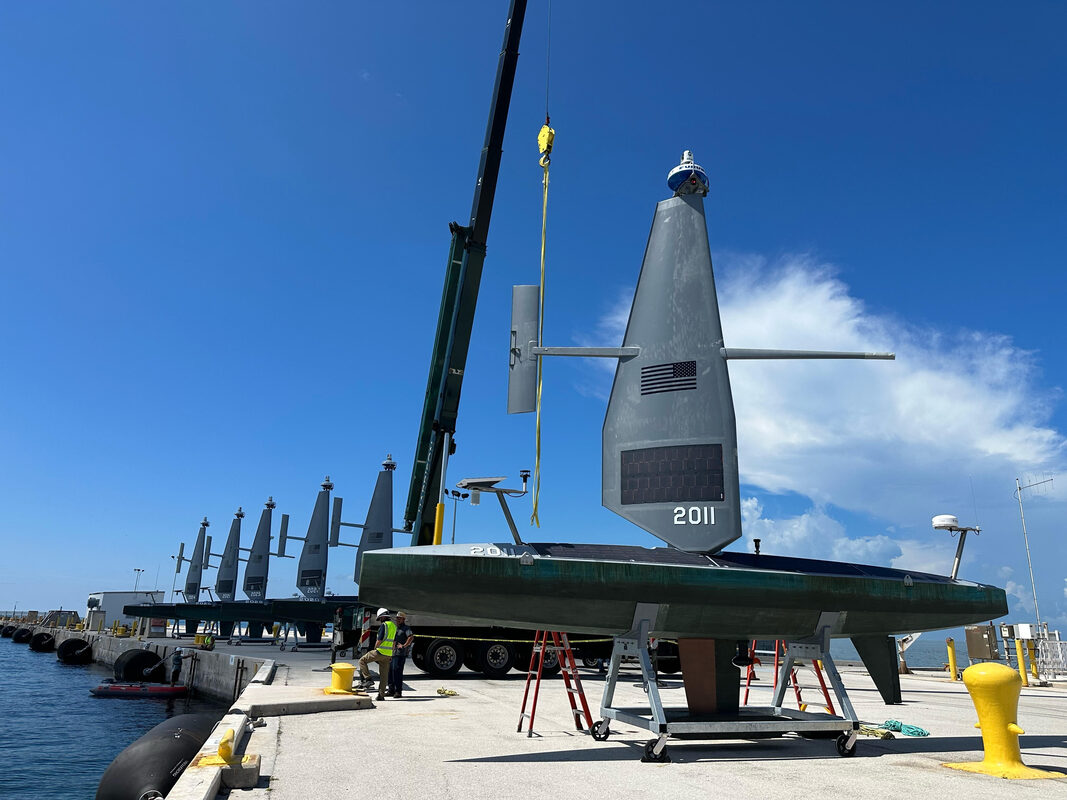
Sweden has signed up for a year of uncrewed surveillance in the Baltic Sea without buying a single boat. Saildrone has started a year-long mission for the Swedish Armed Forces using four of its Voyager uncrewed surface vessels (USVs), each contracted for 360 days. That adds up to 1,440 contracted vehicle-days across Swedish territorial waters and Sweden's exclusive economic zone (EEZ) in the Baltic, according to Naval News.
The vessels aren't the interesting part. The contract is. Under the arrangement, Saildrone maintains, deploys and tasks the USVs, and Sweden receives what they collect. Johan Wahren, project manager at Sweden's Defence Materiel Administration (FMV), put it plainly in remarks reported by Naval News: "This is fundamentally not about four unmanned vessels, but about access to sustained intelligence collection at sea... we are purchasing a persistent maritime surveillance service."
A note on sourcing: FMV's own release could not be retrieved for this report. The contract details below come from Saildrone's announcement and from Naval News and DroneXL, both of which cite FMV.
What Sweden Actually Bought
The figures are consistent across all three accounts: four Voyagers, a year-long mission and 1,440 vehicle-days. Saildrone's announcement says the mission gives the Swedish Navy a sustained view of maritime activity in its waters.
The unit of purchase is the vehicle-day. Sweden is paying for drone-days on station, and DroneXL reports that FMV says Sweden did not buy any of the boats. DroneXL reports that Saildrone staff monitor the boats at all times. In practice the company runs the operation, and the Swedish Navy uses the picture it produces.
Navies have often bought surveillance platforms the other way: acquire the asset, train people to run it and own the full lifecycle. Contracting for coverage appears to shift much of that burden to the vendor, since Saildrone maintains, deploys and tasks the vehicles. The buyer gets a service rather than an inventory. It also takes on a dependency, because the capability lasts only as long as the contract.
First Under NORDEFCO, With More Expected
Naval News describes this as the first national deployment under the Nordic Defence Cooperation (NORDEFCO) framework and says additional national deployments will follow. In Saildrone's announcement, Robert Kleist, the company's European managing director, presents the framework as one that lets each participating nation define and operate its own mission rather than signing up to a single shared tasking.
The Nordic link shows up in Saildrone's footprint too. DroneXL notes that the company opened its European headquarters in Copenhagen this year and now registers Voyagers under the Danish flag. Saildrone has already run a six-month mission for the Royal Danish Navy. According to company figures reported by DroneXL, four Voyagers on that mission held 92% fleet uptime, sailed more than 20,000 nautical miles and detected more than 170,000 unique vessels. Those numbers come from Saildrone, not an independent assessment, but they are the operating record Sweden presumably weighed.
The Ministerial Look and the Bigger Budget
The program has had political attention. DroneXL reports that Defence Minister Pål Jonson saw one of the boats at an FMV media day in Nynäshamn on Oct. 22. The outlet also notes that in January Jonson announced a $440 million push into unmanned military systems, with sea surveillance on the list.
The Swedish deal is not Saildrone's only service-style contract. DroneXL notes that in August Saildrone announced a $16.3 million U.S. Navy task order to keep its Voyager fleet operating in the Caribbean and Eastern Pacific.
The NATO Backdrop
The Baltic has become a testbed for this kind of approach. In a February statement, NATO said Task Force X-Baltic was launched in January 2025 to support Baltic Sentry, the alliance's enhanced military presence in the Baltic Sea. From March to October 2025, the task force enabled the deployment and testing of 70 air and maritime drones alongside Allied maritime assets. NATO called the agreement it announced the positive realisation of Allied Command Transformation's endeavour to enhance multinational maritime operations and the security of critical undersea infrastructure in the Baltic Sea region.
NATO's statement does not mention the Swedish contract or Saildrone. DroneXL reports that FMV says the Swedish boats contribute to Task Force X-Baltic, but the Saildrone mission itself is a Swedish national buy under a Nordic framework. Still, the problem is the same: a Baltic Sea with busy shipping routes and critical undersea infrastructure, where crewed patrols can't be everywhere. Saildrone says long-endurance USVs capable of operating for months at a time help address that gap.
Why It Matters
The first takeaway is the procurement model. FMV is buying an outcome, persistent maritime domain awareness, rather than an inventory of platforms. If this model performs, other Nordic states may find it easier to buy coverage than to build and staff drone fleets of their own. Naval News' reporting that additional NORDEFCO deployments will follow suggests that is the plan.
The second is scale. Four vehicles for a year is a limited fleet for the area it covers, which makes the contract as much a test of the service model as a full surveillance architecture. The numbers worth watching at renewal are uptime, detections and how well the data feeds into the Swedish Navy's existing picture. Denmark's company-reported figures set a benchmark, but Sweden will have its own results.
The third is control. When a contractor maintains, deploys and tasks the sensors, the line between national intelligence collection and commercial service delivery gets thinner. FMV has chosen this service model, and other navies that follow will have to settle where that line sits for themselves.
Sources
- Sweden Selects Saildrone for Year-long MDA Mission in the Baltic Sea (Naval News, Oct. 26, 2026)
- Sweden Expands Maritime Surveillance with Year-long Mission (Saildrone, Oct. 26, 2026)
- Sweden Pays Saildrone for Baltic Sea Data, Not the Boats Collecting It (DroneXL, Oct. 26, 2026)
- NATO Allies agree to expedite innovation adoption and integration for Baltic Sea security (NATO, Feb. 12, 2026)
