
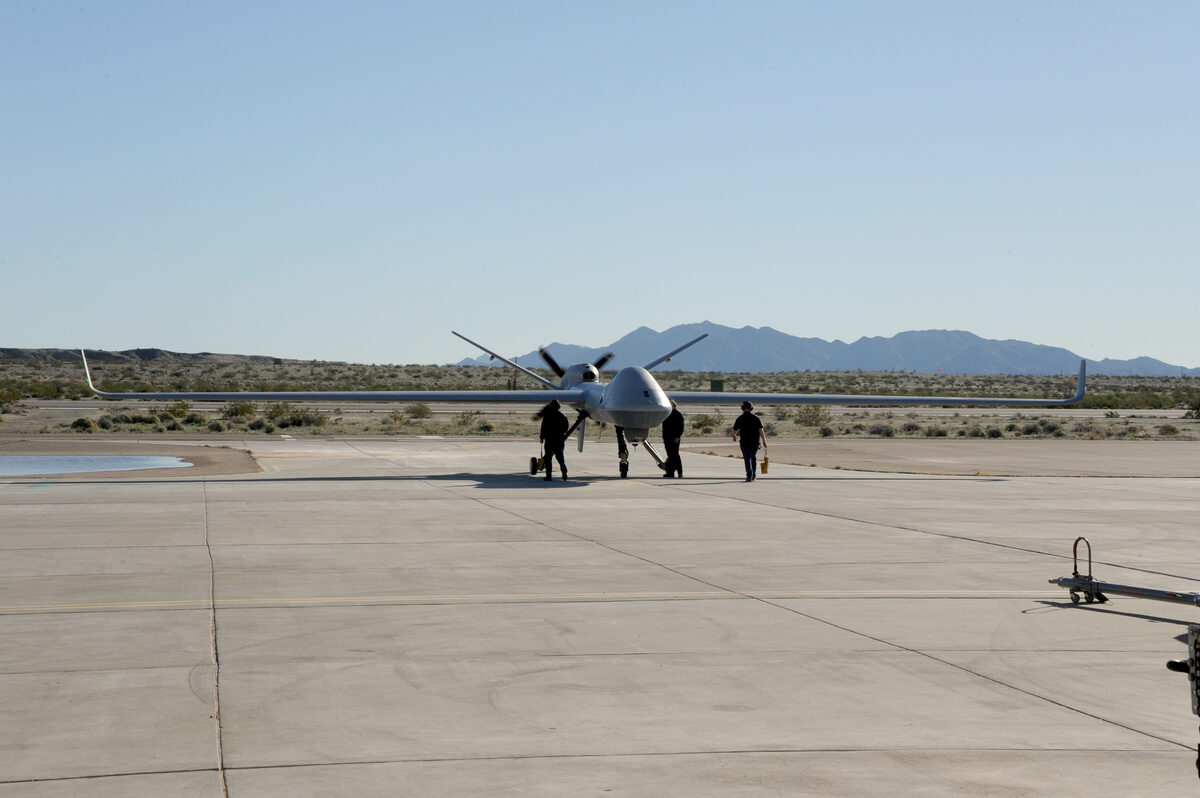
On Oct. 28, General Atomics Aeronautical Systems (GA-ASI) and Saab said a company-owned MQ-9B carrying Saab's LoyalEye airborne early warning (AEW) radar had tracked several airborne and maritime targets at long range during a flight test in Southern California. The targets included what GA-ASI called "multiple instrumented red fighter jets and several commercial aircraft." The flight took place at GA-ASI's Desert Horizon Flight Operations Facility. It is part of a trials campaign that started when the LoyalEye pods first flew on the MQ-9B on May 19, 2026.
The two companies are presenting the result as proof that a long-endurance drone can do at least part of a job that has always needed large crewed aircraft. The announcement leaves out the numbers that would let anyone judge that claim. As AeroTime noted, the companies did not say what detection ranges they achieved, how many sorties were flown, or when the test flights happened. Every performance statement below comes from the companies and has not been checked independently.
What was actually tested
Saab's release, issued from Stockholm, says the flight showed that the integrated system could detect, track and classify airborne targets in real time from an unmanned platform, in what the companies call a representative operational scenario. Janes reported the same account of what the event validated. Saab said stakeholders attended the flight and watched it in real time. It did not name them.
The radar is carried in pods rather than built into the airframe. According to The Aviationist, the companies have spent the past several months testing the company-owned MQ-9B with LoyalEye in these AEW pods, beginning with the first flight in May. "Red" is the term for aircraft simulating an adversary, AeroTime explained. The Aviationist noted that the companies gave no further detail on which aircraft were used.
The companies also described the tracking as simultaneous, covering both air and maritime targets. An AEW system has to keep a picture of many tracks at once, so this is a meaningful claim. Without range figures, though, "long range" means only what the companies want it to mean.
The pitch: complement, not replace
Saab is careful not to say LoyalEye could replace crewed AEW&C fleets. "LoyalEye is designed to complement existing AEW&C solutions by providing additional flexibility and persistence," Bergholm of Saab Surveillance said, as quoted by Janes. Saab's release says the MQ-9B with LoyalEye can work on its own or alongside crewed AEW&C aircraft. It is aimed at persistent surveillance of large areas, where endurance, geographic reach and keeping aircrews out of danger matter.
Endurance is the MQ-9B's main selling point here. Janes put the aircraft's endurance at more than 40 hours. GA-ASI presents the configuration as a way to extend AEW coverage while reserving crewed AEW aircraft for the missions where they are most needed, according to AeroTime.
The plan also depends on where the radar picture goes once it leaves the aircraft. AeroTime reported that battle management, meaning the job of turning tracks into decisions and directing fighters, could be spread across ground stations, ships or crewed AEW aircraft rather than done on board. That split is what makes unmanned AEW possible. The drone carries the sensor, and the people who interpret the picture and control the fight sit somewhere else.
GA-ASI President David R. Alexander called the trial "one of the most highly anticipated flight tests we have performed." That is the kind of thing a company says in a press release, but it does show how much weight GA-ASI puts on AEW as a new mission for the MQ-9B.
Which aircraft, and which customers?
According to AeroTime, the companies plan to offer the capability across the MQ-9B family. That family includes the SkyGuardian, the maritime SeaGuardian, the UK's Protector RG1, and the short takeoff and landing (STOL) variant GA-ASI is developing for carrier operations. Because the radar is carried in pods, it appears to be designed as an add-on that could fit several variants rather than a separate aircraft.
No launch customer has been named. AeroTime reported that GA-ASI is talking about unmanned AEW with several customers but did not identify them. The Aviationist pointed to the United Kingdom as a likely candidate. In May 2025, the UK defence secretary said the MQ-9 was a candidate for the Royal Navy's Carrier Strike Airborne Early Warning requirement. GA-ASI and Saab first announced their joint LoyalEye effort in June 2025, a month after that statement.
The Aviationist reported that an MQ-9-based AEW capability would be carrier-based and would replace the Crowsnest system, which is based on the AW101 helicopter, when it reaches the end of its service life. None of the sources reviewed ties the LoyalEye test to a contract or a firm program decision.
What we still don't know
- Detection ranges. The companies said "long ranges" but gave no figures for fighter-sized or airliner-sized targets.
- Test volume. They did not say how many sorties were flown or on what dates, beyond the May 19 first flight and the Oct. 28 announcement.
- Who was watching. Saab said stakeholders observed in real time but did not name them.
- Customers. GA-ASI says it is in talks with several customers. None has been named.
Until independent evaluators or a customer publish data, the trial is best read as a company demonstration that the integration works, not as a confirmed operational capability.
Why It Matters
Airborne early warning aircraft are among the most valuable assets an air force or navy has. They are also among the most exposed: a long-range radar orbit is a high-priority target. An unmanned, long-endurance radar carrier that can work alongside crewed AEW&C, or cover for it, offers more persistent coverage with fewer aircrews at risk. Saab's release says exactly that.
For GA-ASI, the test is a step toward turning the MQ-9B from an ISR and strike drone into a platform for a wider set of missions, including one with possible carrier applications through the STOL variant. For Saab, it shows that a podded LoyalEye radar can be carried on a drone. The test is real progress, but the most important numbers have not been published, so it does not yet show how close the system is to operational use. The next signals to look for are a named launch customer, or a government statement saying unmanned AEW has moved from candidate to program.
Sources
- GA-ASI, Saab trial MQ-9B-LoyalEye combo in operational scenario (Janes)
- Saab and GA-ASI successfully flight test LoyalEye AEW capability on MQ-9B (Saab press release via PR Newswire)
- GA-ASI and Saab Test AEW Payload on MQ-9B (The Aviationist)
- MQ-9B drone tracks fighter jets at long range with Saab's LoyalEye radar (AeroTime)
