
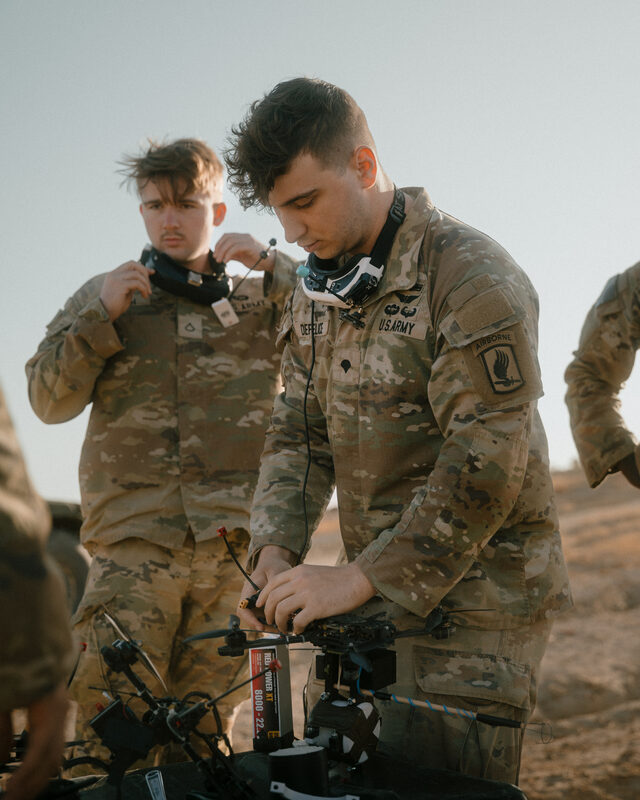
Cpl. Igor used to sit in the gunner's seat of an AMX 10 RC, the French Army's wheeled armored reconnaissance vehicle. Now he flies a first-person-view drone with goggles on. According to C4ISRNET, he serves in the 1er Escadron de Drones de Chasse, France's first dedicated drone-combat squadron. The unit was built by converting one of the three light cavalry squadrons of the 1st Marine Infantry Regiment (1er RIMa) into an all-drone formation.
The French Army now wants many more units like it. At an Oct. 14 hearing, Army Chief of Staff Gen. Jacques de Montgros said the aim is around 15 drone-combat units by summer 2027, with more to follow by the end of next year. The first unit has already deployed to Romania under Mission Aigle, the French-led mission to strengthen NATO's eastern flank. A second is heading to Poland for an exercise next month.
Below is what the 1er RIMa experiment has shown so far, who is building the equipment, and how it fits into France's wider push to buy drones in bulk.
From turret to goggles
The conversion matters for doctrine as much as for equipment. France did not create a new specialist branch for its first drone-combat squadron. It reassigned crews from an existing light cavalry unit, people already trained in reconnaissance and maneuvering alongside mechanized forces. The squadron was declared fully operational in early April 2026, C4ISRNET reports.
The squadron's design follows its cavalry heritage. C4ISRNET quotes Lt. Col. Remi, who helped implement the idea, saying light cavalry principles still apply: gather intelligence, then fix, outflank and ultimately destroy the enemy, with a focus on mobility, dispersion and stealth. Gen. Maxime do Tran of the 6th Armored Brigade told the outlet that for a light cavalry regiment such as the 1er RIMa, drones contribute mainly to reconnaissance and intelligence gathering, while in an infantry regiment their primary role is lethal firepower.
What the exercises showed
Hedgehog 2025, Estonia
The most striking figure in C4ISRNET's report comes from Exercise Hedgehog in Estonia in May 2025. Maj. Sylvain told the outlet that French drone pilots made up around 5% of the tactical group's active strength, yet in a single day of combat they accounted for 20% of the attrition inflicted on the opposing force. That force was the US Army's 5th Squadron, 7th Cavalry, with dismounted soldiers and M2A4 Bradley fighting vehicles.
Exercise kill counts depend on adjudication rules and should not be read as combat results. Still, the ratio is large. A small group of operators produced roughly four times its share of the damage against a mechanized US unit, and that is the kind of number that moves force-structure decisions. C4ISRNET says the result helped convince Army leaders to scale up the experiment.
Orion 2026
Exercise Orion 2026, France's large-scale exercise, produced a similar picture. Col. Aymeric Caussin, the 1er RIMa's commander, told C4ISRNET that the drone pilots tallied four regimental command posts, along with a number of logistics convoys and anti-drone and air-defense units. Staff Sgt. Tristan added that the squadron's reconnaissance drones detected tactical command posts several kilometers from the front line, then called in artillery or directed FPV drones against them.
The industrial partners
C4ISRNET names three industrial partners working with the 1er RIMa:
- Alta Ares, a startup working with the regiment on AI-enabled detection and reconnaissance.
- Icarus Swarms, a startup working on autonomous navigation and computer-assisted piloting.
- Naval Group, the naval shipbuilder, working with the regiment on drone-launch canisters.
The list suggests what the unit is trying to fix. AI detection can cut the workload of spotting targets on a video feed. Autonomous navigation can help when electronic warfare disrupts the control link. Canisters let drones be stored and launched from a vehicle rather than assembled and thrown by hand in the field.
Ford Rangers as drone launch vehicles
Army Recognition reported that during the rehearsal for the 2026 Bastille Day parade, 1er RIMa unveiled Ford Ranger pickups configured as launch vehicles. Each truck carries two rear containers holding 10 FPV attack drones apiece, for 20 drones per vehicle.
Army Recognition says the new attack-drone company is organized in platoons of six Rangers, so a full platoon can field 120 FPV drones (6 x 20). The drone vehicles are meant to operate alongside EBRC Jaguar and AMX-10RC reconnaissance vehicles. That fits the cavalry roots: the drone platoon acts as a launch platform with a deep magazine, working with a reconnaissance and combat formation rather than apart from it. Army Recognition notes that French authorities have released only limited technical information about the drones themselves.
The "open the hives" phrase in C4ISRNET's headline is a fitting image for this kind of setup, though the sources do not tie the phrase to the Ranger vehicles specifically.
Buying in bulk: the Delco order
The squadron's growth is happening while France changes how it buys small drones. On May 28, 2026, the Direction générale de l'armement (DGA), France's procurement agency, ordered 5,000 Delco "combatant drones" from French company Harmattan AI, according to a Ministry of Armed Forces announcement published June 23. Delivery to the Army is due by early 2027 at the latest.
That order follows the delivery of 1,000 Delco drones in January 2026, for Exercise Orion 2026. The procurement was launched in February 2025 with a European tender won by Harmattan AI, under the Pacte drones aériens de défense, France's defense aerial drone pact.
The ministry's published specifications for the Delco are:
- Weight: 1.8 kg
- Range: more than 2 km
- Endurance: 40 minutes
- Sensors: infrared cameras supplied by French firm Lynred
The ministry describes Harmattan AI as the French defense industry's first unicorn. It presents the Delco as an observation and reconnaissance micro-drone with optronic systems. The sources do not say whether 1er RIMa's FPV attack drones are Delco airframes. The two efforts run alongside each other: one is a doctrinal and organizational experiment, the other an industrial base being set up to supply quantities in the thousands.
Why It Matters
Gen. de Montgros's target of about 15 drone-combat units by summer 2027 would take France from a single experimental squadron, conceived within the 1er RIMa in late 2023 and tested at Hedgehog in 2025, to a capability across the force in roughly two years. The pieces now line up: a unit that has been declared operational, exercise results against a NATO ally's mechanized force, a deployment to NATO's eastern flank in Romania, a vehicle setup sized for 120-drone platoons, and a national order for 5,000 small drones from a domestic supplier.
Choosing to convert a light cavalry squadron rather than stand up a new specialty is also significant. Other European armies looking at how to absorb FPV drones face the same choice France faced: create a separate drone branch, or fold drones into existing combat arms. France's answer so far is to put them in existing regiments, crewed by people who already know how to find and engage targets.
Open questions remain. Exercise attrition figures are not combat results, and 1er RIMa officers themselves cautioned C4ISRNET against over-interpreting them: in a March exercise the opposing regiment lacked adequate anti-drone capability, and in June, against a tougher opponent in a contested electronic warfare environment, jamming reduced drone effectiveness on several occasions. Do Tran also warned that drone pilots need ground troops behind them to hold off a numerically strong enemy. The second unit's exercise in Poland next month will offer another data point on how the model travels beyond the 1er RIMa.
Sources
- 'Open the hives' - Why France is turning tank gunners into FPV pilots (C4ISRNET, Oct. 30, 2026)
- La DGA commande 5 000 drones du combattant Delco pour l'armée de terre (French Ministry of Armed Forces / DGA, June 23, 2026)
- France 1er RIMa Unveils FPV Attack Drone Unit to Boost Frontline Precision Strike Capability (Army Recognition, July 11, 2026)
