
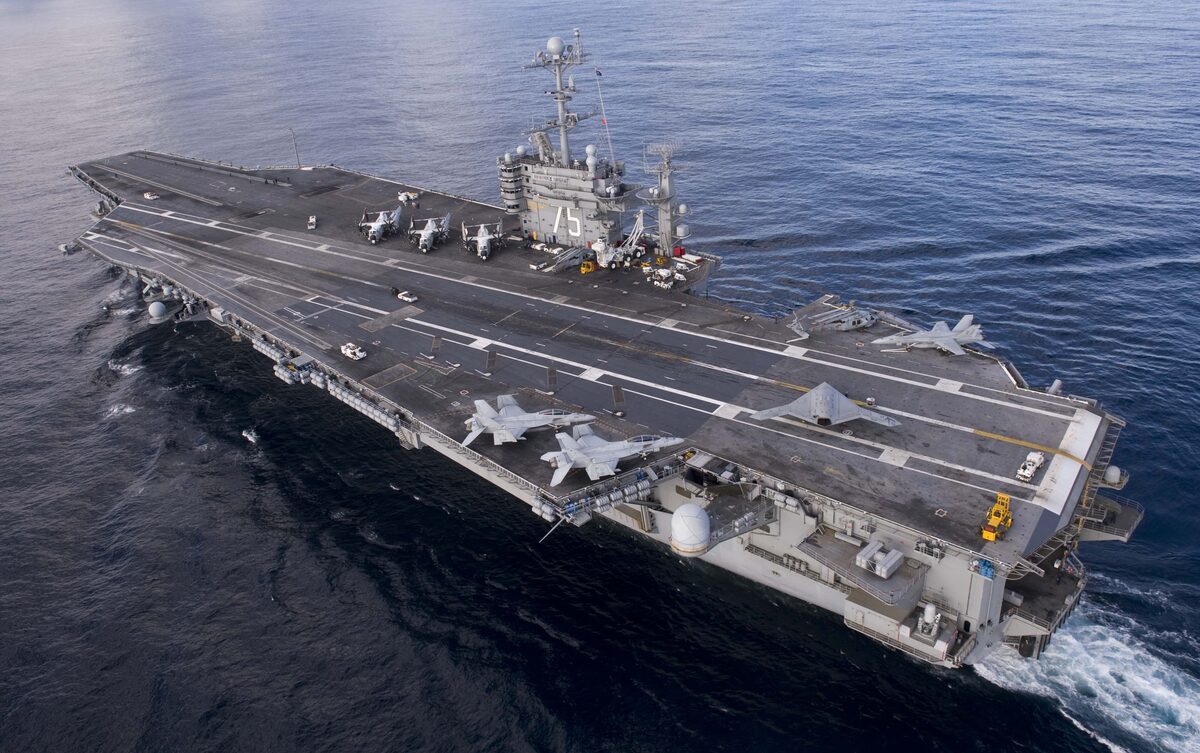
China says a tailless stealth combat drone has flown from the deck of an amphibious assault ship. On October 30, Chinese state outlets reported that the GJ-21, the naval version of the PLA's flying-wing reconnaissance and strike drone, had made its first takeoff and landing aboard the Type 076 Sichuan (Hull 51). Xinhua and the Global Times ran the report first, and China's Ministry of National Defense and the China Military Bugle account repeated it. The Bugle account is an official People's Liberation Army outlet on X. It said the GJ-21 had "recently made its first successful take-off and landing" on the ship.
That sentence is close to everything Beijing has said. According to The War Zone, neither the PLA nor state media gave a date, a location or the number of launches and recoveries. As of this writing, no official photograph or video has come out. Taken at face value, the claim marks a real change in how navies use amphibious ships. It also leaves out nearly everything an analyst would need to judge it.
What exactly is being claimed?
The claim is a catapult launch and an arrested recovery. The Sichuan is unusual among amphibious assault ships. Most ships of this type, including the US Navy's big-deck amphibs, operate helicopters and short-takeoff or vertical-landing jets. The Sichuan instead carries an electromagnetic catapult and arresting gear, so it can launch and recover conventional fixed-wing aircraft much as a full-size carrier does. The Aviationist reports, quoting the Bugle statement, that the ship also has an automatic carrier landing guidance system and a new integrated power system.
Army Recognition describes the event as a catapult launch and arrested landing carried out during late-October sea trials. It also says the ship's electromagnetic catapult was tested with dead-load vehicles in August 2026. Dead-load testing is the usual step before a catapult launches a real aircraft.
Observers tell the GJ-21 apart from the land-based GJ-11 "Sharp Sword" by a catapult launch bar on its nose landing gear, The War Zone notes. That detail matters. Army Recognition lists reinforced landing gear, a nose-gear launch bar and an arresting hook among the GJ-21's naval modifications. It is not a land drone simply moved onto a ship.
Is there any independent evidence?
There is circumstantial evidence. The War Zone looked at commercial satellite imagery. Planet Labs pictures show the Sichuan at its berth at the Hudong-Zhonghua shipyard in Shanghai on October 13, gone by October 17, and apparently back on October 26. A separate image from Vantor shows the ship at the pier again. That gives a window of more than a week away from the berth, which fits the "late-October sea trials" that Army Recognition describes. The War Zone adds that it is unclear exactly when the ship left port. Unconfirmed social-media posts claiming a GJ-21 launch from the ship also circulated around October 15.
None of this proves a flight happened, but the timeline is consistent with the claim. Still, both Army Recognition and The War Zone note the plain gap: without official video or clear imagery, there is no direct visual confirmation of a GJ-21 leaving or landing on the deck.
How did the GJ-21 get here?
The program has been visible in steps. According to Janes, images published between January 31 and February 2, 2026, showed a delta-winged, tailless aircraft under a tarpaulin on the Sichuan's flight deck while the ship sat in dry dock at Hudong-Zhonghua. Janes judged the object to be a mock-up, and said its presence on the vessel indicated China's ongoing efforts to operationalise the capability. It described the GJ-21 as a naval unmanned combat aerial vehicle (UCAV) equipped for CATOBAR (catapult-assisted takeoff, barrier-arrested recovery) operations.
The ship came first. The Aviationist says the Sichuan was launched on December 27, 2024, and began its first sea trial in November 2025. Janes describes it as a 40,000-tonne vessel with a single electromagnetic aircraft launch system (EMALS) and two aircraft elevators, and says it "will almost certainly" field an air wing that includes unmanned platforms. Army Recognition gives a higher displacement estimate of about 50,000 tonnes. It adds that the ship can accommodate more than 1,000 marines and has a floodable well deck for landing craft. The two figures differ, and China has not published an official one, so the ship's exact size is still an open question.
What the flights do and do not tell us
Army Recognition is careful about what a first launch and recovery shows. It says the flights establish that the GJ-21 can use the ship's launch and recovery equipment under the conditions tested. That is a meaningful integration step.
It does not show the numbers that decide whether the aircraft is useful in combat. Army Recognition says the flights do not determine maximum launch weight, recovery speed, sortie-generation rates or how many GJ-21s can be operated at once:
- Maximum launch weight. A single launch says nothing about how much fuel and weapons the GJ-21 can carry off a catapult.
- Recovery speed. One landing does not show how wide the safe operating window is.
- Sortie rate. The number of aircraft the Sichuan can launch, recover, refuel and relaunch in a day is the figure that sets its real combat value. Nothing in the announcement addresses it.
The secrecy also cuts both ways. Holding back imagery this time may reflect operational security around a stealth airframe. It may also mean the test was more limited than the announcement suggests. There is no way to tell from outside.
Why It Matters
If the claim holds, this would be the first time a large stealth UCAV has been operated from an amphibious assault ship. That changes what a ship like the Sichuan is for. A big-deck amphib that can launch and recover a jet-sized, low-observable drone is no longer only a helicopter and landing-craft platform. It could give an amphibious task group an embarked uncrewed reconnaissance and strike capability, as The Aviationist has assessed, without needing one of China's full carriers.
It also points to where the program could go next. The Aviationist notes speculation that the GJ-21 could later fly from the carrier Fujian, which also uses electromagnetic catapults.
The contrast with the United States is clear. The Aviationist compares the effort with the US Navy's MQ-25 Stingray program. The War Zone points out that the US military has eschewed flying-wing UCAV designs, at least publicly. Whatever the GJ-21 can actually do today, China is openly claiming a concept the US has so far held back from. Until imagery or more detailed disclosures appear, the right reading is that this is a credible, partly corroborated first step whose operational meaning is still unproven.
Sources
- Stealthy GJ-21 Drone Has Launched And Recovered From Type 076 Amphibious Assault Ship, China Claims (The War Zone)
- China's Type 076 Sichuan takes on GJ-21 UCAV mock-up (Janes)
- China Claims GJ-21 Naval UCAV has Flown from Type 076 Sichuan LHD (The Aviationist)
- China's GJ-21 stealth drone completes first takeoff and landing aboard Type 076 Sichuan (Army Recognition)
