
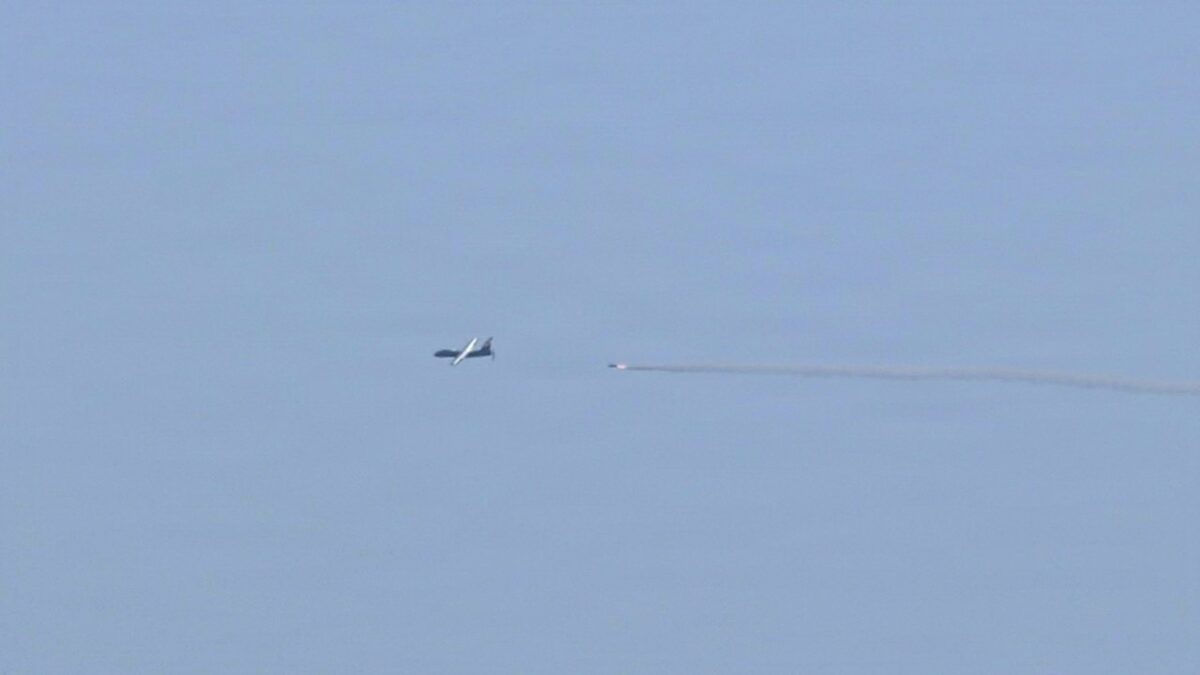
Ukraine has opened state funding for a weapon it does not yet build at scale: a guided air-to-air missile small enough to be launched from a drone. The Ministry of Defence, the Ministry of Digital Transformation and the Brave1 defense-tech cluster have launched grant competitions to develop guided air-to-air missiles and Ukrainian-made radars, Defence Minister Evgeniy Khmara announced. Per the ministry, the next step is a separate competition for turbojet engines.
The stated goals are plain. The programs are meant to counter air targets, to reduce the cost of intercepting jet-powered drones, and to build up Ukrainian radar production. Firms do not have long to decide. According to DroneXL, the first stage closes on Nov. 5 at 23:59 Kyiv time.
What Is Being Funded
There are two parallel competitions, and they are meant to work as a pair.
Competition No. 11: guided air-to-air missiles. According to DroneXL, it opened on Oct. 29 and offers up to four grants of up to UAH 75 million (about $1.64 million) each. The Ukrainian outlet dev.ua independently reported the same UAH 75 million ceiling. It also said the missile track is aimed in particular at integration with, and launch from, unmanned aerial vehicles.
Competition No. 10: tactical radar. This track offers up to four grants capped at UAH 100 million (about $2.19 million) each, DroneXL reports. dev.ua gives the same UAH 100 million figure for the radar track.
Next: turbojet engines. The defence ministry describes an engine competition as the next step. dev.ua says it will start in November and puts its maximum grant at UAH 350 million, which would make it the largest of the three.
Taken together, the three tracks appear to cover the main parts of a low-cost air-defense kill chain: a sensor to find the target, a weapon to hit it, and the propulsion that would let a missile keep up with a jet-powered threat.
The Terms, and What They Signal
DroneXL went through the rules of the missile competition, a 90-page document that the supervisory board of the Innovation Development Fund approved on Oct. 15. DroneXL says the radar competition runs on the same structure, with an 18-month clock and a 15-working-day application window. For the missile track, several of the terms stand out.
- Who can apply: only companies registered in Ukraine.
- No finished product required: applicants do not need a working missile or radar to enter.
- Timeline: 16 months from the first grant payment.
- Money: non-repayable unless the rules are breached, with no co-financing required, paid in two tranches.
- Deliverables: samples and documentation go to a military unit chosen by the Ministry of Defence.
- Process: after compliance checks, applicants get a 10-working-day window to submit a full application. A five-member commission, three of whom are independent experts, evaluates the bids.
- Specifications: the performance targets are confidential under the rules.
Each term says something about what Kyiv wants. Waiving co-financing and the finished-product requirement opens the field to small engineering teams that may have no capital of their own to put in and may not yet have flown hardware. The 16-month window is a development schedule, not a procurement contract. It assumes the state is paying to get from concept to a testable sample, and the delivery clause suggests the first customer is a frontline unit rather than a lab.
Keeping the performance targets confidential is plausibly a security measure: publishing the required range, speed or seeker sensitivity of an anti-drone missile could show Russia how fast or how far its drones would need to fly to get out of reach. The trade-off is that outside observers cannot judge how ambitious the program is. Applicants will see the requirements, and everyone else will have to wait for results.
The grant sizes are also worth keeping in proportion. Up to $1.64 million per missile team is a small budget for a guided weapon by Western standards, and DroneXL describes the cap as sized for small companies. With no more than four grants per competition, the money will be spread across only a handful of teams.
Why a Missile, and Not More Interceptor Drones?
Ukraine already fields interceptor drones against Russian attack drones. DroneXL points to the Wild Hornets Sting interceptor, which it cites at about $2,100 per unit. That cost is the benchmark any new weapon has to be measured against. So why pay to develop a missile?
The answer is in the target. DroneXL cites speeds of roughly 310 to 373 mph (500 to 600 km/h) for the jet-powered Geran-4 and Geran-5. The Ministry of Digital Transformation, quoted by dev.ua, framed the problem directly: jet drones are used against civilians and at the front, and Ukraine needs technologies that can intercept them without risking pilots' lives and at lower cost.
The likely logic is a split of roles, though the sources do not spell it out. A drone gives a cheap way to get a weapon into position. A guided missile adds the speed and terminal guidance needed to close on a fast target. Launching from a UAV keeps a pilot out of the cockpit. The radar competition would supply the cueing that a fast intercept needs, because the shooter has to know where the target is before it can engage. The engine competition fits the same picture, since DroneXL notes that a fast Ukrainian missile needs an engine of its own.
None of this makes cheap interceptor drones obsolete. The ministry's framing is about reducing the cost of intercepting jet-powered drones, and the missile track sits alongside, rather than replaces, the interceptor drones already in use.
The Wider Threat List
Khmara placed the competitions inside a broader list of priorities. He named ballistic missiles, cheap cruise missiles, high-speed drones and guided aerial bombs as the main Russian threats. The ministry expects Ukrainian manufacturers to develop their own navigation solutions, strengthen electronic warfare, create radars to detect low-observable targets, and build affordable systems that can be scaled up in production. He also asked industry for new solutions against glide bombs, known in Ukraine as KABs.
"We need technologies that change the rules of the game in our favor," Khmara said, according to the defence ministry.
The radar track speaks to two of those priorities at once: detecting low-observable targets and developing Ukrainian radar production.
Why It Matters
The economics of defending against drones have been a central problem of this war. A defender who answers cheap drones with expensive interceptors loses money on every engagement, even when the interception succeeds. Ukraine has been closing that gap with cheap interceptor drones such as the Sting. Jet-powered Gerans flying at roughly 310 to 373 mph, by DroneXL's figures, are the kind of target that prompted the new competitions, which the ministry says aim to cut the cost of intercepting them.
These competitions are Kyiv's attempt to build that capability with homegrown hardware: a drone-launchable missile, a domestic radar, and next, an engine program. The missile-track terms (no co-financing, no finished product needed, a 16-month clock, delivery to a ministry-chosen unit) look built for speed and for wide participation rather than for a single prime contractor. Brave1 has a track record to draw on: the defence ministry's site links to a report that the cluster has awarded more than 1,000 grants, while dev.ua reported almost 1,000 in an earlier piece.
Whether any team can deliver a guided air-to-air missile on this budget and timeline is the open question, and with the performance targets confidential, outsiders may not learn the answer until something reaches a unit. For now, the near-term date to watch is Nov. 5, when the first stage closes.
Sources
- Brave1 grants for air-to-air missiles and Ukrainian radars — Ministry of Defence of Ukraine
- Ukraine Will Fund Drone-Fired Air-to-Air Missiles to Catch Jet Shaheds — DroneXL, Nov. 3, 2026
- Brave1 announced grants of up to UAH 100 million for development of Ukrainian guided missiles and radars — dev.ua, Oct. 30, 2026
