
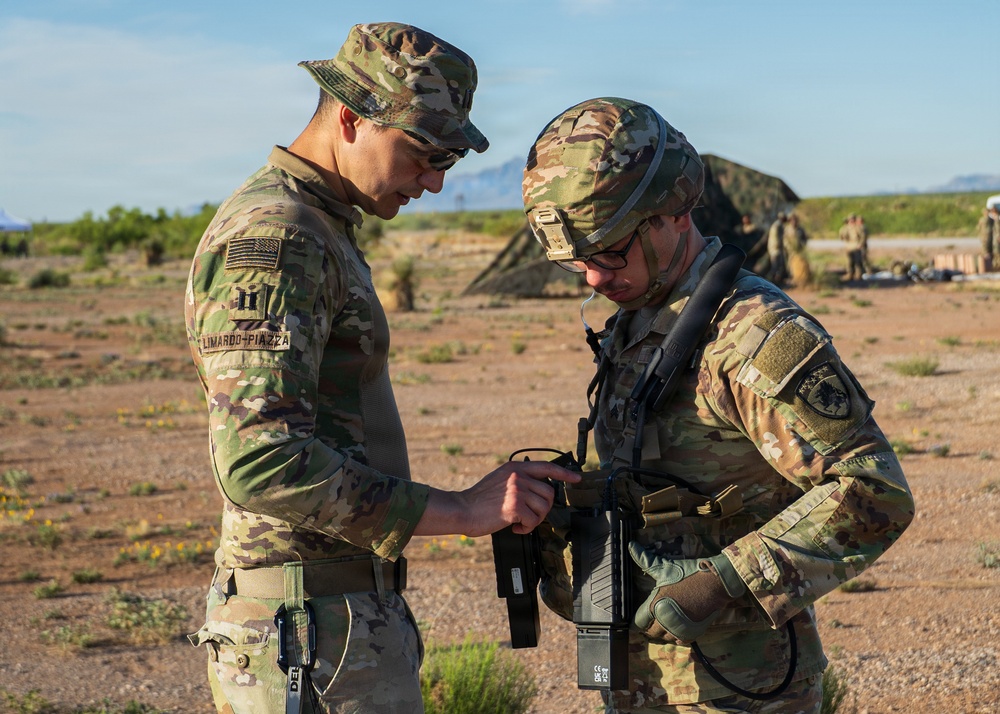
On Nov. 2, soldiers from the 2nd Battalion, 327th Infantry Regiment, 101st Airborne Division trained with the Army Multipurpose High Energy Laser (AMP-HEL), mounted on an Infantry Squad Vehicle, near Fort Hancock, Texas. DVIDS posted photos of the training by Sgt. Michael Graf on Nov. 3. Fort Hancock has a history with these weapons. In February 2026 the U.S. military used a laser over southwest Texas to shoot down a small drone, and the drone turned out to belong to U.S. Customs and Border Protection.
In the months since, the military has released large numbers about its counter-drone campaign on the U.S.-Mexico border. It has released very little that would let anyone outside the government check them. A DroneXL review of the public record, published Nov. 8, puts the gap simply: the Pentagon counts more than 300 border drone defeats in 2026, and only two engagements have had their targets publicly identified.
What the Military Has Claimed
The headline number comes from U.S. Northern Command. According to DroneXL, a NORTHCOM release dated Sept. 4 said Joint Task Force-Southern Border (JTF-SB) had defeated more than 300 drones in 2026. More than 100 of those came in August, and 11 were defeated with AMP-HEL. The release gave Aug. 24 as the first use of AMP-HEL on the border. It described the drones as assessed to be "associated with illicit activity," but, DroneXL says, it did not list drone types or engagement locations, and it did not define what "defeat" means.
The DVIDS release from Aug. 27 gives a narrower and slightly different account. It says JTF-SB used AMP-HEL on the late-night hours of Aug. 25 and 26 to engage and defeat three hostile unmanned aircraft. The drones were determined to be hostile "based on their use in direct support of activities posing a physical threat" to troops and CBP personnel. The release says JTF-SB works under USNORTHCOM in support of CBP, that the mission began in March 2025, and that about 8,000 service members are deployed across 1,954 miles of terrain. Maj. Gen. Curtis Taylor, the task force commander, is quoted in it. The release does not say whether the drones were over U.S. or Mexican territory.
CBS News reported a similar total in a different form. Military officials told the network that since the beginning of the year the military had stopped 300 drones that officials say are linked to cartels, including 11 the laser took down over a span of 10 days. They also said drones probing the Rio Grande Valley dropped by roughly 75% less than two weeks after the laser's debut. Army Col. Robert Felicio of the 130th Maneuver Enhancement Brigade was quoted. Felicio and other officials acknowledged the drop may also have been caused by other variables, such as cartels finding different routes, and Felicio did not disclose the daily number of drones his unit sees, so the 75% figure cannot be checked against a baseline.
The DefenseScoop Numbers
The most detailed breakdown came later. Speaking to DefenseScoop at Yuma Proving Ground during the Falcon Peak 26.2 experiments, Taylor said JTF-SB detected at least 378 drones between Aug. 22 and Sept. 22. Of those, 75 were turn-backs, 15 were engagements and one was a capture.
Those figures say a lot about how varied the outcomes are. Turn-backs, engagements and captures together come to 91 events in that month, roughly a quarter of the drones detected. Only 15 involved an engagement. The NORTHCOM release does not say whether its count of 300-plus defeats includes turn-backs. If it does, many of those defeats could be drones that were sent back, not drones that were shot down or seized. Without a definition, nobody outside the government can tell.
Taylor also described what the task force thinks the drones are doing. He told DefenseScoop that reconnaissance in support of human trafficking accounts for 95% to 98% of the drone activity observed. Brig. Gen. Brian Filler said the aircraft are largely commercial off-the-shelf drones that almost always carry a surveillance device such as a camera. He and Taylor did not specify how the task force directly links the drones to trafficking. That picture fits a cross-border smuggling network using cheap quadcopters to watch patrols. It does not obviously fit the DVIDS language about drones used "in direct support of activities posing a physical threat." Both descriptions may be true of different drones. The public record does not show which applies to which engagement.
The Two Engagements We Can Identify
Only two border counter-drone incidents have been tied to a specific identified object, according to DroneXL, and in neither case was the target a cartel drone.
The first was near El Paso, earlier in February. As The War Zone reported, CBP personnel reportedly used a laser to take down an object they assumed was a cartel drone, and multiple reports said it turned out to be a Mylar balloon.
The second was the February shootdown over southwest Texas. The military fired AeroVironment's LOCUST laser at what turned out to be a small CBP drone. A joint statement from the Defense Department, CBP and the FAA said the engagement happened "far away from populated areas" and that no commercial aircraft were nearby. The incident led to expanded airspace restrictions around Fort Hancock for four months.
So every border engagement whose target the public has been able to identify was a mistake or a non-threat. That does not mean the other 300-plus were. It does mean the official claims about the rest have to be taken on trust.
Oversight That Has Not Arrived
After the February incidents, Sen. Tammy Duckworth asked three inspectors general on March 13 to investigate, according to DroneXL. The outlet says it found no report from any of them that names those incidents. Nearly eight months later, no public review has explained what went wrong in either case.
The airspace rules have changed in the meantime. DroneXL reports that three FAA NOTAMs now ban drones within one nautical mile of the border from the surface to 400 feet, in effect from Oct. 20, 2026, through Oct. 19, 2027. For a year, the strip along the border is closed to the kind of low-altitude drone flying a ranch owner or a news crew might do, unless they get permission through CBP. That change falls on civilians. It does not tell the public anything more about the engagements themselves.
Why It Matters
Directed-energy weapons are moving from test ranges into use inside U.S. airspace, and the border is where that is happening first. DroneXL reports that the captions on the Fort Hancock photos describe the system as now in use for counter-UAS operations, which suggests the Army is treating AMP-HEL as equipment for line infantry units, not as a one-off demonstration. Once a weapon becomes routine, the questions that matter most are about discrimination and accountability. How does the operator know the target is hostile? Which side of the border is it on? Who reviews the engagement afterward?
The official numbers do not answer those questions. "More than 300 defeated" with no definition, "75% decrease" with no baseline, and "associated with illicit activity" with no drone types or locations are claims, not evidence. The task force's own detailed month, 378 detected, 15 engaged, one captured, suggests engagements are a small share of the activity. The only engagements whose targets have been identified in public hit a balloon and a government drone.
None of this proves the military is overstating its record. Cartel reconnaissance drones on the border are a real concern, and a task force of about 8,000 people has every reason to want them gone. But the Defense Department is asking the public to accept a new directed-energy capability over U.S. soil on the strength of totals it has not broken down. Releasing engagement-level data, even redacted, and publishing the inspector general work Duckworth requested would be the obvious way to close that gap.
Sources
- Joint Task Force - Southern Border uses high-energy laser system to mitigate cartel-linked drone threats (DVIDS)
- Task force says drone threats on US-Mexico border increasingly linked to human trafficking (DefenseScoop)
- Drone activity at U.S.-Mexico border drops 75% after U.S. uses laser weapon, military says (CBS News)
- Drone That LOCUST Laser Shot Down On Border Was Small And Belonged To Customs and Border Protection (The War Zone)
- Pentagon Counts 300 Border Drone Defeats. Two Were Publicly Identified (DroneXL)
