
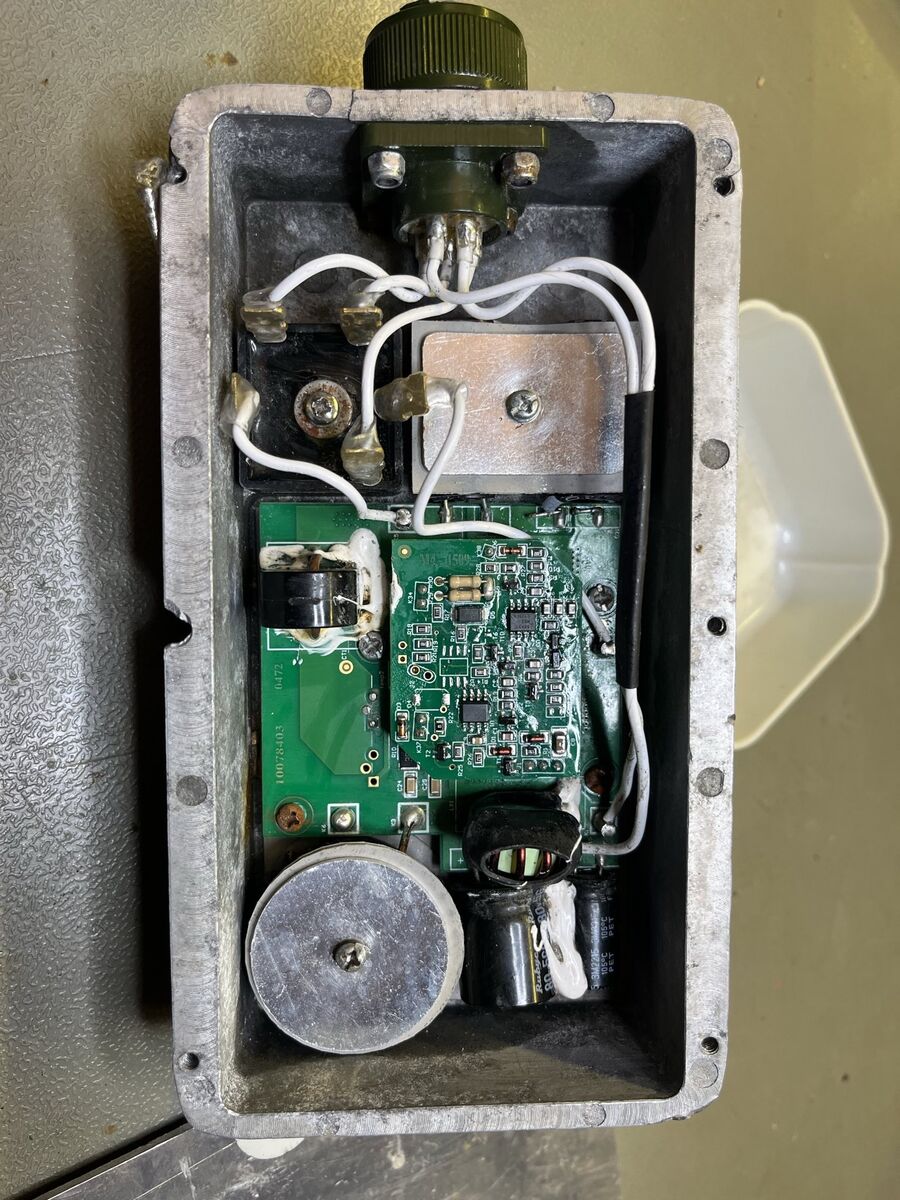
Russia's newest jet-powered Geran sits somewhere between a long-range attack drone and a small cruise missile. Ukraine's military intelligence directorate (HUR) has now published a detailed breakdown of what it is made of, and most of what it found came from outside Russia. The variant is designated Geran-5 K5-K. According to HUR's War&Sanctions portal it carries 93 foreign-made components, and UNITED24 Media and DroneXL report that 52 of those come from US companies.
HUR examined an airframe that came down almost intact. UNITED24 reports that Russian forces began using the K5-K in early autumn 2026, and that HUR has released an interactive 3D model of the airframe along with its component list. The teardown answers several questions about how the weapon is built, and it raises another about how Western electronics keep reaching the Alabuga production site.
What is the K5-K?
HUR's portal calls the K5-K a "small-sized cruise missile." Its specification table gives these figures:
- Length: 4 m
- Wingspan: 3 m
- Warhead weight: 90 kg (the examined airframe carried a TBBCh-90 thermobaric warhead)
- Cruise speed: over 450 km/h
- Range: 1,000 km
- Maximum altitude: 6 km
- Engine: TRD-200 turbojet
- Manufacturer: Alabuga OEZ PPT JSC
DroneXL describes the K5-K as a shorter, faster version of the Geran-5. It gives a ceiling of 6 km against 5 km for the earlier configuration, with cruise speed above 450 km/h. UNITED24 reports that the turbojet is assembled at Alabuga from Chinese components.
The top speed is less certain than those figures suggest. UNITED24 reports, and DroneXL notes that RBC-Ukraine also carried, a statement that the K5-K can reach up to 1,000 km/h during certain maneuvers, attributed to HUR. That number does not appear in the specification table on HUR's own portal, which lists only the cruise figure of more than 450 km/h. Until HUR publishes it in a technical listing, the 1,000 km/h figure should be treated as a reported claim, not a confirmed specification.
Where do the parts come from?
DroneXL broke down the 93 foreign components by country:
- United States: 52
- China: 10
- Switzerland: 10
- Japan: 3
- United Kingdom: 2
- Germany: 1
- Unidentified: 15
Texas Instruments supplied the largest share by a wide margin: 23 parts, including voltage regulators, CAN transceivers and two digital signal processors. Analog Devices accounts for six, Vishay for four, and onsemi and CTS for three each. HUR's portal also lists parts from STMicroelectronics, u-blox and Murata, among others.
Many of these parts are not exotic. Voltage regulators, CAN bus transceivers and oscillators are high-volume commodity chips. DroneXL's reading is that export controls on commodity electronics fail at the distributor and reseller level, because a part that ships by the million passes through enough hands that its maker loses sight of it before it reaches a Russian assembly line.
The date codes
The most telling detail may be on the CTS oscillators. DroneXL reports date codes of 2517, 2539 and 2603, which as year-and-week codes correspond to manufacture between April 2025 and January 2026. These are not old parts stockpiled before sanctions took effect. They were made years after the 2022 restrictions and still ended up in a Russian strike weapon fielded in autumn 2026.
The same question applies to Texas Instruments. DroneXL notes that TI told Bloomberg in December 2023 that it had stopped selling into Russia in 2022, and that nothing on HUR's list says TI or CTS are selling to Russia directly. That does not contradict the teardown: a manufacturer can stop direct sales and still see its chips resold through distributors and intermediaries it does not control. UNITED24 reports that Russia tries to conceal the markings on the TI signal processors and on the Murata inertial modules. That effort suggests the components can be traced and that someone wants to make tracing them harder.
How does Susanin navigate without GPS?
The most significant technical feature of the K5-K is an optical-electronic correlation system called Susanin, which HUR first found in the Geran-4. HUR's portal says the unit is built on a Coke Pi microcomputer, which DroneXL and UNITED24 describe as a Chinese alternative to the Raspberry Pi. UNITED24 reports that Susanin compares imagery from an onboard dual-band camera with reference images stored in the microcomputer's memory, helping the weapon hold its route from launch to target.
DroneXL points out that the original Geran-5 navigated with a satellite receiver and an inertial unit, and that matching photos needs no satellite signal. Jamming satellite navigation is one of Ukraine's standard defenses against Shaheds, so a weapon that can check its position against stored imagery has a way to keep flying when the satellite signal is degraded.
Not every part of that system could be traced. HUR lists the dual-range camera, the mesh modem and several other components with the manufacturer marked "Not identified." HUR's portal does not describe what the mesh modem is used for.
How many are being built?
According to DroneXL, HUR told the Ukrainian outlet NV in October that Russia produces about 4,000 Geran-4 and Geran-5 jet-powered drones a month, a figure DroneXL traces to a Militarnyi report. That figure comes from Ukrainian intelligence and has not been independently verified.
Ukraine's air defenses are not powerless against these weapons. DroneXL reports that during one October attack, Ukraine's Air Force said it shot down or suppressed 59 of 77 jet drones, or about 76 percent. DroneXL also reports that interceptor drones are closing the gap, citing a Militarnyi report that an upgraded ZIRKA interceptor brought down a Geran-5 on November 1.
Why It Matters
The K5-K shows two trends coming together. First, Russia's Geran family is moving from slow propeller-driven Shaheds toward jet-powered weapons that behave more like cruise missiles, with higher ceilings and, in this variant, navigation that does not depend on satellites Ukraine can jam. Each of those changes puts more strain on the layered, low-cost air defense Ukraine has built up against the earlier Shaheds.
Second, the teardown is another indication that sanctions on Russia's weapons supply chain are leaking. Fifty-two US-made components, oscillators manufactured as recently as January 2026, and attempts to hide chip markings all point to the same conclusion: Western commodity electronics are still reaching Alabuga, most plausibly through third parties. Of the 93 foreign components, 15 could not be traced to any country at all. That shows the limits of even a detailed forensic teardown, and DroneXL argues that pressure on distributors and resellers, and not only on the original chipmakers, is where enforcement is falling short.
For drone and counter-UAS developers, the Susanin unit is the most important lesson. An image-matching navigator built around a commercial Chinese microcomputer suggests that resistance to satellite-signal denial is no longer limited to the most expensive missiles. Defenses that rely mainly on denying satellite signals will have to account for that.
