
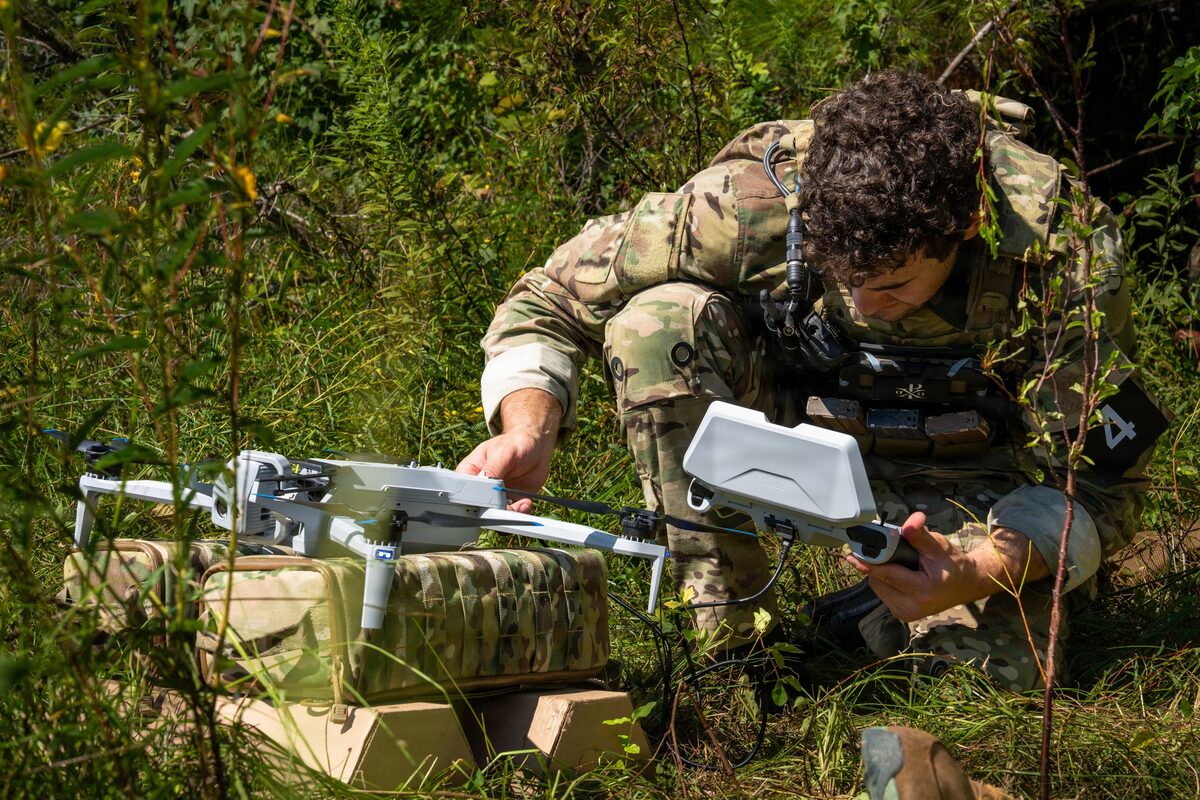
Fifteen teams from 1st Special Forces Command converged on Fort McClellan, Alabama, from August 24 to 28 for the command's first "Watchtower" Best Drone Team Competition — an event built to find out which small-unit drone tactics and hardware hold up when the electromagnetic spectrum turns hostile. Among the vendors putting equipment in front of Green Berets was a three-company package aimed squarely at that problem: Orqa US, KEF Robotics and Blue Arrow Defense, each contributing a different layer of a system meant to keep drones flying, navigating and communicating after GPS signal disappears.
The pairing is notable less for any single piece of hardware than for what it represents: a navigation and command-and-control stack assembled from a Croatian FPV manufacturer scaling up US production, a Pittsburgh-based visual-navigation startup with roots in a Defense Innovation Unit-sponsored hackathon at a NATO-Ukraine forum, and a Kyiv-and-Pittsburgh command-and-control developer whose system is being fielded with Ukrainian defense units in contested, jammed airspace.
What Watchtower Tested
Watchtower is 1st Special Forces Command's first dedicated competition for evaluating drone teams, and GPS denial was a central theme of the event at Fort McClellan. Fifteen teams took part over the five-day window, working through scenarios designed to stress the parts of small-UAS operation that jamming breaks first: precise navigation without satellite positioning, reliable command and control when the radio link is contested, and the ability to keep multiple aircraft coordinated when the electromagnetic environment is actively hostile.
That is the specific gap the Orqa–KEF–Blue Arrow package was built to close, combining hardware manufacturing, onboard visual navigation software and a multi-drone command layer into one demonstration.
Orqa's Manufacturing Push — and a Supply Chain Fix
Orqa US is in the middle of a significant US manufacturing buildout. The company is constructing a 180,000-square-foot plant in Port Orange, Florida, with full production slated to start in October. That US facility sits on top of an existing Croatian plant rated to produce 280,000 drones per year, plus a CAD 150 million deal with Canada — giving Orqa a combined manufacturing base spanning two continents as it moves to supply US defense customers.
The buildout follows a supply chain problem the company has had to publicly correct. In December 2024, the Defense Innovation Unit found radio modules assembled in China inside earlier Orqa units, a finding first reported by Forbes — a serious issue for any vendor courting Pentagon and special operations customers, given the persistent DoD concern about Chinese-origin electronics in drone supply chains. Orqa CEO Srđan Kovačević says those radio modules are now built in-house, removing the flagged component from the bill of materials rather than simply swapping suppliers.
KEF Robotics: From a NATO-Ukraine Hackathon to a Green Beret Demo
The navigation software KEF Robotics brought to Fort McClellan has an unusual origin story. It traces back to a Defense Innovation Unit-sponsored hackathon held in Kraków, Poland, as part of the NATO-Ukraine Defence Innovators Forum, where a Ukrainian-Norwegian team competing jointly as Sensorama Lab and KEF Robotics won the top $50,000 prize. The competition's challenge was building autonomous visual-object-identification navigation software that could run on limited onboard compute, without relying on GPS or heavy processing hardware. That constraint is exactly what makes the technology relevant to small tactical drones, which don't have the power or payload budget for the kind of compute that visual navigation might otherwise demand.
From that hackathon win, the technology moved into real-world use: KEF's navigation software has been field-tested in Ukraine since February 2025, giving it a combat-adjacent track record well before it reached a Special Forces evaluation in Alabama.
Blue Arrow's RII: Command and Control for Contested Airspace
The third piece of the package is Blue Arrow Defense's RII, a command-and-control system the company launched on April 2, 2026. Blue Arrow, which operates out of both Kyiv and Pittsburgh, built RII as a layer that lets a single operator run multiple heterogeneous drones — ISR, bomber and strike aircraft — simultaneously, specifically in GPS-denied and jammed environments.
RII is paired with MZK, nicknamed "Mozok" (Ukrainian for "brain"), an onboard module that handles GPS-independent visual navigation, object detection, fleet coordination and terminal guidance directly on the aircraft rather than relying on a contested link back to an operator. Blue Arrow says its initial deployment of RII and MZK was with Ukrainian defense units, for field testing and iteration under real-world conditions — meaning, like KEF's software, it arrives at a US Special Forces demonstration already tied to the conflict that has done more than any other to prove out (and break) counter-drone and anti-jamming technology.
Why It Matters
GPS jamming and spoofing have moved from a theoretical vulnerability to a routine feature of modern battlefields, and Ukraine's war has become the proving ground where navigation and control systems either hold up or don't. A Special Forces command running its first dedicated drone-team competition — with GPS denial as a central test condition — signals that US special operations units are treating jam-resistant navigation and C2 as baseline requirements, not optional upgrades.
The specific combination on display at Fort McClellan is also a case study in how the small-drone supply chain is reorganizing itself. Orqa's move to build its own radio modules in-house after a DIU finding of Chinese-made parts reflects the broader push to scrub adversary-nation components out of systems bound for US defense customers, while its 180,000-square-foot Florida plant and Canadian contract show a European manufacturer betting heavily on North American production capacity. KEF Robotics and Blue Arrow Defense, meanwhile, both carry direct lines back to the Ukrainian battlefield — one through a NATO-Ukraine hackathon, the other through Ukrainian defense units where RII and MZK are being fielded and tested — suggesting that lessons learned under real jamming in Ukraine are migrating quickly into US special operations evaluation events. For Green Berets planning small-unit drone operations against a peer adversary capable of denying GPS at scale, that pedigree matters as much as the hardware spec sheet.
