
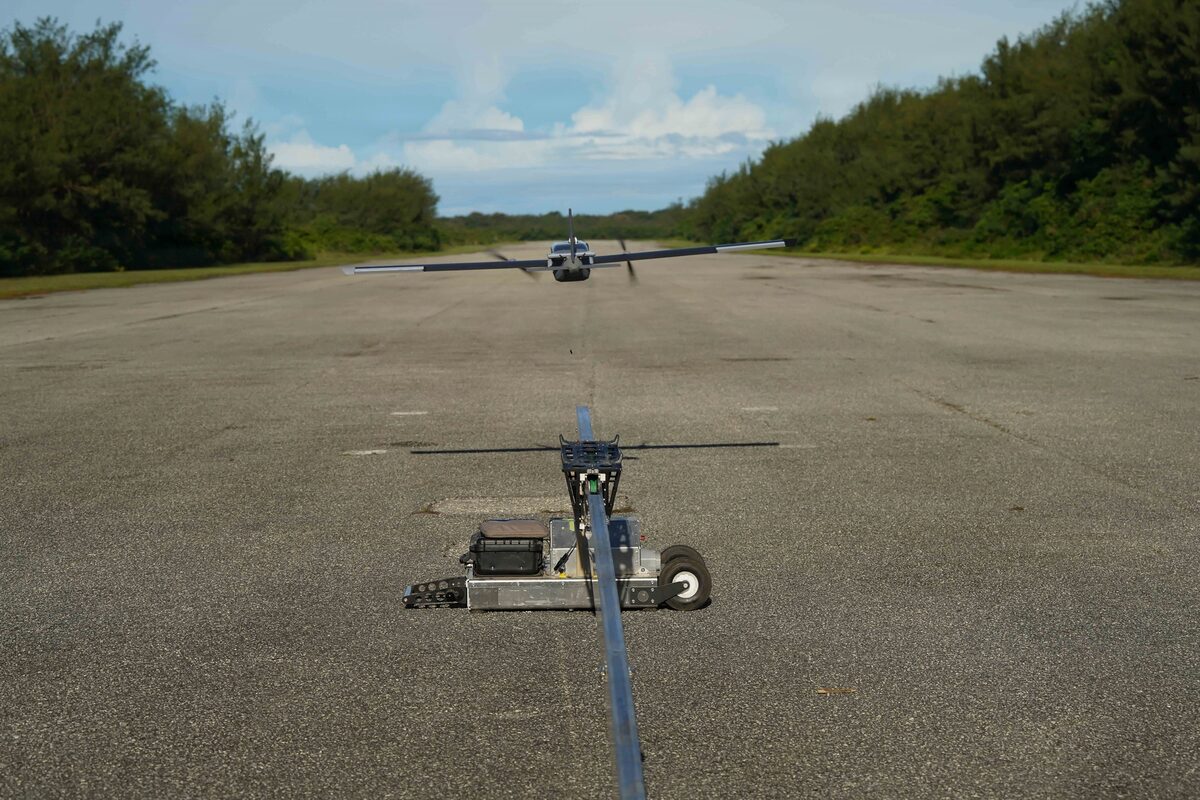
Twice on September 19, Ukraine's Security Service (SBU) said it brought down a Russian Geran-5 one-way-attack drone using an interceptor UAV of its own — an unnamed, delta-wing aircraft with a turbojet exhaust nozzle, launched off a rail catapult and carrying a thermal camera that recorded footage matching the Geran-5's distinctive exhaust signature during the engagement. Two days later, on September 21, a separate Ukrainian manufacturer announced it had finished testing a second interceptor design aimed at the same problem. Together, the two announcements mark the most visible sign yet of a scramble reshaping how Ukraine defends its skies — one driven less by innovation for its own sake than by a shortfall in a much more conventional weapon: air-to-air missiles.
Two Interceptors, One Week
The SBU intercept, first reported by Janes, followed a September 19 social media post from Ukrainian President Volodymyr Zelensky describing what he called a "successful operation" — the second successful use of the interceptor drone that day. Video released alongside the announcement showed a delta-wing UAV with a turbojet exhaust nozzle launching from a ground-based rail catapult, according to Janes reporter Tamara Rozouvan. Thermal footage captured during the engagement matched the exhaust signature of a Geran-5, the newest and fastest variant in Russia's Shahed-derived one-way-attack drone family, which trades the piston engines of earlier models for jet propulsion. Separate reporting from Aviation News corroborated the deployment, describing it as part of a rapidly expanding Ukrainian interceptor-drone program aimed specifically at jet-powered kamikaze UAVs.
Neither Janes nor Aviation News named the SBU airframe, and neither outlet's reporting resolves who builds it. But the broader shape of the program came into sharper focus on September 21, when Ukrainian company Vluchnyk announced it had completed internal testing of the Zorelit v5, nicknamed "Starship," and declared it ready for military service. "Zorelit v5 has completed all testing and is ready for military use," CEO Stepan Radiboh told Ukrainska Pravda reporter Iryna Levytska. The company put the interceptor's top speed at 416 km/h, with a range of 47 km and roughly 17 minutes of endurance at a 200 km/h cruise. It carries a 300 to 600 gram warhead and, according to Vluchnyk, costs about UAH 89,500 — roughly $2,000 per unit.
Vluchnyk pitches the Zorelit v5 against Gerbera-type drones, the piston-engine Geran-2 and the jet-powered Geran-3 and Geran-4 — not against the Geran-5 that the SBU interceptor engaged, though Vluchnyk's own specifications show its interceptor already targeting other jet-powered variants of the Shahed family. Vluchnyk describes it as a direct descendant of the Zorelit v4, a combat-proven predecessor that has already been assigned a NATO Stock Number — a bureaucratic detail that matters in practice, since NSN-listed equipment is easier for Ukraine's Western partners to fund, procure and eventually supply themselves.
Why Two Companies Are Racing the Same Problem
The pressure behind both programs shows up in the Institute for the Study of War's Critical Threats Project's Russian Offensive Campaign Assessment for September 20, which cites a Kremlin-affiliated Russian military blogger's claim that Ukrainian forces "can currently only effectively counter Russian jet-powered drones with air-to-air missiles, of which Ukrainian forces currently have a shortage." ISW did not independently verify the claim, and it originates with a Russian source rather than Ukrainian officials — but it is consistent with the shape of Ukraine's public response: two separately developed interceptor drones, announced within 48 hours of each other, both aimed at substituting a domestically producible airframe for a missile that the claim says Ukraine is running short of.
The scale of the nightly threat gives that claim its teeth. The same ISW assessment cites a Ukrainian Air Force report that Russian forces launched 138 Shahed-, Gerbera- and Parodiya-type drones on the night of September 19–20, with roughly half of the Shahed drones jet-powered. The Air Force said it downed 101 of the 138 — a respectable interception rate, but one achieved against a barrage that included a large share of the fastest, hardest-to-catch drones. Jet propulsion lets the Geran-5 and similar variants close the speed gap with the propeller-driven Shahed-136 lineage that Ukrainian air defenses spent the past two years learning to intercept with everything from mobile machine-gun teams to fighter jets. A faster drone shrinks the intercept window for every one of those methods, and, per the Russian-sourced claim ISW relays, it hits missile-based defenses hardest because Ukraine does not have enough air-to-air missiles to expend one on every incoming jet-powered target, night after night.
Why It Matters
Interceptor drones exist to substitute a cheap, domestically producible airframe for an expensive, import-dependent missile. At roughly $2,000 apiece, per Vluchnyk's pricing for the Zorelit v5, an interceptor costs a small fraction of a Western air-to-air missile — and unlike those missiles, it doesn't require a foreign government to approve a transfer or backfill a depleted stockpile. That arithmetic matters enormously when the threat side of the equation is also cheap: Shahed-family drones, including their jet-powered variants, are themselves mass-produced expendables that Russia can launch by the hundred in a single week. A defense that costs more than the weapon it stops is not sustainable at that tempo; the Russian-sourced claim relayed in ISW's assessment suggests Ukraine's current missile-based defense against jet-powered Shaheds is already strained, one shortage away from a gap in coverage.
The timing of two separate announcements — a state security service deployment and a private manufacturer's testing completion — within 48 hours of each other also signals something about how Ukraine is organizing this effort: not as a single program but as parallel tracks, with government and industry both fielding designs against overlapping variants of the same threat. The Zorelit v5's lineage from a NATO Stock Number-holding predecessor suggests at least one of those tracks is being built with an eye toward Western logistics integration, not just domestic use. Whether either interceptor, or others still undisclosed, can be produced and fielded fast enough to close the gap ISW describes will likely show up in the nightly intercept statistics before it shows up in any official announcement.
Sources
- Ukraine's SBU deploys delta-wing interceptor UAV against Russia's Geran-5 — Janes
- Ukrainian company unveils interceptor for jet-powered Shahed drones: top speed of 416 km/h — Ukrainska Pravda
- Russian Offensive Campaign Assessment, September 20, 2026 — ISW/Critical Threats
- Ukraine Deploys High-Speed Drone Interceptors to Neutralise Jet-Powered Russian Kamikaze UAVs — Aviation News