
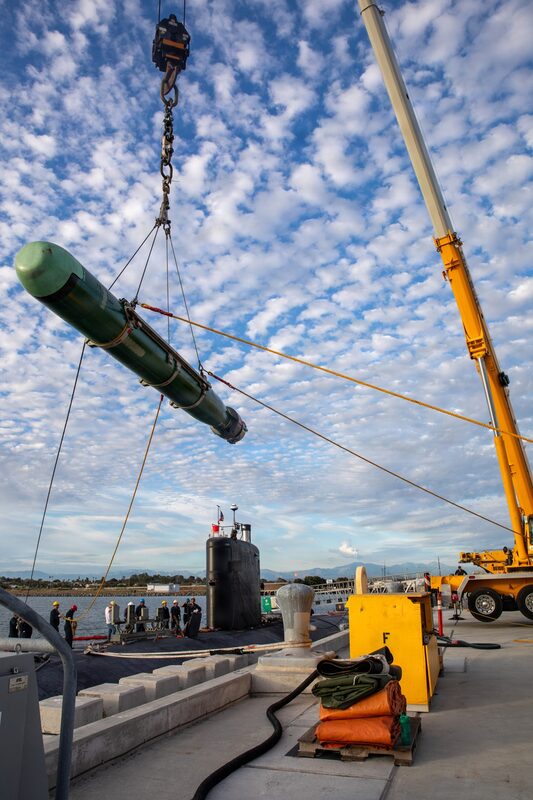
On Sept. 13, 2026, in the cold waters off Scotland's west coast, a torpedo left a tube it had never fired from before. The weapon was a US Navy Mk 48 Heavyweight Torpedo — a mainstay of American and allied submarine warfare for decades. The launch platform was not a submarine in the traditional sense at all, but XV Excalibur, the Royal Navy's extra-large uncrewed underwater vehicle (XLUUV). No sailors were aboard. It was, by every account released so far, the first time either the United States or the United Kingdom had launched a heavyweight torpedo from an uncrewed undersea vessel rather than a crewed submarine.
The test took place at the British Underwater Test & Evaluation Centre (BUTEC), a Royal Navy range on Scotland's northwest coast built for exactly this kind of weapons trial. It was conducted under Project Broadsword and its associated Trial Iron, both organized within AUKUS Pillar 2 — the trilateral technology-sharing track of the Australia-UK-US pact that, unlike Pillar 1's nuclear-submarine work, covers advanced capabilities including undersea autonomy, hypersonics and electronic warfare.
Neither government announced the firing immediately. The U.S. Navy's account, released Sept. 22 through the Department of the Navy, was picked up via a GlobalSecurity.org mirror of the original navy.mil release after the primary Navy.mil page proved unreachable behind a web application firewall. The United Kingdom's confirmation came the same day, published on GOV.UK by the Prime Minister's Office, which described "a historic live firing of a heavyweight torpedo... launched from a 12-metre-long undersea Plymouth-made drone named Excalibur." Trade outlets Army Recognition, Navy Lookout and Defense News all filed similar accounts within hours of each other, each independently sourcing government statements; Navy Lookout and Army Recognition both described the firing as having happened "last week," per the UK government's own announcement, while Defense News reporter Claire Barrett cited the precise date of Sept. 13.
What Exactly Fired, and From What
The weapon is understood to be the Mk 48 Mod 7 CBASS — the Common Broadband Advanced Sonar System variant of the Mk 48, a heavyweight torpedo jointly developed by the United States and Australia and used across both navies' submarine fleets to engage surface ships and other submarines. Navy Lookout's reporting on the trial identifies the CBASS variant specifically; the Navy's own release does not detail the exact model, but that variant is Mk 48's current front-line configuration for allied undersea forces.
The platform, XV Excalibur, is a purpose-built XLUUV roughly 12 meters long and approximately 19 tonnes, constructed by Plymouth-based submarine manufacturer MSubs under the Royal Navy's Project CETUS. It was formally named in a ceremony at Devonport in May 2025. Firing a heavyweight torpedo from a vehicle of that size and without a crew required solving problems that simply don't arise on a manned boat — reliably managing weapon release, tube pressurization and safety interlocks with no one aboard to intervene if something goes wrong.
A Fast Timeline for a First-of-Kind Test
What stands out in the Navy's account is less the physics of the launch than the speed at which it came together. According to the Department of the Navy's release, the project was approved in February 2026 by the Department of the Navy's Rapid Capabilities Office (DONRCO) and executed in under seven months — a compressed schedule for a first-of-its-kind weapons integration effort, achieved with the Defense Innovation Unit (DIU), the Naval Undersea Warfare Center (NUWC) Keyport and industry partners working alongside the program office.
Navy leadership framed the milestone in correspondingly large terms. Chief of Naval Operations Adm. Daryl Caudle called it "a historic first for allied undersea warfare." Vice Adm. Robert Gaucher, Director of Submarine Programs, addressed the weapon-release milestone directly, while Vice Adm. Seiko Okano, director of DONRCO, tied the test to the office's broader mission of pushing capability from concept to fielded system faster than the traditional acquisition cycle allows.
Q&A: What Comes Next
Is this a one-off demonstration, or does it lead somewhere?
The Navy's release points to a specific follow-on: Project CUTLASS, which the Rapid Capabilities Office says will push further payload integration work onto the Anduril Dive-XL platform. Dive-XL is Anduril's own large uncrewed underwater vehicle, distinct from the UK's MSubs-built Excalibur, suggesting the effort is meant to validate weapon integration across more than one uncrewed hull rather than being tied to a single vehicle design.
Does this replace crewed submarines?
Nothing in the released material suggests that. What it demonstrates is that a heavyweight, wire-guided-class torpedo can be fired from a large uncrewed vehicle under range conditions — a capability that could extend undersea strike reach without putting a crewed hull, and its sailors, in the most exposed forward positions.
Why announce it now, and why through the Prime Minister's Office rather than the Ministry of Defence?
The UK government tied the disclosure to Prime Minister Andy Burnham's visit to the UN General Assembly, using the torpedo test as one anchor point in a broader announcement of a new UK-US artificial intelligence and autonomy partnership — pairing the UK Ministry of Defence's Rapid AI Delivery Taskforce with the US Department of War's Chief Digital and AI Office. The GOV.UK release frames the Excalibur firing as evidence that the two allies can move quickly on autonomous systems, using it to underwrite the credibility of the newly announced AI partnership.
Why It Matters
Torpedoes are among the most tightly controlled weapons in any navy's inventory, and firing one from an uncrewed platform is a different engineering and safety problem than firing one from a submarine with a trained crew managing every step. Success at BUTEC means the U.S. and UK now have a demonstrated, if still early, path to arming large uncrewed underwater vehicles with heavyweight torpedoes rather than restricting them to sensing, surveillance or smaller effectors. That matters for AUKUS Pillar 2 specifically: the pact's non-nuclear technology-sharing track has so far produced more concept demonstrations and roadmaps than fielded weapons, and a live-fire torpedo launch is a tangible marker of progress that both governments can point to.
It also matters for the emerging uncrewed-undersea-vehicle market. The Navy's decision to route the follow-on Project CUTLASS toward Anduril's Dive-XL — a different vehicle from the UK's own Excalibur — signals that Washington wants weapon integration proven across multiple industry platforms rather than locked to one design, a pattern consistent with the Pentagon's broader push to qualify several vendors for autonomous systems rather than commit early to a single supplier. For a defense-tech sector where large uncrewed submarines have mostly been demonstrated as sensors and cargo carriers, a confirmed heavyweight-torpedo launch is a meaningful step toward treating them as combatants in their own right.
Sources
- U.S. Navy and Royal Navy Successfully Test Fire Torpedo from Unmanned Undersea Vehicle (US Navy release, via GlobalSecurity mirror)
- Royal Navy's autonomous submarine fires heavyweight torpedo in AUKUS trial
- UK and US Make First Torpedo Launch From XV Excalibur Drone to Expand AUKUS Undersea Strike Options
- Royal Navy successfully launches US Mk 48 torpedo from uncrewed submersible
- Prime Minister drives global work on artificial intelligence at UNGA as UK and US make history with firing from undersea drone