
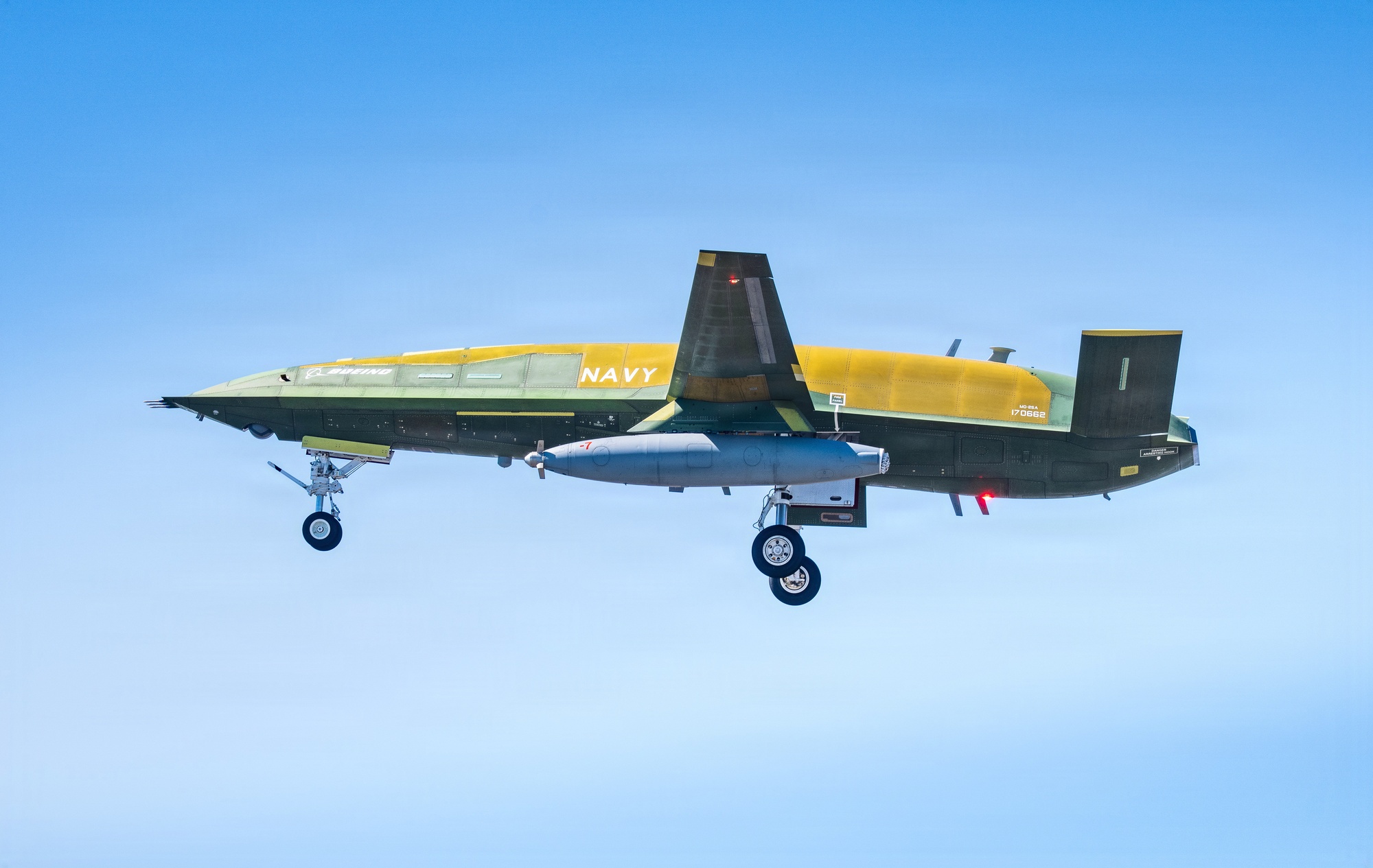
At 5:00pm Eastern on August 13, 2026, the submission window closed on a Navy sources-sought notice that could reshape the composition of the carrier air wing for decades to come. Issued by the Navy's Portfolio Acquisition Executive (Aviation), the notice asked industry to describe how it would design, develop, prototype, manufacture and field a next-generation family of unmanned carrier-based aircraft — the clearest signal yet that the service intends to move beyond a single tanker drone and toward a genuinely diversified unmanned component of the carrier air wing.
The notice, posted to SAM.gov as part of the Air Wing of the Future Family of Systems strategy, lists Samantha Moore as point of contact and does not commit the Navy to a program of record. Sources-sought notices are explicitly market-research instruments: they let the government gauge industrial capacity and shape acquisition strategy before a formal solicitation is drafted. But the scope described in this one is unusually broad, spanning six mission areas and a demanding set of technical thresholds that suggest the Navy has already done considerable internal homework on what it wants this aircraft family to do.
What the Navy Is Asking For
According to reporting by Military Aerospace, published August 7, 2026, the notice calls for an unmanned aircraft — or family of aircraft — capable of a minimum 1,000 nautical mile combat radius without aerial refueling when flying strike missions. That figure matters: it directly addresses the "tyranny of distance" problem the Navy has spent the past decade worrying about as adversary anti-ship missile ranges have grown. An unmanned platform that can hold that radius without a tanker assist would let a carrier strike group operate its air wing from farther offshore, complicating an adversary's targeting problem.
The requirements don't stop at strike. The notice describes missions spanning intelligence, surveillance, reconnaissance and targeting (ISR&T); electronic warfare; anti-submarine warfare; logistics; and aerial refueling — effectively asking industry to conceive of an unmanned aircraft, or a family of related unmanned aircraft, that could take over roles currently split across several manned platforms and the MQ-25A. The aircraft must be compatible with both Ford-class and Nimitz-class carrier decks, and the notice further raises the possibility of operating from destroyers or expeditionary sea bases via vertical takeoff and landing, according to Military Aerospace's account of the solicitation language.
On the autonomy side, the bar is set high. The notice calls for autonomous carrier landings, autonomous deck taxi, dynamic retasking in flight, threat evasion, and automated aerial refueling — a cluster of behaviors that together describe an aircraft able to operate on and around a flight deck with minimal human intervention, not merely fly a pre-programmed route. The notice also asks that submissions align with Open Mission Systems standards, the open architecture framework meant to let government and third-party software run across different vendors' airframes without being locked to a single prime contractor's proprietary systems.
Deliberately Open-Ended by Design
What the Navy notably has not done is specify a single airframe configuration. Reporting from Navy Times on July 14, 2026, framed the effort as part of the broader Air Wing of the Future — also referred to internally as "Golden Fleet" — initiative, and noted that the service is inviting single-role aircraft, multirole aircraft, or modular family-of-systems concepts rather than dictating a specific design up front. That is a deliberate acquisition posture: rather than writing a requirement so tightly that only one plausible design fits it, the Navy appears to be using this sources-sought process to see what industry believes is achievable across the full mission set before committing to firmer requirements in a subsequent solicitation.
Navy Times also situated the effort alongside two programs already underway: the MQ-25A Stingray, the carrier-based unmanned tanker that has been the Navy's flagship unmanned aviation program for years, and the Collaborative Combat Aircraft (CCA) program, the Air Force-led effort to build lower-cost, semi-autonomous drones that fly alongside crewed fighters. This next-gen carrier UAS notice reads as an attempt to give the carrier air wing its own analogue to CCA — an unmanned aircraft family that isn't just a tanker, but a genuine combat and mission-systems contributor operating from the boat.
A Faster Timeline Than Expected
Coverage from The War Zone characterized the move as the Navy "suddenly" pushing forward on carrier-based "loyal wingman" drone development, describing the pace as faster than many observers had anticipated — a shift from the Navy's own prior public posture of following the Air Force's and Marine Corps' lead on collaborative-combat-style drones. The War Zone framed the effort as broadly aligned with the Air Force's CCA program and part of a wider push across the services to expand unmanned mass within combat air formations — the idea that adding large numbers of comparatively low-cost autonomous aircraft alongside a shrinking pool of expensive crewed fighters increases both magazine depth and survivability without a proportional increase in cost or aircrew risk.
That acceleration is notable given how methodically the MQ-25A program has moved through years of development and carrier testing. A next-gen family of systems spanning six mission sets, VTOL-capable basing flexibility, and Open Mission Systems compliance is a considerably more ambitious ask than a single-mission tanker drone, and it remains to be seen how quickly the sources-sought responses translate into an actual request for proposals, let alone a contract award.
Why It Matters
The carrier air wing has spent nearly a century organized around crewed aircraft, and the pace of change toward unmanned systems within it has, until recently, been slow and narrow — largely confined to the single-mission MQ-25A tanker. This notice signals the Navy is now willing to contemplate unmanned aircraft carrying weapons, flying strike missions, hunting submarines, jamming enemy sensors and hauling cargo from the same decks that today launch F/A-18s and F-35Cs. A 1,000nm unrefueled combat radius, if achieved, would materially extend how far offshore a carrier strike group can operate while still projecting airpower — a plausible response to the growing reach of adversary anti-ship missiles that has driven Navy strategists to worry about carriers being pushed further from contested waters. Pairing that reach with autonomous deck operations and Open Mission Systems compliance also points toward an air wing where unmanned aircraft aren't bolted-on afterthoughts but integrated, multi-vendor components managed through common software architecture — a philosophy that echoes the Air Force's CCA effort. Whether this sources-sought notice matures into a funded program of record, and how quickly, will be an early indicator of how seriously the Navy intends to follow the Air Force's lead on unmanned mass at sea.
Sources
- Next-Generation Unmanned Carrier-Based Aircraft — Sources Sought Notice (SAM.gov)
- Navy seeks industry concepts for next-generation carrier-based uncrewed aircraft family (Military Aerospace)
- The US Navy is eyeing next-gen carrier-based drones. Here's what they might do. (Navy Times)
- Navy Carrier-Based 'Loyal Wingman' Drone Development Suddenly Pushes Forward (The War Zone)
