
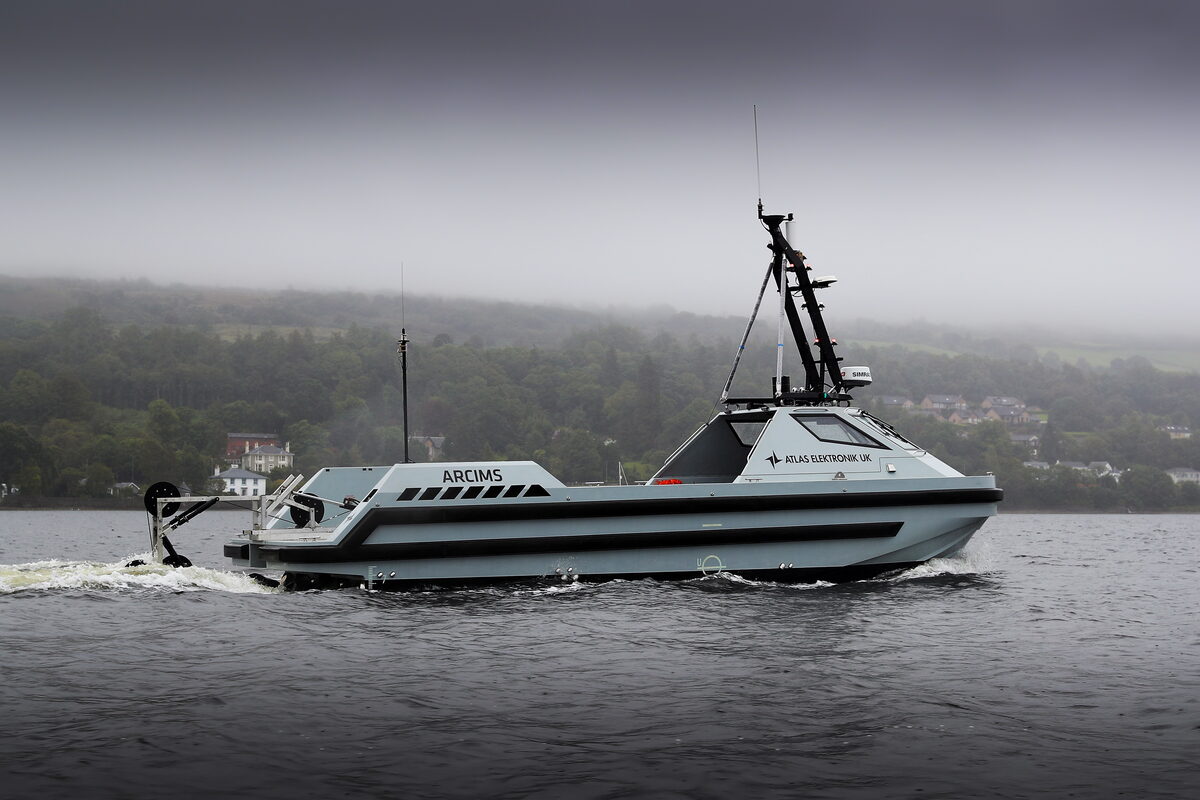
The Royal Navy now knows how its uncrewed mine-hunting systems will get to sea. On November 12, at the Atlantic Future Forum in Oslo, UK Defence Secretary Wes Streeting and his Norwegian counterpart Tore O. Sandvik confirmed that Britain will buy three Offshore Support Vessels to serve as motherships for uncrewed mine countermeasure (MCM) systems. Norway calls the ships "standardised vessels." The first is due in 2031, and the deal includes an option for three more.
Britain is not designing these ships itself. It is joining Norway's P1118 Standardised Vessel Programme, and the ships will be delivered through a government-to-government arrangement called the Maritime Capability Partnership Framework. The Ministry of Defence presents the deal as part of the wider Type 26 frigate export agreement with Norway. That agreement is the UK's biggest-ever warship export by value, and the government says it supports 4,000 jobs in the UK supply chain, more than 2,000 of them at BAE Systems' yards in Glasgow.
The announcement settles some questions and leaves others open. Here is what is known.
What exactly is the UK buying?
Three Offshore Support Vessels, with an option for three more. They will not hunt mines themselves. Their job is to carry and support the uncrewed systems that do. The MoD describes the vessels as a key step in building the "Hybrid Navy."
The Defence Investment Plan includes an extra £90 million for buying the ships. That number needs context. Earlier, in a written answer to MP Ben Obese-Jecty reported by UK Defence Journal, Defence Minister Luke Pollard said that under the next phase of the Mine Hunting Capability programme, "the Department will procure three Offshore Support Vessels, alongside enhanced autonomous mine countermeasures capability." According to that report, the Defence Investment Plan commits £1.1 billion to the Mine Hunting Capability programme, and a separate written answer put the offshore support vessel element at £90 million within the seabed warfare investments.
On those figures, the ships are a small slice of the programme: £90 million against £1.1 billion.
Why motherships instead of minehunters?
The traditional minehunter is a crewed, purpose-built warship that sails into a suspected minefield to find and neutralise mines. Uncrewed MCM changes that. The drones go into the danger area, and the ship that carries them can stay farther back. The MoD says the vessels will keep sailors further from danger.
That also changes what the ship has to be. A mothership does not need the specialised design of a minehunter that must operate inside a minefield. It mainly needs to carry the drones, launch and recover them, and support them. That is why a fairly general-purpose offshore support design, shared with an ally, can do the job.
The shift is already showing up in the fleet. UK Defence Journal reports that HMS Chiddingfold has formally left service as the Royal Navy's crewed minehunters retire. The motherships are meant to fill the gap those ships leave, with the first one not arriving until 2031.
What does Hormuz have to do with it?
The government release explicitly cites Iran's mining of the Strait of Hormuz. The MoD says the mine threat has been brought into sharp focus by the mining, which it says has caused major disruption to global energy trade. Streeting framed the deal in terms of freedom of navigation, meaning the ability to keep sea lanes open against exactly this kind of threat.
The release also points to a second use closer to home. It says the ships will support anti-submarine warfare on NATO's northern flank, the waters off Norway that matter to both countries. A ship built to carry uncrewed systems may not be limited to one mission.
Why Norway, and why now?
The motherships come out of the same relationship as the Type 26 deal. The MoD release calls the deal an export agreement, and Naval News describes the purchase as part of the wider UK-Norway Type 26 partnership. The two navies are tying their fleets together: Norway is buying British frigates, and Britain is joining a Norwegian ship programme.
Sandvik said operating similar platforms will improve cooperation between the two navies, and linked it to the Lunna House agreement between the two countries. In practice, common hulls can mean shared training, logistics and spares, and crews that can work together more easily in the North Atlantic.
What hasn't been decided?
Quite a lot. The announcement commits Britain to a programme and a delivery mechanism, not a finished ship. Naval News notes that the final design of the UK's three motherships will be set by whoever wins the Royal Norwegian Navy's P1118 Standardised Vessel Programme competition. That competition has not yet been decided, so the Royal Navy has signed up for a ship whose design is not yet known.
Other questions are also open:
- The option for three more. The deal covers three ships plus an option for three more. Nothing announced says when, or whether, the option would be used.
- Where the ships are built. The ships come through Norway's programme under the government-to-government framework. The Type 26 jobs figures cover the frigate export, not the motherships, and the sources do not say where the motherships will be built.
- The drones. Pollard's answer pairs the vessels with "enhanced autonomous mine countermeasures capability," but the sources do not break down how the £1.1 billion is split. Which systems will go aboard, and in what numbers, was not part of the Oslo announcement.
- The gap. Crewed minehunters are retiring now, and the first mothership is due in 2031. The announcement does not say how mine-hunting will be covered in the meantime.
Why It Matters
This is one of the clearest signs yet of how the Hybrid Navy will actually be built. The Royal Navy is not replacing its minehunters one-for-one. It is splitting the job in two: the risky work goes to uncrewed systems, and getting them there goes to a smaller number of support ships that stay out of the danger area. The reported figures fit that picture: £90 million for the ships inside a £1.1 billion programme.
The way Britain is buying the ships matters too. Joining an allied programme through a government-to-government framework, instead of running a national design competition, likely trades control over the design for interoperability with a close NATO partner, a point Sandvik stressed. The cost of that trade is visible in the announcement: Britain has agreed to buy ships before knowing what they will look like. Whether the approach works will depend on the outcome of Norway's P1118 competition and on whether the first ship really arrives in 2031.
For the drone community, the lesson is about scale. Uncrewed mine-hunting has moved past trials. A major navy is now buying ships specifically to carry it, and retiring the crewed ships it replaces.
Sources
- UK growth and security boosted as Royal Navy agrees export deal for new mine-hunting motherships (GOV.UK)
- UK Selects Norwegian P1118 Design for New Mine-Hunting Motherships (Naval News)
- UK and Norway seal Royal Navy mine-hunting mothership deal (UK Defence Journal)
- UK to buy three mine hunting motherships (UK Defence Journal)
