
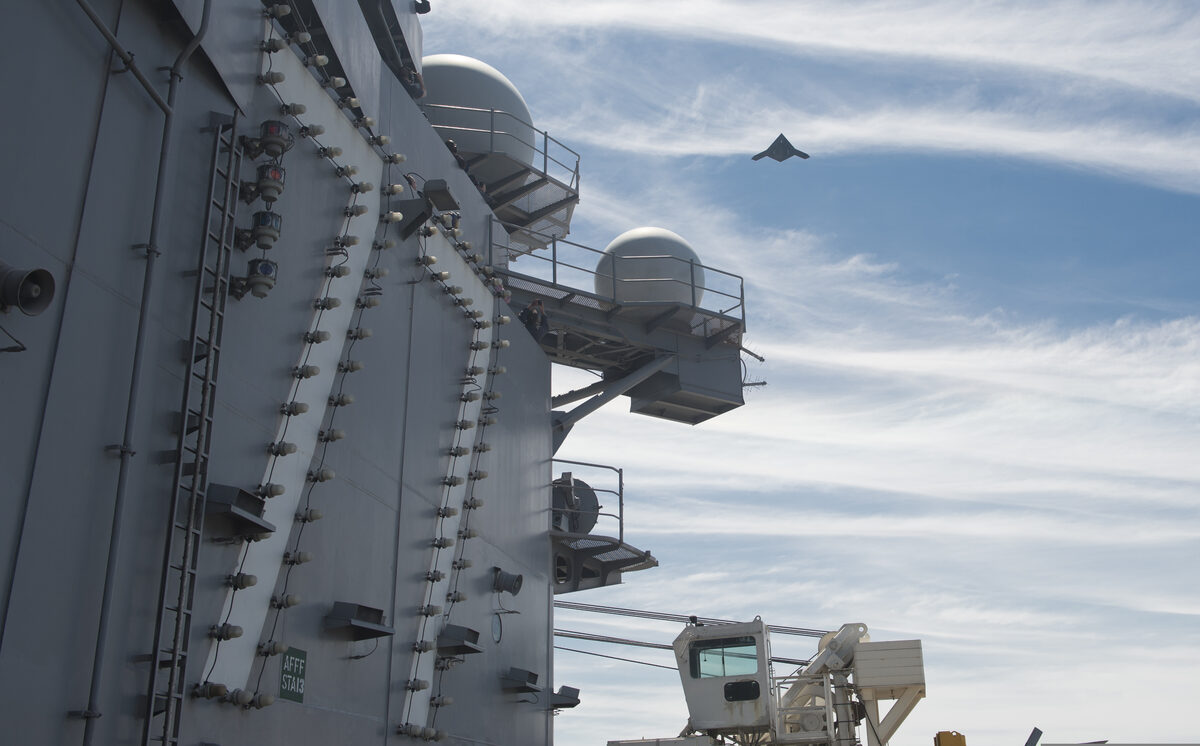
The Royal Navy plans to put a jet-powered collaborative combat aircraft on the deck of one of its carriers within about a year. Speaking at the International Sea Power Conference in Oslo on Nov. 10, First Sea Lord Gen. Sir Gwyn Jenkins said the service would sign a statement of intent with Northrop Grumman to prepare the company's Talon demonstrator for trials under Project Vanquish. The goal is a demonstration in UK waters in 2027 that includes a launch from the carrier.
"In two days' time, on this carrier, I will sign a statement of intent with our friends at Northrop Grumman to prepare their TALON demonstrator for trials with the Royal Navy under Project VANQUISH," Jenkins said, according to the Ministry of Defence's published text of the speech. "That demonstrator is here with me on this stage. Through that agreement, we will work towards a demonstration in UK waters in 2027, including a launch from the carrier."
Northrop has confirmed the plan. "We look forward to working with the Royal Navy over the next 12 months on this future demonstration," the company told The War Zone.
A very young aircraft
The timeline is aggressive given how new the airframe is. Northrop announced on Oct. 3, 2026, that the YFQ-48A Talon Blue had completed its first fully autonomous flight at Mojave, California, about five weeks before Jenkins spoke. The company says the flight covered taxi, takeoff, in-flight maneuvers and landing.
Talon Blue is company-funded. It belongs to Northrop's internally funded Project Talon portfolio, which also includes the Talon IQ testbed. Northrop says manufacturing and design innovations cut part count and overall weight, and it describes a high air intake, a wide wheelbase and an integrated weapons bay. The War Zone reports that Northrop first disclosed the aircraft publicly in December 2025.
Craig Woolston, Northrop's vice president and general manager for research and advanced design, said in the first-flight announcement that customers need systems that can be "fielded faster and more affordably." The company also pointed to more than 500,000 autonomous flight hours across its programs as background experience.
Nothing published so far says how much a Talon Blue costs. The War Zone notes that hard cost data of any kind has yet to be disclosed. The closest reference points are the two CCAs now in production for the U.S. Air Force's first increment, General Atomics' FQ-42A and Anduril's FQ-44A, which are understood to have unit costs in the low tens of millions of dollars. Whether Talon Blue lands in that range, or below it, matters a great deal for a navy that wants Tier 2 aircraft cheap enough to be put at risk.
What Project Vanquish is trying to solve
Jenkins first announced Project Vanquish in September 2025. As The War Zone describes it, the goal is to demonstrate the ability to launch and recover what the UK calls a Tier 2 Autonomous Collaborative Platform from a carrier without a catapult or arresting gear. Tier 2 platforms are defined primarily by being attritable, generally taken to mean low-cost enough to be used in higher-risk environments from which they may not return.
The Royal Navy's Queen Elizabeth-class carriers are short-takeoff and vertical-landing (STOVL) ships that lack catapults and arresting gear, though The War Zone notes there has been talk in the past of adding such features in some form. The Royal Navy has not said publicly how a Talon Blue launch or recovery would work on such a ship, and Jenkins's quoted remarks refer specifically to a launch. The War Zone adds that configuring Talon Blue for carrier operations remains to be seen, and that an entirely new variant could be required.
The navy has already flown drones off its carriers, but those were propeller-driven. The War Zone reports that the Royal Navy has launched and recovered several types of propeller-driven drones from its Queen Elizabeth-class carriers since 2023, including General Atomics' Mojave, and that Tekever's AR5 recently joined the list. None of them is as advanced as the jet-powered Talon Blue, according to The War Zone.
The Hybrid Air Wing
Jenkins presented Talon as one piece of a wider push. In the same speech he said the Royal Navy's first jet-powered drones, the CCAs, will join its F-35Bs, Merlins and Wildcats in what he called the "Hybrid Air Wing," and that he had said last year he wanted the first of them launched from the carrier flight deck by next year. He also announced that a counter-drone capability will be integrated on the navy's Kraken scouts in the new year.
He acknowledged the tension in that pace. "Of course, moving at pace carries some risk," he said, adding that the trials "will give us the evidence we need to understand how uncrewed combat aircraft can operate safely and effectively alongside the existing air wing."
What's actually been agreed
Readers should be precise about what this deal is. Jenkins described a statement of intent, not a contract. It covers preparing a company-funded demonstrator for trials and working toward a demonstration. Nothing in the published remarks or statements commits the UK to buying Talon Blue, fixes a number of aircraft, or sets a budget. Northrop's own wording, "over the next 12 months on this future demonstration," matches that scope. The War Zone also calls the plans "still very much in their infancy."
The agreement is still significant. It gives Talon Blue a defined maritime test objective and the Royal Navy a jet-powered candidate for Vanquish. The War Zone notes it is also a notable development for Northrop, whose Talon Blue grew out of lessons from its unsuccessful bid in the first increment of the U.S. Air Force's CCA program.
Why It Matters
If a jet CCA can be launched from a STOVL carrier without catapults or arresting gear, it would show a path for adding uncrewed jets to an air wing built around F-35Bs and helicopters. Success would be a strong argument for cheaper uncrewed jets operating alongside crewed aircraft at sea. Slips, cost growth or problems recovering the aircraft would show how hard it is to fit high-performance drones onto decks never designed for them.
It is also a test of how fast procurement can move. A company-funded aircraft that announced its first flight in October, a statement of intent due to be signed days after Jenkins's speech, and a carrier demonstration targeted for the following year fit the pace Jenkins says he wants, which he describes as getting the latest technology into the hands of his people "as quickly as possible." Jenkins has already said publicly that the approach carries risk. The 2027 trial will show how much.
