
U.S. Africa Command wants to know whether a single-engine utility turboprop with nobody at the controls can fly a casualty evacuation in rough conditions. On Nov. 11, Merlin Labs said AFRICOM had picked it for the initial phase of the command's Autonomous CASEVAC Industry Technology Challenge. The award is a $500,000 contract to show the company's Merlin Pilot autonomy system flying a Cessna 208B Grand Caravan through a complete evacuation mission in Morocco, which Merlin says will happen in early fiscal year 2027.
The money is small. The War Zone called it a "very small $500,000 contract." The concept is the significant part. If it works, the aircraft would take its tasking, plan its own route, take off, fly to an austere casualty collection point, wait while litters are loaded, and bring the patients back. According to Merlin's description, it would do this without a flight crew on board and without a remote pilot on a ground station.
What the demonstration is supposed to show
Merlin's announcement breaks the planned demo into a full mission sequence:
- Tasking and flight planning: the system receives a mission and builds a route.
- Autonomous departure and en-route flight to an austere casualty collection site.
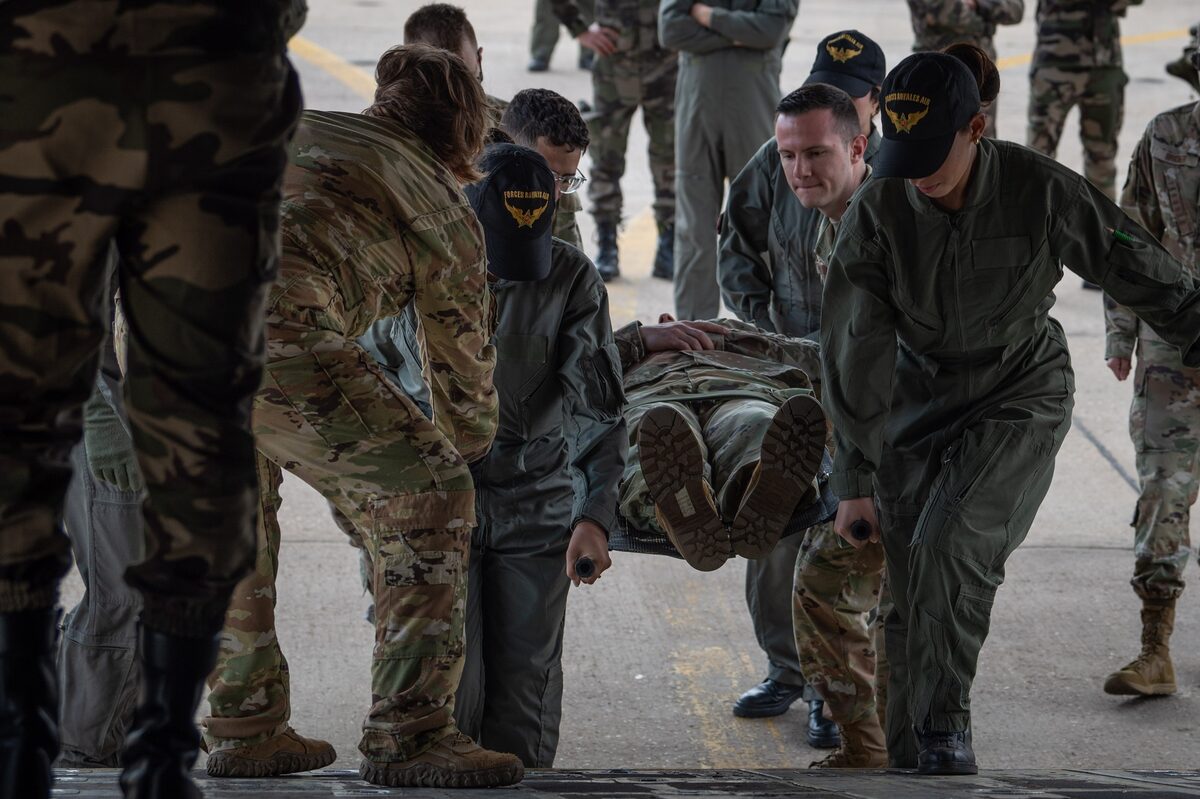
- Simulated patient loading on the ground.
- Autonomous return and landing.
The company says the system is designed to plan an optimal route and to replan dynamically around hazards. It is also meant to talk to air traffic control using natural language processing, which implies the aircraft would handle ordinary voice-style ATC exchanges itself, without a human relaying them. If the communications link drops, Merlin says the aircraft will keep flying the plan it was authorized to fly. Without that feature, an uncrewed casualty flight could end up stranded or circling in exactly the kind of degraded environment it is meant for.
"Onboard autonomy could accomplish CASEVAC end to end, even when communications are disrupted," Merlin CEO Matt George said in the release. The cabin will carry an air-ambulance medical module with oxygen, electrical power and mounts for patient monitoring equipment.
Readers should keep in mind that all of these performance claims come from Merlin. The demonstration has not flown yet. UASFeed did not review any AFRICOM announcement of the award; the details here come from Merlin and The War Zone. The descriptions of how the system will behave are what the company says it is designed to do, not results anyone has observed.
Why a Caravan?
Casualty evacuation usually brings helicopters to mind. Merlin's release, as quoted by TWZ, says the Caravan's large cargo door and flat cabin floor let crews load litters from ground level. There is no rotor wash to work under and no winching. Load teams on an improvised strip can roll or carry patients straight in. The sources do not describe the Caravan's field performance in more detail.
Merlin is already thinking past the Caravan. The company has suggested a twin-engine King Air variant as a follow-on to add capacity and scale, according to Merlin's release, which says it would add twin-engine redundancy, payload and room for multiple litter patients and an in-flight attendant. Nothing has been announced for that next step.
Where this fits in Merlin's military work
The AFRICOM award came one day after another Merlin defense announcement. TWZ reports that Merlin announced an $8.9 million U.S. Special Operations Command deal the day before for continued C-130 autonomy work. Next to that, the Caravan contract is minor. Merlin's earlier military work includes autonomy efforts on SOCOM's C-130 and the U.S. Air Force's KC-135 tanker, and TWZ says Merlin Pilot has flown on at least four aircraft types.
Merlin describes Merlin Pilot as aircraft-agnostic and as able to support pilot-optional flight. Casualty evacuation is time-critical and logistically complex, and Merlin argues that crewed aircraft and remotely piloted systems that need persistent control links both have limits in austere or contested environments.
AFRICOM is a natural place to try it. Merlin says the command's area of responsibility spans vast distances and that security threats can prevent access to nearby medical facilities, often forcing longer and more dangerous patient transport. TWZ adds that U.S. forces in Africa are often dispersed in small groups far from higher-level care.
Why It Matters
Behind the challenge is a change in how military medicine plans for the next major war. A state-of-the-art report from the Homeland Defense and Security Information Analysis Center (HDIAC), titled Autonomous Platforms for Casualty Evacuation, sets out the problem. In large-scale combat operations and in extreme, remote and austere environments, the report says senior military medical leaders anticipate that the "Golden Hour" will likely be impossible. The Golden Hour is the long-standing goal of getting a casualty to advanced care in under 60 minutes. The report's examples include Ukraine, Gaza, potential action over Taiwan, the Arctic and the Pacific.
The report says the services are instead preparing field medical personnel to treat casualties for at least an entire day before evacuation, which it calls the "Golden Day." That shift moves the focus to prolonged field care and to whatever can carry patients out once evacuation becomes possible. Autonomous platforms are one candidate. Merlin says the AFRICOM challenge seeks solutions that can accelerate access to a higher level of care while reducing the number of personnel exposed to risk, and that onboard autonomy could work even when communications are disrupted.
The Merlin demonstration is a small first step toward that idea. A half-million-dollar challenge award proves nothing on its own. What it gives AFRICOM is a planned test of whether one autonomy stack can handle the whole chain, from tasking through ATC communication to lost-link behavior and landing, without a flight crew or remote ground station. If it can, a cheap, widely available utility aircraft could add to the crewed aircraft that conventional casualty evacuation relies on today.
There are plenty of open questions. The public material does not say how the aircraft will judge landing sites that are truly unprepared. It also does not say how medical attendants would ride along, if at all, or how airspace authorities will treat an aircraft with no pilot. None of those questions will get answers until the Caravan flies in Morocco. Watch for the demo date in early FY2027 and for any King Air follow-on award, which would show whether AFRICOM wants to go beyond the challenge phase.
