
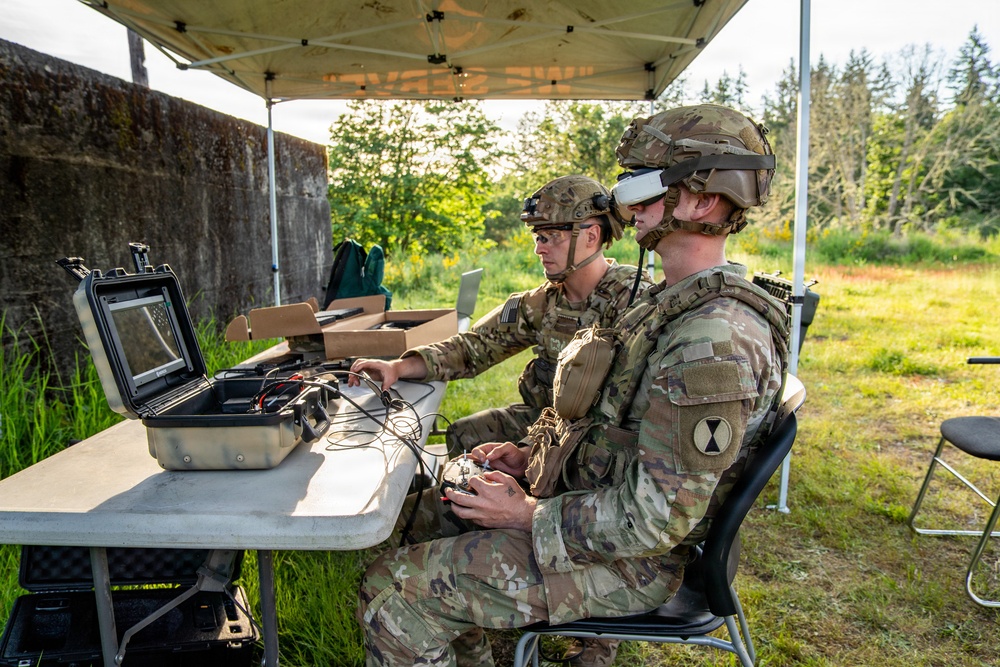
For most of its history the U.S. Army has bought equipment to keep. Vehicles, radios and aircraft come with spare parts, depot overhauls and decades of maintenance manuals. Small attack drones will not, according to the official responsible for building them.
Jon Strzelec, advanced manufacturing lead for small drones at Army Materiel Command, told Breaking Defense in an October interview, published Nov. 12, that the service does not plan to store or sustain its cheapest strike drones. "The Army had told us right away when we started this that none of this stuff's getting stored on shelves because the iteration cycle is so much that we have to manufacture to deliver, not to stock," he said. Breaking Defense summarized the approach as flying the drones "until they break."
Strzelec said that instead of "sustain," the word for these smaller drones is "replace."
The arithmetic of a throwaway fleet
The case Strzelec made rests on two clocks. The first is the battlefield. He pointed to Ukraine, where, he said, Russia can come up with a countermeasure for a new drone within 72 hours. Software, circuit cards, radios and cameras are all vulnerable to such counters and need to be swapped out quickly. A drone design sitting in a warehouse loses value quickly when the threat it was built against keeps changing.
The second clock is the factory. Strzelec argued that repairing a small drone costs more than building a fresh one. "For us to take a drone off the shelf and take it apart, pull a card out, put a new card in it, flash the software, it's cheaper in the assembly line process just to make a new one," he said.
Industry describes the same pace. James Slider, CEO of Performance Drone Works, told Breaking Defense that the fast side of the innovation cycle for these weapons is about three months. On that cadence, a stockpiled drone could be outdated before it is ever used.
The policy groundwork came earlier. A July 10, 2025 memo from Defense Secretary Pete Hegseth, cited by DroneXL, directed that Group 1 and Group 2 drones, meaning aircraft up to 55 pounds, be "accounted for as consumable commodities, not durable property." That accounting change matters. Under it, a drone is treated as a consumable rather than as durable property: drawn, used and replaced.
Where the line falls: cost
The throwaway logic does not cover every unmanned aircraft. Strzelec told Breaking Defense that some of the pricier Group 2 drones in the 21- to 55-pound class, used for intelligence, surveillance and reconnaissance (ISR) and for delivery, will likely be sustained and used for longer. "Cost is going to be the driver of which ones are throwaways and which ones aren't," he said.
That gives a rough rule. The cheaper and more expendable a drone is, the more likely it is to be flown until it breaks and then replaced. The more it costs, the more traditional maintenance thinking comes back. Strzelec did not give a specific price threshold in the reporting.
The pipeline feeding the fleet
The replace-not-repair model depends on a steady supply, and the Army is now taking deliveries. According to Breaking Defense, as of the interview the service was receiving 10,000 of the first 30,000 small drones bought through Drone Dominance Gauntlet 1, and those aircraft are going to units for training.
DroneXL reports that the Drone Dominance Program placed its first base orders, covering 22,320 drones, in March, with the last deliveries due within four and a half months. By mid-September, three of the 11 winning vendors had delivered their full orders. Breaking Defense describes Drone Dominance as a competition billed as an avenue for spending $1 billion over two years, and separately cites plans to spend nearly $55 billion on the Defense Autonomous Warfare Group (DAWG), the successor to Replicator.
The Army's in-house manufacturing effort has also changed direction. SkyFoundry, which was set up with a goal of 10,000 drones a month, has been renamed Advanced Manufacturing for sUAS and now focuses on components, Strzelec told Janes on Oct. 6, as reported by DroneXL.
The bottleneck may not be hardware at all. Col. Gregory Merkl, the Army's Drone Dominance director, said on Sept. 17 that the Army has drones for every squad but too few qualified pilots, according to DroneXL.
Crash them to learn
Some officials want even more attrition. Air Force Col. Dustin Thomas, who heads the Defense Contract Management Agency's Unmanned Systems - Experimental (US-X) Command, has argued in essays for Breaking Defense that the Pentagon should not be afraid to destroy small drones, potentially crashing 100,000 a year to better learn how they work. In that view, broken drones are not waste. They are how the force builds skill and finds out which designs hold up.
The unanswered questions
Not everyone is convinced the plan is complete. Breaking Defense reports that several analysts have said they are concerned the Pentagon is rushing to buy large quantities of drones without a clear plan for managing them long term. Joe Costa of the Atlantic Council said the Pentagon should be "unquestionably" building out a sustainment plan, and Erin Dumbacher of the Council on Foreign Relations questioned the department's plan for when components and software become obsolete.
Their concern is a fair one. Replacing a drone works only if replacements reach the unit that lost one, in time and in the needed numbers, and if the supply chain holds up under wartime demand. "Don't stockpile" also assumes production can surge when it has to. A fleet with no reserve depends entirely on its supply line, and the Breaking Defense report does not show the Army publicly explaining how it would get through a disruption to that line.
A different model from West Point
A Sept. 4 essay from West Point's Modern War Institute, published before the Strzelec interview, takes a more mixed position. Authors Philip J. McCormick and Angel F. Davila argue that Army maintenance doctrine, built for durable platforms, fits poorly when units operate large numbers of low-cost, modular, commercially derived systems. Their answer is not pure disposability. They want bounded repair, adaptation and replacement decisions pushed down to trained technicians close to the fight. Their title sums it up: "Repair Forward, Replace Fast."
The authors point to Ukrainian drone battalions' frontline engineering workshops, which run with roughly ten to twelve personnel, and to Ukrainian drone output rising from two million in 2024 to ten million a year. They also note that the Army is already revising its maintenance policy and experimenting with "replace, not repair" approaches under the RACS (Rapid Attritable Commercial Off-the-Shelf Strike) framework.
The two positions overlap more than they first appear. Both treat the traditional depot-centric model as a poor fit for cheap drones. They differ on emphasis: the MWI authors argue that "the cheapest system isn't always disposable, and the repairable system isn't always worth repairing," and want technicians to weigh replacement cost, repair time and other variables case by case. Strzelec's comparison was made at the assembly line, where, he said, building new beats repair. The MWI authors are looking at the unit, where rapid return to service matters.
Why It Matters
Sustainment shapes how an army fights as much as procurement does. By treating small attack drones as consumables, the Army is betting that speed of iteration and production volume are worth more than the life of any single airframe. Strzelec's account of Russia countering new drones in Ukraine within 72 hours is the reasoning behind that bet. Analysts' questions about a long-term sustainment plan, and West Point's argument for forward repair, point to the risk: a force that keeps no stock and fixes nothing depends heavily on factories and logistics that an adversary could target. Cost will set where the Army draws the line between expendable and sustained. Whether that line holds up in wartime is still untested.
