
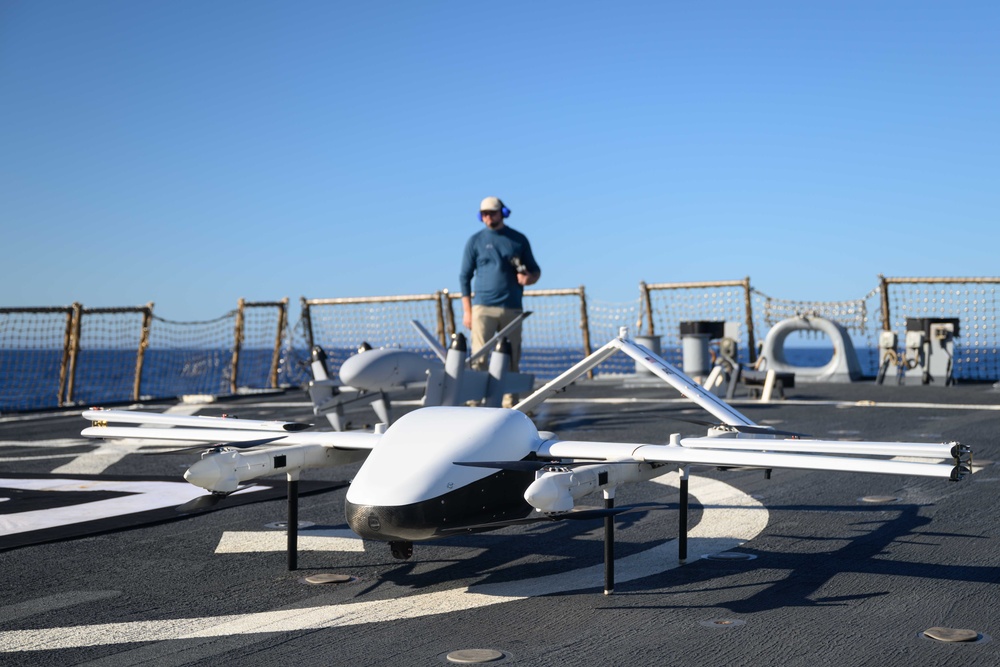
For the first time in its history, the Royal Navy has launched a strike-capable drone from a ship underway at sea. The trial, conducted off England's south coast in early June 2026 and announced July 3, 2026, saw a Nyan One-Way Effector (OWE) fired from a rail launcher mounted on the deck of the experimentation vessel XV Patrick Blackett — a milestone the service is billing as the opening move in a broader push to arm its fleet with attritable, autonomous strike systems.
The drone itself is not new. Built by Callen-Lenz, a BAE Systems company, the Nyan OWE is a 2.9-meter-wingspan, microturbine-powered munition that has already been produced in quantities exceeding 1,000 units for use by land forces. What changed in this test was the launch platform: instead of a truck-mounted or ground-based rail, the Nyan flew off the deck of a ship rolling in open water, pre-programmed to fly to a specific target after release.
What Happened Aboard XV Patrick Blackett
The trial was run jointly by personnel from 26 Royal Artillery and 744 Naval Air Squadron, pairing an Army unit that already operates the Nyan system on land with a Fleet Air Arm squadron responsible for integrating new aviation capability into naval operations. That combination reflects the tri-service nature of the underlying effort: the launch was conducted under Project VANTAGE, itself nested within the Royal Navy's Operation Neptune Reach, and framed publicly as a proof point for the service's "Hybrid Navy" concept — the idea that future British warships will fight alongside, and launch, uncrewed systems as a matter of course rather than as an add-on capability.
Lt. Cdr. David Burton, describing the test, called it "a significant step forward" for the Royal Navy. Luke Pollard MP framed the launch in broader strategic terms, saying it shows "Britain is serious about the transition to a Hybrid Navy." Neither official statement disclosed further operational detail about the trial's target profile or flight parameters, consistent with the early, experimental nature of the test.
Why a Ship-Launched One-Way Effector, and Why Now
The Nyan's core design logic — a relatively low-cost, mass-producible strike drone rather than a small number of exquisite, expensive missiles — is what makes a rail-launched, ship-based version attractive to naval planners. A munition already produced in the thousands changes the economics of naval strike in a way that traditional cruise missiles and guided weapons do not: it allows a ship to carry, and expend, far more strike capacity per magazine than legacy weapons allow.
That logic sits inside a much larger UK government commitment. On June 29–30, 2026, the Ministry of Defence announced a Defence Investment Plan directing more than £5 billion toward drones and autonomous systems over the next four years. That plan is not limited to naval one-way effectors: it also funds Project NYX, which aims to field 24 autonomous armed drones by 2030, Project Corvus, and £50 million earmarked for a program called RAPSTONE. The Nyan sea trial is the most visible naval expression of that investment plan to date, and the government has explicitly tied the "Hybrid Navy" concept to the wider funding announcement.
What Comes Next
Officials have described the sea trial as a first stage rather than an endpoint. The stated trajectory is toward integrating Nyan-type strike drones on the Royal Navy's Queen Elizabeth-class aircraft carriers, the largest and most capable surface combatants in the fleet. Getting from a rail launcher on an experimentation ship to a carrier deck involves working through questions the announcement did not address in detail — magazine capacity, launch-rate under combat conditions, integration with a carrier's existing air wing and defensive systems, and how a one-way munition is targeted, controlled, and cleared to fire in a live threat environment. None of that detail has been made public yet; what has been confirmed is that the underlying platform, launch mechanism, and command relationships have now been demonstrated at sea for the first time.
Why It Matters
Navies have spent the past decade watching one-way attack drones reshape land warfare, most visibly in Ukraine, without a clear answer to how the same mass-produced, low-cost strike logic applies to a warship. The Royal Navy's sea trial is a direct attempt to answer that question rather than simply observe it. Launching a microturbine-powered strike drone off a ship's deck — using a weapon already produced in quantities above 1,000 units for the Army — suggests the Royal Navy intends to inherit an existing industrial base and cost structure rather than build a bespoke naval effector from scratch. That matters because magazine depth and cost-per-shot, not just range or precision, increasingly define naval relevance in contested waters. If the path to Queen Elizabeth-class integration holds, Britain's carriers would gain a strike option that trades exquisite precision for volume and expendability — a genuinely new tool in the Royal Navy's kit rather than an incremental upgrade to an existing one. The £5 billion-plus Defence Investment Plan behind it signals this is meant to be a program of record, not a one-off demonstration.
