
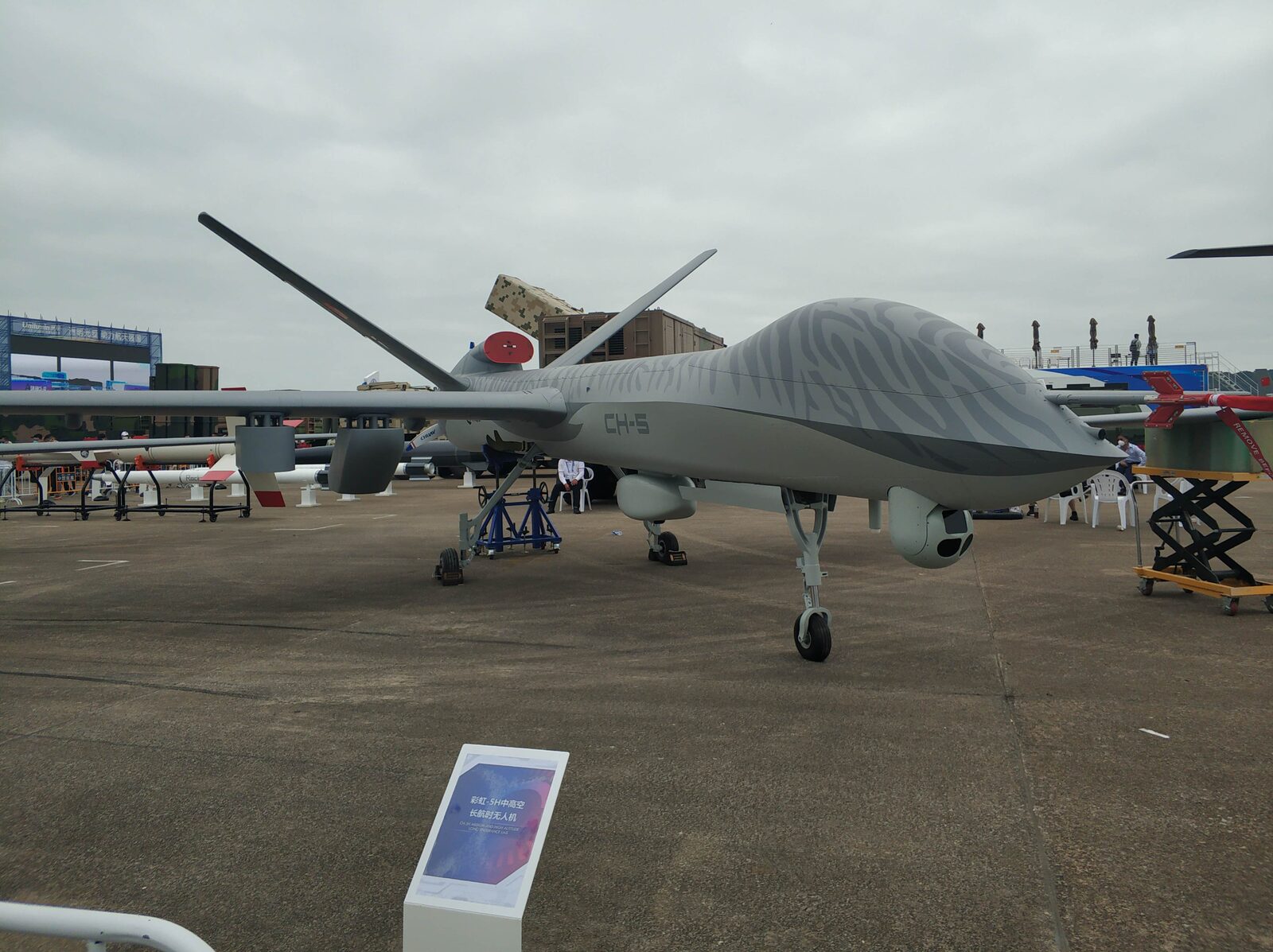
For most of the post-9/11 era, the United States held an effective monopoly on the export of capable medium-altitude long-endurance (MALE) armed drones. That monopoly is gone. Two Chinese state enterprise programs — the Wing Loong family from AVIC's Chengdu Aircraft Design and Research Institute and the Rainbow (Caihong, or CH) family from CASC — have placed combat-capable unmanned systems in the hands of more than a dozen governments that Washington would never have sold to. The consequences are visible in Libya, Ethiopia, Iraq, Nigeria, and elsewhere, and the proliferation map is still being redrawn.
Two Programs, One Market Logic
The Wing Loong and Rainbow series emerged from different corporate lineages but converged on the same strategy: build a credible MALE armed platform, price it well below the American equivalent, and sell without the political and legal friction that encumbers U.S. exports.
Wing Loong (Pterodactyl) is an AVIC product, developed by the Chengdu Aircraft Design and Research Institute (CADI). The program launched in 2005, flew for the first time in 2007, and AVIC began exporting in 2010. By December 2018, AVIC had delivered 100 units to foreign customers. The base Wing Loong I carries a price tag of approximately $1 million per unit — a figure that recurs constantly in comparative analyses of the Chinese export offer.
Rainbow (Caihong) is a product of CASC — China Aerospace Science and Technology Corporation, the country's primary space and ballistic-missile contractor. The CH series runs from the small, tactical CH-3 through the CH-4 and CH-5, with the jet-powered CH-6 and stealthy flying-wing CH-7 in development. According to SIPRI data, Chinese UAV manufacturers collectively sold 282 combat drones to 17 countries over the past decade, compared to 12 armed UAVs exported by the United States across the same period.
The Wing Loong I is the baseline export platform, broadly comparable in role — if not raw capability — to the MQ-1 Predator: 9 m length, 14 m wingspan, maximum speed 280 km/h, maximum payload 200 kg across two hardpoints, endurance approximately 20 hours, service ceiling 7,500 m. Later variants expanded substantially. The Wing Loong I-D introduced all-composite construction, a high-definition electro-optical pod, and synthetic aperture radar with four external hardpoints, first flying in 2018. The Wing Loong I-E (first flight January 18, 2022) pushed maximum takeoff weight to 1,600 kg, maximum payload to 400 kg with a 300 kg weapon load, and endurance to 35 hours, with four external hardpoints.
The Wing Loong II is the high-end platform, a turboprop-powered design aimed squarely at the MQ-9 Reaper market: approximately 370 km/h maximum speed, 9,144 m ceiling, payload described by Bloomberg as approximately a dozen missiles. By the time Bloomberg reported on the platform, AVIC had produced around 50 Wing Loong II units for export, with additional units produced for the PLA.
On the CASC side, the CH-4B is the dominant export variant — approximately 18–20 m wingspan, 11 m length, up to 1,300 kg maximum takeoff weight, 345 kg weapon load across four to six underwing hardpoints, endurance up to 30–40 hours, service ceiling permitting weapons release from up to 5,000 m. (Note: specifications vary by sub-variant; the 1,300 kg MTOW and 30-hour endurance figures are per GlobalSecurity.org for the CH-4A/B; Military Factory's entry, which may reflect a different variant, lists substantially different figures.) It carries the AR-1/HJ-10 laser-guided anti-tank missile (China's Hellfire analogue), the Blue Arrow-7 laser-guided missile, and TG100 laser/INS/GPS-guided bombs. Military Factory records approximately 500 total CH-4 production units; known operators include China, Egypt, Iraq, Jordan, Nigeria, and Saudi Arabia.
CASC officials reported that the CH-4 "conducted more than 4,000 flights... boasting over 20,000 flying hours and an astonishing kill rate of 99 percent in its more than 800 missile strikes."
The CH-5 is CASC's answer to the Reaper directly: 21 m wingspan (identical to the Reaper's), more than 3 tonnes maximum takeoff weight, 1,000 kg payload, 9,000 m service ceiling, 60-hour endurance at 10,000 km range. Wang Song, associate professor at Beihang University's school of aeronautic science and engineering, stated that the CH-5 offers "performance equalling that of the General Atomics MQ-9 Reaper, but at around half the cost." The CH-5's July 2017 flight was a mass-production model, not a prototype — indicating China had achieved commercial-scale manufacturing of a Reaper-class platform at a time when the MQ-9 cost approximately $16.9 million per unit.
The MTCR Gap That Built a Market
The decisive structural advantage for both AVIC and CASC is not primarily technical — it is regulatory. The United States is a signatory to the Missile Technology Control Regime (MTCR, signed 1987), which restricts the export of unmanned systems capable of delivering weapons over 500 km. MALE armed drones fall squarely within those parameters. American companies including General Atomics, Northrop Grumman, and Textron lobbied for years to loosen these restrictions; General Atomics explicitly noted that its export business was "seriously affected by the relevant policies."
Through most of the 2010s, the United Kingdom was the only country flying U.S.-supplied armed drones. The Obama administration opened a modest exception pathway in February 2015, requiring government-to-government transfers and end-use assurances, but the bar remained high, the process slow, and the political conditions attached made sales impossible or unattractive for several key Middle Eastern and African buyers.
China faces no equivalent constraint. It has not signed the MTCR, attaches no human rights or governance conditions to arms transfers, and — as GlobalSecurity.org documented — explicitly markets its drones on the principle that "China does not attach political conditions to arms sales, unlike some countries such as the US." CASC went further: when Saudi Arabia sought not merely to purchase but to manufacture CH-4s domestically, CASC signed a production partnership in March 2017. Pakistan and Myanmar have similarly established local production facilities for CH-series drones. Technology transfer and co-production arrangements of this kind are structurally unavailable through U.S. arms export channels.
The price gap compounds the policy gap. According to analysis cited by DefenceWeb, American drones can cost "as much as 15 times more expensive" than Chinese alternatives. Chinese companies have also accepted natural resource payments in lieu of hard currency — a critical advantage in cash-constrained African procurement environments.
What the Combat Record Actually Shows
Iraq was the CH-4's first documented combat user. After receiving an undisclosed number of CH-4B drones in 2015, Iraqi forces flew the first documented combat mission over Anbar Province the same year, with footage showing an AR-1/HJ-10 missile strike against an alleged ISIS target.
Libya became the most consequential proving ground. UN Special Representative Ghassan Salame described the Libyan conflict as "the largest drone war in the world," with nearly 1,000 UAV air strikes conducted during the fighting. Wing Loong drones arrived in 2016 operated by the United Arab Emirates from Al Khadim airbase, covering the entire theater with a 1,500 km combat radius. Their first decisive use came in the 2016 Battle for Derna, where Wing Loong drones were credited as decisive in fighting between Khalifa Haftar's Libyan National Army and the Shura Council of Mujahideen. During Haftar's 2019 siege of Tripoli, Wing Loong strikes mounted as urban targets were engaged, with civilian casualties documented. UN investigations and BBC reporting concluded that Wing Loong-2 drones were supplied by the UAE.
The Tigray civil war marked the Wing Loong II's appearance in Sub-Saharan Africa's highest-profile conflict. Ethiopian National Defense Forces received Wing Loong 2 systems and employed them to "track down the movement of Tigray rebels, locate control and command centers and destroy targets of interest." Press coverage described the combined use of Chinese Wing Loong 2 and Turkish Bayraktar TB2 as a "game-changer" in reversing ENDF momentum.
Nigeria operates both CH-3 tactical drones and Wing Loong II systems in its campaign against Boko Haram. Saudi Arabia is both a CH-4 and Wing Loong operator that signed the 2017 local-production deal with CASC and deployed both drone types in Yemen. Egypt has used Chinese drones extensively in Sinai against ISIS-affiliated groups and for smuggling tunnel detection near Gaza.
"They've been able to feed lessons learned back into their manufacturing." — Heather Penney, Mitchell Institute fellow
That feedback loop — now running across a dozen theaters simultaneously — is accelerating Chinese MALE drone development faster than any domestic test program could. Libya alone provided years of real-world operations data on targeting algorithms, data-link reliability under contested conditions, and munition performance.
Capability, Proliferation, and the Problem That Won't Price Away
The raw capability gap with the MQ-9 Reaper is real at the baseline: the Reaper at 4,760 kg maximum takeoff weight, 15,240 m ceiling, and 1,700 kg payload dwarfs the Wing Loong I's 1,150 kg, 7,500 m, and 200 kg. The Wing Loong II and CH-5 close that gap substantially — the CH-5's 1,000 kg payload and 60-hour endurance rival the Reaper in persistence. But in most export contexts, the Reaper comparison is the wrong frame. Countries buying Wing Loongs are not choosing between a Wing Loong and a Reaper — they are choosing between a Wing Loong and nothing, because the Reaper was never available to them. For fighting insurgencies, monitoring borders, and striking in permissive environments — the actual operating context in Libya, Ethiopia, Nigeria, and Sinai — the Wing Loong I or CH-4B is more than sufficient.
AVIC ranked sixth globally in 2019 military equipment sales at $22.5 billion, behind five American companies, per SIPRI. Serbia's 2019 Wing Loong purchase opened the NATO-adjacent market, with press reports at the time characterizing it as the first sale of Chinese-made unmanned aerial vehicles to a European country. The entry-level product of 2015 is the mid-tier product of 2025, with jet-powered and stealthy successors in development.
What the U.S. and its allies face is not merely a cheaper alternative to their own systems. It is an alternative supply chain, alternative maintenance infrastructure, alternative training pipelines, and alternative political relationships — now embedded in the militaries of governments from Tripoli to Addis Ababa to Lagos to Riyadh. Reversing that is not a procurement decision. It is a decade-long strategic problem.
Sources
- GlobalSecurity.org — Wing Loong drone family overview
- GlobalSecurity.org — CH-4 Rainbow
- Bloomberg — China's Combat Drones Push Could Spark a Global Arms Race (March 17, 2021)
- Al Jazeera — 'Largest drone war in the world': How airpower saved Tripoli (May 28, 2020)
- Eurasian Times — Chinese Wing Loong 2, Turkish Bayraktar TB2 Drones Proving To Be A 'Game-Changer' In Ethiopian Civil War (December 13, 2021)
- DefenceWeb — Chinese UAVs finding a large market in Africa
- Military Factory — CASC CH-4 Rainbow specifications
- South China Morning Post — China unveils its answer to US Reaper drone
- Al Jazeera — US to allow sales of armed drones to allies (February 19, 2015)
- U.S. Department of Defense — Annual Report on Military and Security Developments Involving the People's Republic of China
