
Ask two people in the drone industry what a "Group 3 UAS" is, and you'll likely get two different answers pointing at the same rough weight class. The confusion is understandable — the Department of Defense's five-group classification system for unmanned aircraft systems (UAS) is neither obvious from first principles nor widely explained outside defense-acquisition circles. Yet it governs which authority can approve a flight, what training a crew needs, and how a program office budgets for a new airframe. Here is what the groups actually mean, where they came from, and where the system's edges get blurry.
Where the Group System Came From
DoD's formal engagement with UAS classification dates back to 1988, when the UAV Joint Program Office published the department's first UAS master plan at Congress's direction under P.L. 100-202. For nearly two decades afterward, DoD sorted unmanned aircraft into just three classes. That changed in 2007, when the Joint UAS Center of Excellence (JUAS COE) proposed expanding the scheme to five groups. DoD adopted the five-group approach in 2008 and published it the following year in the congressionally mandated "FY2009-FY2034 Unmanned Systems Integrated Roadmap," itself required under P.L. 106-398, §220.
That five-group structure is still in use today. It now lives in Joint Publication JP 3-30, "Joint Air Operations," as the official "UAS Categorization Chart," according to the Congressional Research Service (CRS). DoD's own dictionary of military terms, reflected in JP 3-30, defines an unmanned aircraft (UA) as an "aircraft that does not carry a human operator and is capable of flight with or without human remote control," while a UAS encompasses "the necessary equipment, network, and personnel to control" that aircraft.
The Five Groups, Defined
The JP 3-30 chart sorts every DoD unmanned aircraft into one of five groups based on three attributes: maximum gross takeoff weight, normal operating altitude, and airspeed. CRS reproduces the official chart as follows:
| Group | Max Gross Takeoff Weight (lbs) | Normal Operating Altitude | Speed (KIAS) | Representative UAS |
|---|---|---|---|---|
| 1 | 0–20 | <1,200 ft AGL | 100 kt | WASP III, TACMAV, RQ-14A/B, Buster, Nighthawk, RQ-11B (Raven), FPASS, RQ-16A, Pointer, Aqua/Terra Puma |
| 2 | 21–55 | <3,500 ft AGL | <250 kt | ScanEagle, Silver Fox, Aerosonde |
| 3 | <1,320 | <18,000 ft MSL | <250 kt | RQ-7B Shadow, RQ-15 Neptune, XPV-1 Tern, XPV-2 Mako |
| 4 | >1,320 | <18,000 ft MSL | Any airspeed | MQ-5B Hunter, MQ-8B Fire Scout, MQ-1C Gray Eagle, MQ-1A/B/C Predator |
| 5 | >1,320 | >18,000 ft MSL | Any airspeed | MQ-9 Reaper, RQ-4 Global Hawk, MQ-4C Triton |
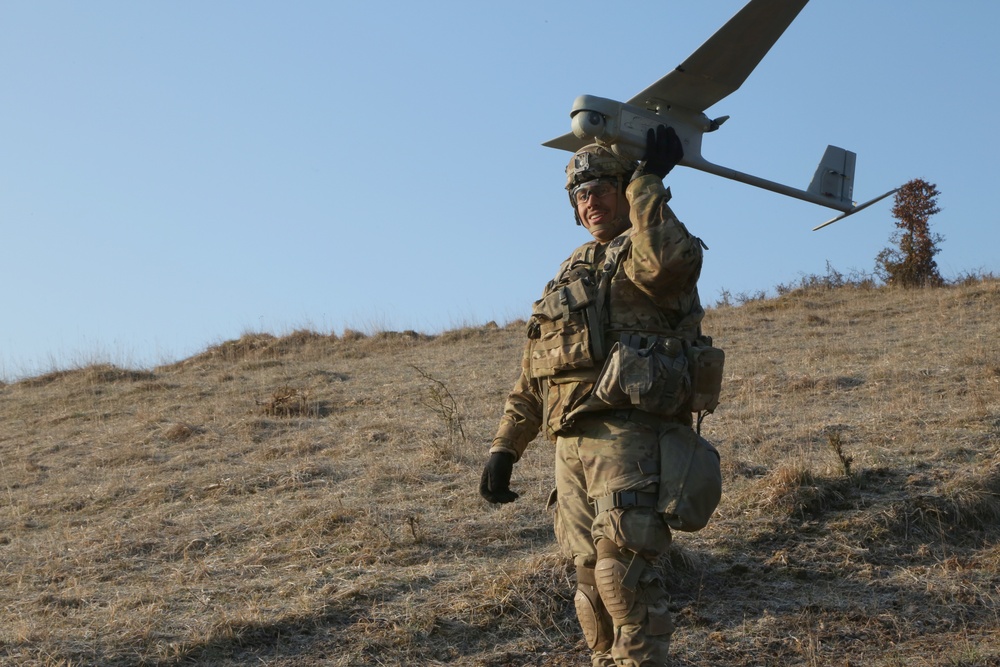
Group 1 covers the smallest hand-launched systems — think RQ-11B Raven, the ubiquitous backpack-sized reconnaissance drone the Army has fielded for years. Group 2 covers somewhat larger, still line-of-sight-range platforms like ScanEagle. Groups 3 through 5 climb into progressively heavier, higher-flying, longer-endurance territory, culminating in Group 5's high-altitude, long-endurance platforms like the MQ-9 Reaper and RQ-4 Global Hawk, which have effectively no altitude or speed ceiling in the chart.
One deliberate design choice: DoD set the Group 2 upper weight limit at 55 pounds specifically to align with the FAA's "small UAS" maximum takeoff weight threshold under 14 C.F.R. Part 1, per CRS. That's not a coincidence of round numbers — it's an attempt to keep DoD's categories legible against the civil aviation framework operators also have to navigate.
The "Any Higher Attribute" Rule
Because each group is defined by three separate attributes — weight, altitude, and speed — a given aircraft could plausibly qualify for different groups depending on which attribute you look at. DoD resolves that ambiguity with a simple rule, independently described by a Penn State GEOG 892 course reference on the classification system: "if a UAS possesses any attribute that falls within a higher group... it is assigned to that higher classification group, regardless of its other characteristics." In other words, the group assignment is a ceiling function across all three attributes, not a majority vote.
When Real Platforms Don't Fit Neatly
The chart's clean boundaries can strain against real hardware. The Army's FM 3-04 field manual ("Army Aviation," July 29, 2015) lists the MQ-1C Gray Eagle — a JP 3-30 Group 4 representative platform — with a maximum gross takeoff weight of 3,200 to 3,600 pounds (depending on engine variant) and an operating altitude of 25,000 feet MSL. That altitude figure sits above the JP 3-30 Group 4 ceiling of under 18,000 feet MSL, which by the "any higher attribute" rule would arguably push Gray Eagle into Group 5 territory on altitude alone, even though it is fielded and referenced elsewhere as a Group 4 aircraft. This isn't necessarily a contradiction in DoD doctrine — a "normal operating altitude" range in a categorization chart and a platform's demonstrated altitude ceiling in a field manual can describe different things — but it's a genuine tension between the two documents worth flagging rather than smoothing over. It's also a useful illustration of why the group system, however tidy on paper, requires judgment calls in practice.
By contrast, the RQ-7B Shadow — FM 3-04's Group 3 example — fits its bracket cleanly: 404 to 467 pounds maximum gross takeoff weight, an operating altitude of 15,000-plus feet MSL, cruise speed of 70–80 knots, and a maximum dash speed of 110 knots, all comfortably inside the Group 3 thresholds of under 1,320 pounds, under 18,000 feet MSL, and under 250 knots.
A Different Kind of "Small UAS"
Adding to the terminology tangle, DoD doesn't use "small UAS" consistently across its own documents. The generic federal definition, under 49 U.S.C. §44801, caps "small UAS" at under 55 pounds — matching the JP 3-30 Group 1/2 boundary. But DoD Directive 3800.01E, which designated the Army as executive agent for counter-small-UAS efforts, defines "small UAS" for that specific counter-UAS mission as anything in Groups 1, 2, or 3 — meaning up to 1,320 pounds. A system that is "small" for counter-UAS defense planning purposes could weigh roughly 24 times more than a system that is "small" under the general statutory definition (1,320 pounds versus 55 pounds).
Why It Matters
The group a UAS falls into isn't academic trivia — it determines concrete operational and bureaucratic realities. Even an Army-owned Group 1 aircraft weighing under 20 pounds, identical in every physical respect to a hobbyist consumer drone, requires an Airworthiness Release, formal risk acceptance, and unit training before it can fly, according to Army Aviation Magazine — because Army ownership makes it a "state aircraft" subject to military airworthiness rules that a civilian-owned equivalent would never encounter.
Airspace approval mechanics also flow from these classifications. Per that same trade publication's account, operations outside restricted airspace require a location-specific FAA Certificate of Authorization, which the article describes as taking anywhere from roughly 48 hours to 60 business days to process depending on airspace class; inside restricted airspace, a range commander can approve operations directly. An Army UAS Proper Use Memorandum is also described as a requirement for Army UAS operations outside restricted airspace. These specific procedural claims come from a trade publication rather than a primary FAA or Army regulation fetched directly for this article, so readers relying on them for compliance purposes should verify against current official guidance.
That same trade publication is notably cautious about overstating the group system's regulatory reach, however: it states plainly that "the groups exist to identify UAS capabilities, not to address regulatory requirements." In other words, the group number by itself isn't a blanket switch that determines approval authority or training rules — those flow from separate Army and FAA processes, like the AWR, COA, and Proper Use Memorandum requirements described above, some of which happen to key off a platform's weight or group threshold without the group label functioning as regulation in its own right. Broader claims that group classification maps neatly onto acquisition and contracting categories appear in some secondary reporting but are not backed by doctrine fetched for this piece, and should be read with that caveat.
Criticism and Ongoing Review
The system isn't without critics. CRS notes that analysts have argued Group 3 — which CRS itself describes elsewhere as covering aircraft between 55 and 1,350 pounds — is "too broad," lumping together a wide range of airframe sizes and mission sets under one label. CRS also points out that DoD's five groups don't align with allied and NATO classification schemes, which instead use three classes (Class I subdivided into micro/mini/small categories, Class III subdivided by mission), creating a potential source of confusion in coalition operations.
Congress has taken notice. Section 1073 of the FY2022 National Defense Authorization Act (P.L. 117-81) directed the Under Secretary of Defense for Acquisition and Sustainment to review whether the JP 3-30 classification system needs revision and to report back to Congress. As of the most recent CRS reporting, the five-group structure remains DoD's operative framework — but the mandated review is a signal that the system, nearly two decades after its 2008 adoption, may not be its final form.
Sources
- Congressional Research Service, "Defense Primer: Categories of Uncrewed Aircraft Systems," IF12797
- U.S. Army, FM 3-04, "Army Aviation"
- Wikipedia, "UAS groups of the United States military"
- Penn State GEOG 892, "U.S. Department of Defense (DoD) UAS Group Classification"
- Army Aviation Magazine, "What Are the Rules for Small Unmanned Aircraft?"
