
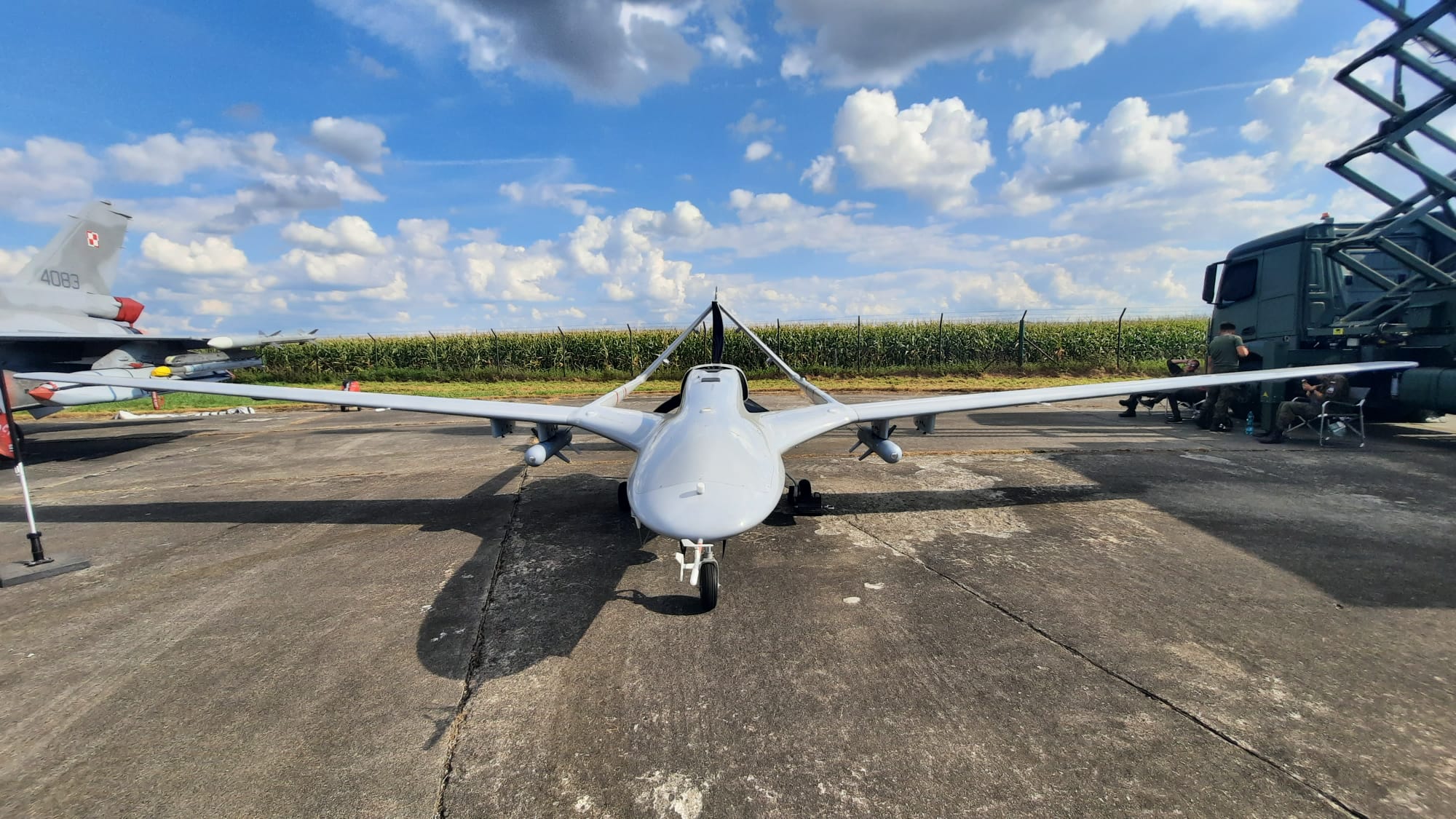
At roughly $5 million a copy, the Bayraktar TB2 costs about one-quarter of what the U.S. pays for an MQ-9 Reaper — and it comes with laser-guided munitions, 27-hour endurance, and a combat résumé spanning at least a dozen hot conflicts. That price-to-capability ratio has driven export agreements with at least 30 countries across four continents, making Turkish manufacturer Baykar the world's largest armed-drone exporter three years running. The TB2 didn't make drones affordable; it made armed drones affordable, which is an entirely different disruption.
Embargo-Forced Self-Reliance
Baykar's path to that market position was not a government program. The company delivered its first surveillance mini-UAV in 2006, partnered with Kale Group on a TB-1 prototype in 2009, and signed a serial-production deal with Turkey's defense-procurement authority in December 2011. The TB-2 flew for the first time in April 2014; twelve aircraft were delivered by June 2015. Throughout, Baykar accepted no government subsidies and took no bank loans — an unusual posture for a prime-level defense contractor. Today the company employs roughly 4,500 people with a median age of 29, nearly half of them engineers, and it accounts for 32% of Turkish defense and aerospace exports.
The Western arms embargo that followed Turkey's S-400 acquisition turned out to be an accelerant. The TB2's original foreign content included a Harris bomb rack, a Wescam MX-15D electro-optical sensor, a Rotax 912 ULS engine, and British Andair fuel systems. By 2021–22, L3Harris and Rotax had blocked further exports. Baykar replaced them with Turkish equivalents: Aselsan's CAT FLIR sensor and laser designator, and TEI's PD170 diesel rated at 105 hp. The embargo intended to ground the program; instead it stripped Baykar's dependence on Western supply chains entirely, a lesson other aspiring drone powers are still digesting.
The Hardware: Specs and Strike Package
The TB2 is a medium-altitude, long-endurance (MALE) platform with a 12-meter wingspan, a 6.5-meter fuselage, and a maximum takeoff weight in the 650–700 kg range. It carries 150 kg of payload to operational altitudes between 16,000 and 18,000 feet — ceiling is 27,000 ft — at a cruise speed well below 120 knots. Endurance runs 24 hours in standard configurations; a record sortie of 27 hours 3 minutes has been logged. Line-of-sight datalink reaches 150 km; satellite relay extends coverage to beyond line-of-sight range.
Two Roketsan munitions define the strike package. The MAM-L is a 22-kg, laser-guided weapon with up to 14 km standoff range, available in high-explosive blast-fragmentation and thermobaric variants — sized for armor and crew-served weapons. The smaller MAM-C, at 6.5 kg and 8 km range, trades warhead mass for precision against lighter targets. Both integrate across the aircraft's four hardpoints, giving operators the ability to prosecute time-sensitive targets while the ground crew watches through the CAT sensor feed in real time.
Combat Record: Breakthrough and Correction
The TB2's first operational validation came against PKK/YPG targets in Syria starting in 2017. A sharper test arrived on February 27, 2020, after a Syrian government airstrike killed 34 Turkish soldiers. In the hours that followed, TB2s destroyed 37 tanks, 9 infantry fighting vehicles, 26 self-propelled artillery pieces, and 10 air-defense systems. Open-source tracking attributed the majority of Syrian heavy vehicles destroyed in the broader operation to TB2 strikes — an extraordinary concentration of armored kills in a compressed window.
Libya followed. The UN-recognized Government of National Accord purchased 20 aircraft; TB2s enabled the capture of Al-Watiya airbase in 2020 and forced a direct confrontation with Chinese Wing Loong drones operated by the rival Libyan National Army. But the defining moment came in Nagorno-Karabakh. Over 44 days, Azerbaijani claims credited the aircraft with hundreds of armored vehicles and air-defense systems destroyed. The conflict established the TB2 as a tested export system rather than a paper capability, and demand moved sharply upward.
Ukraine added complexity to that picture. Ukraine had acquired TB2s before February 2022, with the first kinetic use logged in the Donbas in October 2021. By mid-March 2022, open-source records documented 24 wheeled vehicles and two fuel trains destroyed against the loss of two IFVs and six artillery pieces. More significantly, the TB2 was linked to nine of fifteen open-source-confirmed kinetic kills against Russian surface-to-air missile systems — roughly 30% of all documented SAM kills, accounting for roughly 60% of direct kinetic salvos. Jamestown Foundation analysts credited the aircraft with helping blunt the Belarus-axis advance and described it as "an offense-dominant regime with a clearly advantageous defense economics bill" and "a real warfighting asset to augment the North Atlantic Alliance's eastern flank."
By summer 2022, however, Russian air-defense networks had organized. TB2 operations contracted sharply, and the aircraft shifted primarily to reconnaissance. IFRI cautioned that media coverage had overstated capabilities; analysts noted that Russian electronic-warfare systems had limited effect on early Ukrainian TB2 operations, but that early Ukrainian success owed as much to Russian SAM crews being ill-prepared for a slow, piston-engine platform as to any inherent TB2 quality. The aircraft is weather-sensitive and payload-limited. Against a peer adversary that adapts, it is a capable MALE — not a decisive weapon system.
"We concentrate on being the best in technology over profits." — Haluk Bayraktar, CEO, Baykar
Export Market and the Successor Line
Export agreements now cover at least 30 countries including Ukraine, Poland, Azerbaijan, Qatar, Morocco, Kenya, Niger, Croatia, Estonia, Latvia, Lithuania, and the Maldives, which signed a $37 million deal for six units in March 2024. Production has scaled from 10 aircraft per year to 250. Export revenue reached approximately $1.8 billion in 2023 and a record $2.2 billion in 2025. "Baykar in 2025 achieved $2.2 billion in exports, continuing to be the leader of the world's armed drone export market," said chairman Selçuk Bayraktar — a figure that represents Baykar alone accounting for nearly a third of Turkey's entire 2023 defense and aerospace export total.
Baykar's follow-on portfolio is aimed well past the MALE tier the TB2 occupies. The TB3 is a naval STOL variant designed for TCG Anadolu, which logged 204 sorties in the 2025 Sea Wolf Exercise with a production target above 50 per year. The Akıncı high-altitude, long-endurance platform has accumulated more than 100,000 flight hours, with 110 delivered and 120 more planned by end 2025 across at least 11 export deals. The Kızılelma unmanned combat aircraft — launched in 2021 on $1 billion of private capital, with a maiden flight in 2022 — carries an AESA radar and an afterburning engine, fired a beyond-visual-range shot in November 2025, and is scheduled to enter Turkish inventory in 2026. "2026's keyword for Baykar will be production," Selçuk Bayraktar said. "Kızılelma will enter inventory and begin operations." A cooperation agreement with Leonardo signed in April 2025 signals European integration ambitions beyond the export-customer relationship the TB2 created. The drone that sold on price is now underwriting a program that competes on capability.
Sources
- The Defense Post — Bayraktar TB2 drone guide (May 2026)
- IFRI — TB2 Bayraktar: Big Strategy for a Little Drone
- Jamestown Foundation — A Dangerous Drone for All Seasons: Assessing the Ukrainian Military's Use of the Bayraktar TB-2
- Baykar (official) — Haluk Bayraktar: "We Concentrate on Being the Best in Technology Over Profits"
- Türkiye Today — Baykar sets $2.2B export record; Kızılelma to enter inventory in 2026
- Army Recognition — Bayraktar TB2 specifications and profile
