
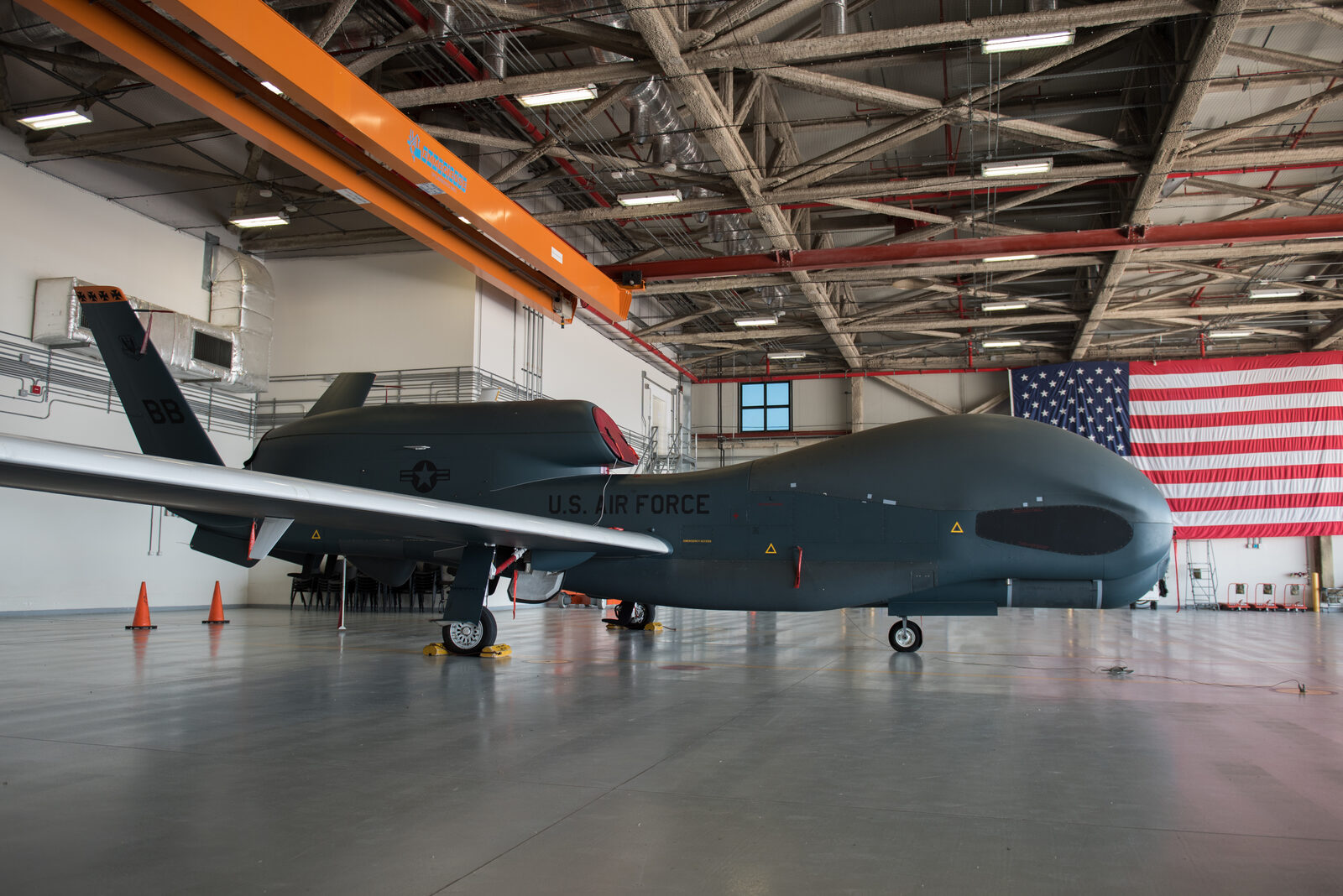
For more than two decades, a pair of enormous, ungainly jets has circled the planet's most contested airspace at 60,000 feet — patient, tireless, and largely invisible to the people below. The Northrop Grumman RQ-4 Global Hawk and its maritime sibling, the MQ-4C Triton, represent the United States' most consequential experiment in persistent high-altitude surveillance. Together they have accumulated hundreds of thousands of combat flight hours watching wars unfold over Afghanistan and Iraq, scanning the South China Sea for Chinese naval movements, and assessing Japan's tsunami damage when no ground observer could safely reach the northeast coast. They are also platforms that spent the better part of a decade trapped in a standoff between an Air Force eager to retire them and a Congress that kept blocking the plan.
Origins and the Machine
The Global Hawk's lineage traces to DARPA's early-1990s effort to fill the reconnaissance gap left by the aging U-2. The goal was an unmanned vehicle capable of autonomous stratospheric flight for more than a day, covering the imaging footprint once requiring multiple satellite passes, without risking a pilot. Ryan Aeronautical — later absorbed into Northrop Grumman — built the Advanced Concept Technology Demonstrator; its first prototype flew in February 1998 from Edwards Air Force Base. In April 2001, a pre-production aircraft flew non-stop from Edwards to RAAF Base Edinburgh, Australia — 13,219 kilometers (8,214 miles) — setting a world record for absolute distance flown by an unmanned aircraft. The timing proved fortuitous: Global Hawks deployed to Afghanistan just weeks after September 11, accumulating combat hours before production lines were fully operational.
The definitive RQ-4B production variant is a striking machine. Its wingspan of 130.9 feet exceeds a Boeing 737's, yet maximum takeoff weight is just 32,250 pounds — less than a loaded F-15E. That extreme aspect ratio delivers a lift-to-drag ratio of roughly 33:1, allowing a single Rolls-Royce AE3007H turbofan (7,600 lbs of thrust) to push the aircraft to a 60,000-foot service ceiling and sustain loiter for 33 hours or more. At altitude, Global Hawk surveys 40,000 square miles per day in wide-area search mode — roughly Virginia's land area — with spot mode resolving individual vehicles at 1-foot resolution. A 48-inch Ku-band satellite antenna supports datalinks at up to 47.9 Mbps over satellite and 137 Mbps line-of-sight.
The program evolved through four production blocks. Block 30 — the multi-intelligence workhorse — simultaneously carried EO/IR cameras, a Raytheon X-band SAR with 0.3-meter spot resolution and a moving-target indicator sensitive to contacts as slow as 4 knots, and signals intelligence pods covering both high and low bands. Congress authorized divestiture of Block 20 and Block 30 aircraft in FY2021. Block 40, the only variant the USAF now plans to fly to its FY2027 retirement date, carries the Multi-Platform Radar Technology Insertion Program (MP-RTIP), an active electronically scanned array optimized for ground-moving target indication — explicitly the sensor designed to absorb part of the retiring E-8C JSTARS mission. A small number of Block 40s remain in the inventory.
The coalition of operators grew substantially. South Korea contracted for four RQ-4B Block 30 aircraft in 2014 for $657.4 million, with the first aircraft delivered December 2019 to a base near Sacheon. Japan ordered three Block 30i aircraft in 2018 for approximately $1.2 billion, receiving the first in March 2022. NATO took a different path: five RQ-4D Phoenix aircraft — a Block 40 derivative customized to Alliance interoperability standards — achieved initial operating capability with the Alliance Ground Surveillance Force in 2021, based at NAS Sigonella and jointly funded by 15 nations. The fleet's cumulative total surpassed 320,000 flight hours across combat and humanitarian operations.
The Retirement Standoff
The Air Force first proposed killing the entire Global Hawk fleet in the FY2013 budget, citing a cost-per-flight-hour of $40,600 — with $25,000 attributable to contractor logistics — exceeding the manned U-2's operating cost. Congress blocked the retirement and restored full funding. The USAF tried again in FY2015. Congress blocked it again.
What eventually changed the argument was not cost but threat environment. Air Force officials stated it plainly:
"This platform cannot compete in a contested environment. And tomorrow's conflicts will be contested."
A Global Hawk at 60,000 feet over permissive Afghan airspace is a surveillance asset; over the Taiwan Strait it is a slow target for advanced surface-to-air missiles. Defense analyst Stacie Pettyjohn argued Block 40s should be retained "as a stopgap" while the E-8C JSTARS retired simultaneously. Rep. Adam Kinzinger warned the Air Force "repeatedly retires aircraft without replacements, then come begging to congress for money to fill a needed capability." Congress ultimately granted permission to divest Block 20 and Block 30 aircraft in FY2021; the remaining Block 40s are now funded through FY2025 with retirement in FY2027. The replacement is a composite vision — F-35 onboard sensors, classified penetrating ISR, expanded satellite GMTI systems — not a single successor platform.
The cost picture had, by then, inverted. Operational improvements reduced the flight-hour figure to approximately $18,900 by 2013 — reversing the original cost argument against the platform.
MQ-4C Triton: The Maritime Variant That Found Its Footing
While the Air Force worked through its complicated relationship with the Global Hawk, the Navy was building something more coherent: a committed, long-term application of the HALE concept to maritime domain awareness. The Broad Area Maritime Surveillance program awarded a $1.16 billion development contract to Northrop Grumman in April 2008, selecting the RQ-4N maritime derivative to leverage existing manufacturing and ground infrastructure while making targeted modifications for the naval environment.
Those modifications were substantive. Structural reinforcement addressed stress from sea-level descents through cloud layers; de-icing systems and lightning protection were added; the AE3007H was upgraded to produce up to approximately 8,900 lbs of thrust. The sensor suite was built from scratch for maritime use: the AN/ZPY-3 Multi-Function Active Sensor provides 360-degree electronically steered radar coverage for ship detection and classification; the AN/ZLQ-1 handles electronic support measures; an Automatic Identification System receiver cross-references radar contacts against civil shipping registries — vessels operating without transponders, a key indicator of smuggling or sanctions evasion, stand out immediately against compliant traffic. The MTS-B multispectral targeting system provides high-resolution EO/IR identification, and Link-16 integration enables interoperability with P-8 Poseidons and surface combatants. The IFC-4 upgrade, first flown in July 2021, added multi-intelligence collection capability sufficient to absorb the retiring EP-3E Aries signals intelligence mission — making Triton a signals collection node, not merely a surveillance aircraft.
The program moved from first flight in May 2013 through initial deployment to Andersen AFB, Guam, in January 2020, operated by Unmanned Patrol Squadron 19. Initial Operating Capability was declared in September 2023, by which point Triton had already operated continuously in the Indo-Pacific Command area for more than three years. The platform also deployed to Naval Air Station Sigonella, extending coverage to the Mediterranean.
The Royal Australian Air Force is the Triton's only export customer, and its commitment reflects explicit geostrategic calculation. Australia approved a $1 billion acquisition in June 2018 and a second funding authorization in June 2020, committing to four aircraft total. The first was formally received June 16, 2024, and is operated by No. 9 Squadron RAAF — reactivated specifically for the purpose — with launch-and-recovery at RAAF Base Tindal in the Northern Territory and remote operations from RAAF Base Edinburgh in South Australia. A purpose-built facility at Tindal positions the aircraft to cover Australia's northwest approaches, the South China Sea, and the Indo-Pacific maritime crossroads without transiting from the densely populated southeast.
The Global Hawk family's lasting contribution is not any individual aircraft but the doctrine and infrastructure it forced into existence: ground stations controlling autonomous vehicles in contested airspace, satellite datalink architectures supporting multi-gigabit video streams, and operational procedures for persistent HALE surveillance that now underpin both the Navy's maritime patrol architecture and NATO's pooled ISR capability. The USAF is walking away from its Block 40s in FY2027. The Navy and RAAF are building infrastructure designed to carry the Triton well into the 2030s. The gap between those two trajectories captures most of what the last decade of HALE debate was actually about.
