
The rifle used to be the thing every recruit had to master before anything else counted. That is no longer entirely true. Across the U.S. military, and increasingly across allied and adversary forces alike, a second skill has become nearly as universal: knowing how to fly, or at least fend off, a small unmanned aircraft. But "drone pilot" is not one job. It spans a highly selective officer pipeline that turns Air Force lieutenants into MQ-9 Reaper aircraft commanders, an enlisted Army specialty that has quietly run the world's largest unmanned aircraft training center for two decades, and a fast-growing set of programs trying to give ordinary infantrymen at least a working familiarity with first-person-view (FPV) drones before they ever reach a combat unit. Here is how each pipeline actually works, and why the distinctions between them are becoming a strategic bottleneck in their own right.
The Officer's Seat: Building an MQ-9 Aircraft Commander
Flying an armed MQ-9 Reaper remains, for now, an officer's job in the U.S. Air Force. Air Force recruiting materials describe Remotely Piloted Aircraft (RPA) pilots as commissioned officers who must hold a bachelor's degree and commission through Officer Training School, the Air Force Academy or AFROTC before ever touching the pipeline, with a service commitment of roughly ten years once training is complete.
The training itself runs through three geographically separate phases. Student pilots start at Pueblo Memorial Airport in Colorado for Initial Flight Training, logging around 40 hours in a Diamond DA-20 light aircraft to prove basic airmanship before they ever sit at a ground control station. From there, students move to Joint Base San Antonio-Randolph in Texas for instrument qualification — roughly three months of flying modified T-6 flight training devices networked together to simulate real airspace and air traffic control, followed by a shorter RPA fundamentals course covering sensors, tactics and air tasking orders. The final and longest phase happens at Holloman Air Force Base in New Mexico, where students spend about four months training on the Predator Mission Aircrew Training System and then the aircraft itself, moving through initial qualification, mission qualification and mission rehearsal training before assignment to an operational squadron under Air Combat Command. Formal curricula blend roughly 40 to 45 hours of flight time with an equal number of simulator hours, plus 50 to 60 hours of academics — a deliberate 50-50 split between live and simulated flying.
Every Reaper crew, though, is two people. The enlisted half of that cockpit is the RPA sensor operator, an entirely separate career field (Air Force Specialty Code 1U0X1) that trains through 7.5 weeks of Basic Military Training followed by 31 days of technical training split between Lackland and Randolph Air Force Bases in Texas. Sensor operators run the multi-spectral targeting systems, help discriminate valid targets from invalid ones, and conduct battle damage assessments — work that does not require a college degree or a commission, only an ASVAB score, security-clearance eligibility and normal color vision. The Air Force has also, since 2015, run a small and so far limited experiment letting select senior enlisted airmen cross-train as pilots on the unarmed RQ-4 Global Hawk, the first enlisted personnel to pilot Air Force aircraft since World War II — but the weaponized MQ-9 fleet remains an officer-only cockpit. For readers unfamiliar with how the Pentagon actually categorizes drones by weight and altitude — a system that determines who is even eligible to fly what — UASFeed's explainer on DoD UAS Group classifications lays out Groups 1 through 5 in detail.
The Army's Enlisted Track: MOS 15W and the Schoolhouse at Fort Huachuca
The Army takes a fundamentally different approach: it has trained enlisted soldiers to fly tactical unmanned aircraft for years under Military Occupational Specialty 15W. Training runs through the 2-13th Aviation Regiment at Fort Huachuca, Arizona, which operates what the Army describes as the largest UAS training center in the world, helped along by more than 300 days a year of flyable desert weather. After the standard 10 weeks of Basic Combat Training, 15W soldiers move into roughly 15 weeks of Advanced Individual Training at Fort Huachuca that mixes classroom academics, simulator time and live flight hours on the RQ-7 Shadow and MQ-1C Gray Eagle systems — the medium-sized tactical platforms that sit above the small quadcopters now proliferating at the squad level. Entry requires a minimum ASVAB score in the Surveillance and Communications aptitude area, and qualified soldiers can go on to instructor, warrant-officer technician and command-and-staff tracks run out of the same regiment.
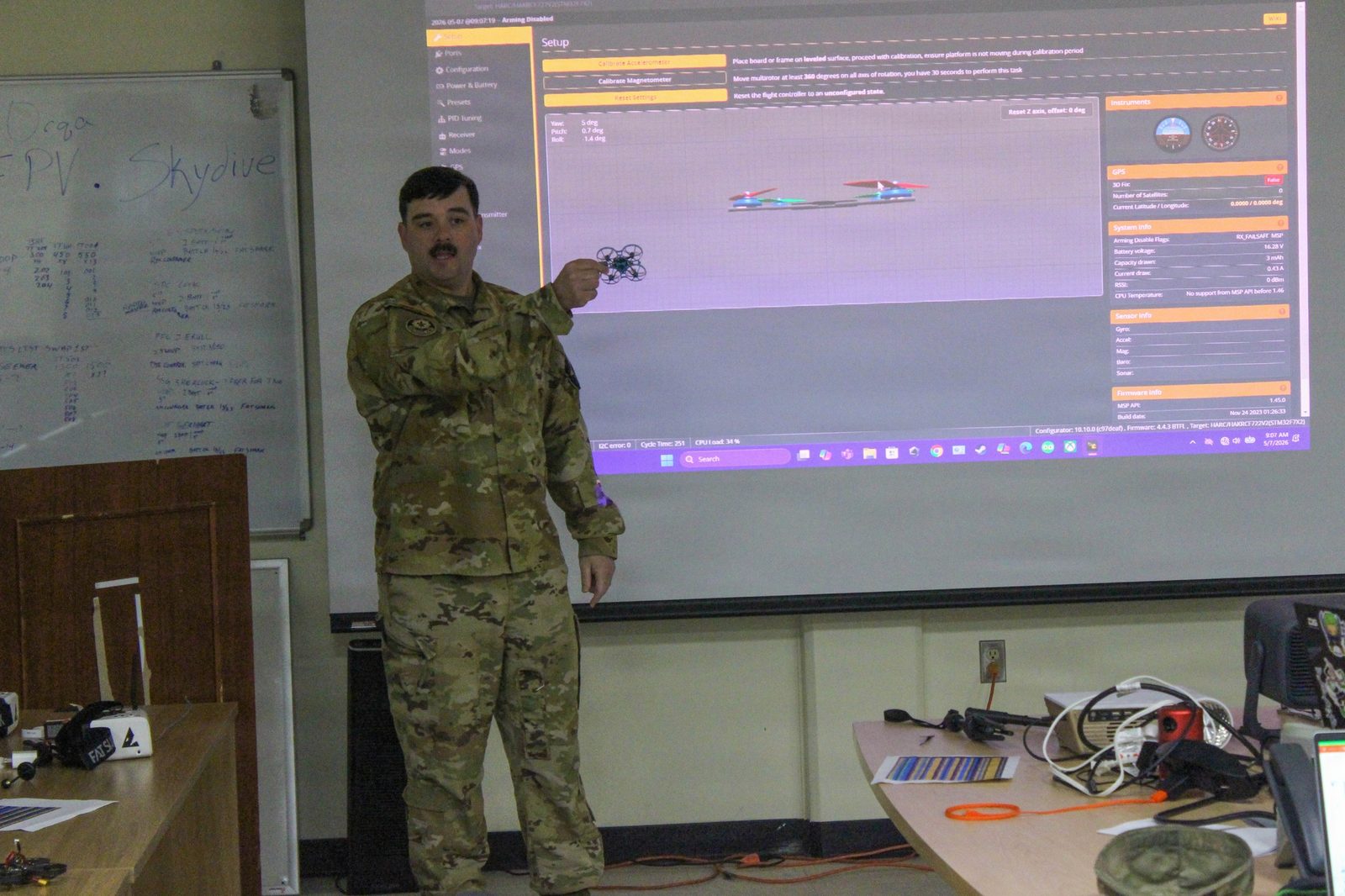
That established pipeline trains soldiers to operate specific, Army-owned aircraft. It does not, by itself, teach soldiers to build, modify or fight with the cheap, attritable FPV drones that have come to define drone warfare in Ukraine. To close that gap, the Army Aviation Center of Excellence at Fort Rucker, Alabama, stood up an entirely new program in 2025: the Unmanned Advanced Lethality Course, which the Army describes as its first formal course covering flying, manufacturing and repairing unmanned systems in one curriculum. The course pairs three weeks of classroom instruction with 20 to 25 hours of simulator time on commercial platforms like Liftoff and VelociDrone, then moves into field exercises built around simulated urban combat, including target-identification runs on reconnaissance drones and live FPV attack-drone practice against balloon targets. It is open to soldiers from any MOS — the first class of 28 mixed infantry, cavalry, aviation and hobbyist soldiers together — and was built in roughly three months. "We're behind globally, and this is our aggressive attempt to close that gap," course director Capt. Rachel Martin said of the effort.
Training the Whole Force, Not Just Specialists
The more consequential shift underway is not a new advanced course — it is a push to give every soldier, not just 15Ws or Unmanned Advanced Lethality Course graduates, basic drone competency. Defense Secretary Pete Hegseth's July 2025 "Unleashing US Military Drone Dominance" memo set the Army on a deadline to field small, one-way attack drones to every squad by October 1, 2026, and the training bill that comes with that mandate is now the Army's most visible near-term challenge. Col. Nick Ryan, director of Army UAS Transformation, has framed the calibration bluntly: a soldier expected to fly cargo drones needs minimal instruction, but "if we have a FPV-style drone that is lethal and armed, and we expect that soldier to hit a very precise target," the training burden looks much more like a specialist skill.
The Army is building that pipeline in layers. At Fort Stewart, Georgia, the Marne Unmanned Center of Excellence — operational since March 2026 — runs soldiers through 40 to 50 hours of virtual drone operation before they touch a real aircraft, progressing from desktop simulators to a 60-seat collective trainer to supervised outdoor flights and finally beyond-line-of-sight courses in wooded terrain. Earlier in the pipeline, the Maneuver Center of Excellence at Fort Benning has folded a 10-hour small-UAS familiarization course directly into One Station Unit Training for infantry and armor trainees, using virtual simulators before live optics and strike-simulation exercises — a course the Army also uses as an early talent-scouting filter. Engineer, CBRN and military police soldiers are getting UAS instruction too, on the reasoning that drones are becoming a tool across occupational specialties, not just a combat-arms weapon. The Air Force has made a smaller, similar move, folding drone familiarization into the Pacer Forge capstone exercise of Basic Military Training. And in February 2026 the Army ran its first Best Drone Warfighter Competition in Huntsville, Alabama, drawing more than 800 attendees to race FPV drones, run hunter-killer field exercises and showcase self-built hardware — an event Ryan described as existing to "inform us what skills we need to train."
The Marine Corps has taken the institutional route, standing up a dedicated command to own this problem service-wide rather than leaving it to individual bases. UASFeed has covered that decision — the stand-up of the Marine Corps Robotics Integration Group at Twentynine Palms — in detail elsewhere; it is worth reading alongside the Army's more decentralized, base-by-base build-out as two different answers to the same workforce problem.
How Other Militaries Are Doing It
The United States is not alone in treating drone literacy as a mass-training problem rather than a niche specialty. South Korea has gone furthest on paper: as UASFeed reported in June, Seoul's Ministry of National Defense wants to train 500,000 "drone warriors" across all four service branches, treating the drone as a soldier's "second personal weapon" alongside the rifle — a scale no other military has publicly committed to matching.
Ukraine offers the opposite model: not a top-down numerical target, but a wartime training economy that grew organically out of necessity. Dronarium Academy, one of the country's larger drone schools, runs a mix of programs out of Kyiv and Lviv — a 14-day FPV drone course covering flight and combat training, shorter multi-day courses in FPV engineering and fiber-optic systems, and free instruction for active-duty personnel alongside paid civilian courses. The academy says it has trained roughly 18,000 people across Ukraine's armed forces, intelligence services, border guards and emergency responders since Russia's 2022 invasion. That compressed, weeks-not-months model — training pilots fast, expecting losses of both drones and proficiency, and iterating constantly — is precisely the lesson the U.S. Army says it is trying to import through events like the Best Drone Warfighter Competition and courses like Fort Rucker's Unmanned Advanced Lethality Course.
Why It Matters
Every one of these pipelines is really an answer to the same question: how many people does a modern military need who can competently operate an unmanned aircraft, and how good do they each need to be? A decade ago the honest answer was "not many" — RPA operations were a specialist mission flown by a small officer corps and an even smaller enlisted sensor-operator community, entirely separate from an Army UAS community that trained a few thousand 15Ws a year at Fort Huachuca. That answer no longer holds. Formations built around one-way attack drones, reconnaissance quadcopters and counter-drone defense need that competency spread across entire squads, not concentrated in a schoolhouse a few hundred graduates deep.
The bottleneck this creates is not hardware — cheap FPV airframes can be bought or 3D-printed by the thousands. It is instructor capacity, training infrastructure and the sheer number of person-hours needed to move a soldier from "has never touched a controller" to "can hit a precise target with a lethal drone under stress." The Army's own timeline makes the stakes explicit: fielding one-way attack drones to every squad by October 1, 2026 is a hardware deadline the service can likely meet through procurement. Whether the training pipeline — Marne Unmanned Center of Excellence, Fort Benning familiarization, Fort Rucker's lethality course, and whatever the Marine Corps' MCRIG ultimately builds — can produce soldiers competent enough to use that hardware safely and effectively on the same timeline is a genuinely open question, and one that South Korea's 500,000-operator plan and Ukraine's wartime academies are both, in their own ways, stress-testing in real time.
Sources
- Halldale Group — The RPA Pilot Training Pipeline
- U.S. Air Force — Remotely Piloted Aircraft Pilot career page
- U.S. Air Force — Remotely Piloted Aircraft Sensor Operator career page
- Task & Purpose — Air Force opens door for select few from the enlisted ranks to become officers
- MOS Roadmap — Army 15W Unmanned Aircraft Systems Operator
- Task & Purpose — Army plays 'catch up' on drone warfare with new operator course
- Breaking Defense — Training, logistics and property accountability: Army preparing for influx of small drones
- Military Times — As the US Army adds drones to formations, here's how one base trains its operators
- DefenseScoop — As the Pentagon goes full-tilt on small UAS, some services are trying to build a new generation of drone-savvy troops from the rip
- C4ISRNET — US Army lets soldiers flaunt their drone skills in first-ever competition
- Dronarium Academy — Drone operator training courses, Kyiv and Lviv
- DVIDS — Warrior FPV Drone Course