
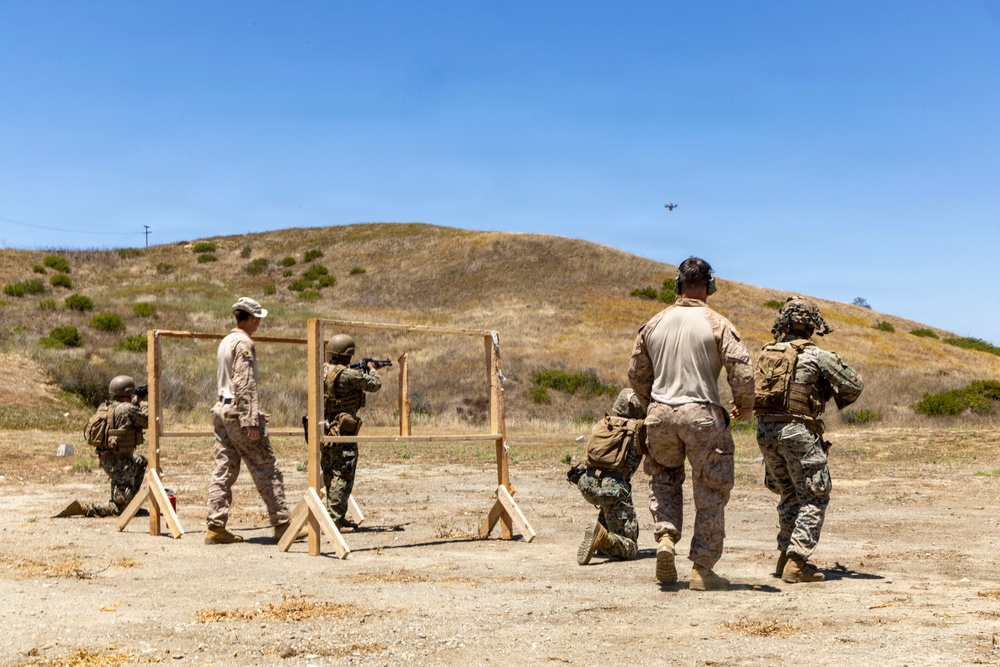
The Marine Corps has created a new institutional home for how it teaches Marines to fly small drones and shoot them down. A MARADMIN issued July 2, 2026, and authorized by Lt. Gen. Thomas B. Savage establishes the Marine Corps Robotics Integration Group (MCRIG) at Twentynine Palms, California, tasking it with unifying training, curriculum development and instructor qualification for Group 1 and Group 2 small unmanned aircraft systems (sUAS) and counter-sUAS (C-sUAS) across the entire service.
Coverage from DefenseScoop on July 6 and Military Times on July 7 filled in how the new organization is meant to operate — and made clear the Corps is already recruiting Marines to staff it.
What MCRIG Actually Does
Per the MARADMIN, MCRIG sits at Marine Air Ground Task Force Training Command (MAGTFTC) at Twentynine Palms and becomes the central authority for Group 1/2 UAS and C-sUAS training and standardization Corps-wide. Its portfolio, as laid out in the order, spans four areas:
- Pilot course development — building out the formal training pipeline for Marines who will operate small drones in the field.
- Curriculum standardization — ensuring units across the Corps are teaching the same tactics, techniques and procedures rather than developing ad hoc, unit-level training that varies from base to base.
- Instructor qualification — setting the bar for who is certified to teach sUAS and C-sUAS skills, a prerequisite for scaling training beyond a handful of specialized units.
- Regional-hub synchronization — coordinating delivery of that standardized training across designated hubs rather than leaving it siloed at individual installations.
Military Times reported that MCRIG's stated purpose is to "standardize service-wide training efforts, institutionalize programs of instruction (POIs), and facilitate delivery across designated Regional Hubs in order to increase readiness." That framing puts the emphasis less on developing new drone hardware or tactics from scratch and more on taking whatever the Corps has already learned — including from its dedicated attack-drone testing unit — and turning it into a repeatable, service-wide training pipeline.
Group 1 and Group 2 — What's In Scope
The Pentagon's UAS classification system sorts drones into five groups by weight, altitude and speed. MCRIG's mandate is scoped to the two smallest and most numerous categories:
- Group 1: under 20 pounds, operating below 1,200 feet and under 100 knots — the small quadcopters and hand-launched fixed-wing platforms increasingly carried by individual squads.
- Group 2: 21 to 55 pounds, operating below 3,500 feet and under 250 knots — larger tactical platforms typically flown at the company or battalion level.
These are precisely the drone classes that have proliferated fastest in recent conflicts, both as friendly reconnaissance and strike tools and as threats Marines must detect and defeat. By explicitly bracketing MCRIG's authority to Group 1/2, the Corps is signaling that the near-term institutional priority is the small, cheap, ubiquitous end of the drone spectrum rather than larger, more exquisite unmanned systems handled elsewhere in the service's structure.
A Separate Lane for R&D
DefenseScoop's reporting notes that the Marine Corps Attack Drone Team will continue its own research, development, test and evaluation work independent of MCRIG, with that work feeding into the training baselines MCRIG standardizes. In other words, the Corps appears to be drawing a deliberate line between the units that experiment with new drone capabilities and tactics and the new organization responsible for turning proven approaches into formal, repeatable instruction. MCRIG is described as a training and standardization body, not primarily an R&D shop.
Recruiting Push Already Underway
The stand-up comes with an active call for personnel. According to DefenseScoop, the Corps is recruiting drone and counter-drone team chiefs, staff noncommissioned officers, intelligence officers and electronic warfare specialists to fill out MCRIG's ranks. Applicants must be eligible for a permanent change of station in fiscal year 2027 and be prepared to commit to assignments lasting 24 to 36 months.
Military Times reported the Corps has specifically announced openings for NCOs and at least one commissioned officer to serve as subject matter experts, all of whom would need to relocate to California to support the new organization. The mix of billets — team chiefs and SNCOs for hands-on training delivery, intelligence officers presumably for threat-informed curriculum, and EW specialists for the counter-drone side of the house — suggests MCRIG is being built as a genuinely cross-functional unit rather than a narrow schoolhouse focused only on flying.
Why It Matters
Small drones have moved from a novelty on the battlefield to a baseline expectation for infantry units, and the threat picture has moved just as fast in the other direction: adversary quadcopters, loitering munitions and first-person-view attack drones are now a standing hazard down to the squad level. Until now, the Marine Corps' response to that shift has been distributed — individual schools, MAGTFs and experimental units each building their own sUAS and C-sUAS training with limited cross-service standardization. MCRIG consolidates that authority into a single organization with the explicit mandate to set curriculum, certify instructors and synchronize delivery across regional hubs.
That matters operationally because inconsistent training is a readiness gap: a Marine trained to fly or defeat drones at one base may receive a different — or no — standard of instruction at another. It also matters institutionally, because standing up a dedicated command signals the Corps views Group 1/2 UAS and C-sUAS proficiency not as a niche specialty but as a core skill set that needs the same kind of centralized schoolhouse treatment traditionally reserved for larger, longer-established warfare disciplines. The recruiting requirements — multi-year commitments, EW and intelligence billets alongside training NCOs — further suggest the Corps expects this to be a sustained institutional investment rather than a short-lived pilot program.
Sources
- Establishment of the Marine Corps Robotics Integration Group (MCRIG) for Group 1 and Group 2 Small Unmanned Aircraft System (sUAS) and Counter-sUAS (C-sUAS) Training and Standardization — MARADMIN 307/26
- Marine Corps establishes robotics integration group for drone and counter-drone training — DefenseScoop
- Marine Corps creates new small drone training unit — Military Times
